
An electric vehicle (EV) traction inverter can drive unwanted current through the motor bearings. Its switching creates voltage on the motor shaft, even without a direct electrical connection between the windings and rotor. If the voltage across a … [Read more...]
Q&A: What the shift to chrome-free coatings means for EV design
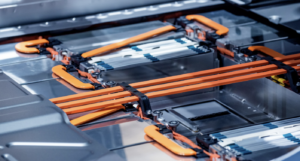
The transition away from traditional chrome-based coatings presents new challenges for electric vehicle (EV) manufacturers. Alternative surface treatments must provide the same level of protection against corrosion and wear while meeting the … [Read more...]
How do two-level and three-level inverter topologies compare in EVs?
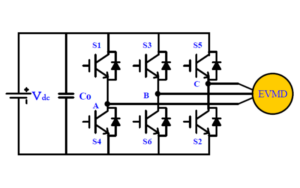
Whenever an electric vehicle (EV) battery bus exceeds 400 V, it poses powertrain design challenges for engineers. One of the key design challenges is the choice of inverter topology, whether a two-level or a three-level inverter topology. Though a … [Read more...]
Inside the development of the Megawatt Charging Standard

The publication of International Electrotechnical Commission (IEC) standard 61851-23-3 establishes the international requirements for the Megawatt Charging System (MCS), developed to meet the charging needs of electric trucks and other heavy-duty … [Read more...]
How does fault-tolerant control keep an EV operating after a sensor failure?
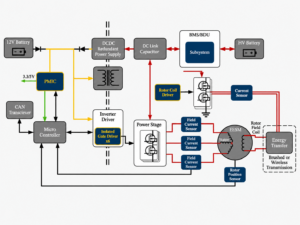
The rotor in an electric vehicle (EV) traction motor delivers torque through the motor shaft to the drivetrain. A rotor-position sensor, such as a resolver, reports the rotor angle needed for accurate torque control. If the sensor fails, … [Read more...]
Q&A: How EV architectures are changing high-speed connectivity

As electric vehicles (EVs) add more cameras, radar, and other high-bandwidth sensors, the amount of data moving through the vehicle continues to grow. At the same time, those data links have to operate alongside high-voltage power electronics … [Read more...]
How to catch EV faults before they become failures
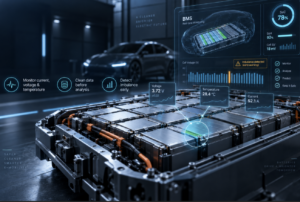
Most electric vehicle (EV) battery failures do not happen out of nowhere. Long before a pack trips into a protective shutdown, there are usually small signs sitting quietly in the data, a cell running a few millivolts higher than its neighbors, or a … [Read more...]
How do busbar design and stray inductance affect EV power electronics?
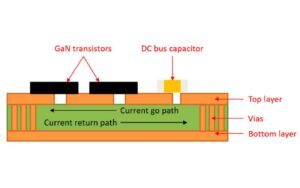
Silicon carbide (SiC) or gallium nitride (GaN) switching operations are limited by the busbar stray inductance because the inductance is present in the commutation loop. It's through the commutation path that current travels through the dc bus … [Read more...]
Q&A: How do battery-pack design choices affect EV assembly?

Battery-pack assembly becomes significantly more difficult as pack architecture evolves. The challenge is not simply moving a heavy component through a production line. The pack has to remain correctly positioned throughout assembly while the process … [Read more...]
Engineering reliable charging hubs for autonomous EV fleets

Autonomous ride-hailing fleets need somewhere to recharge between trips, and that’s often a dedicated charging hub rather than a public station. These hubs can look a lot like large dc fast charging sites, but they’re used very differently. A … [Read more...]
How is EV charging interoperability tested?
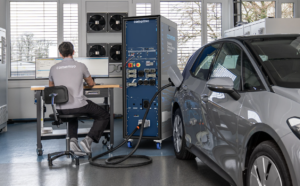
A connector that physically fits an electric vehicle (EV) inlet does not guarantee a safe, successful charging session. Electrical or communication differences can halt energy transfers, while backend issues may prevent authorization or transaction … [Read more...]
Q&A: How adaptive charging responds to shifting battery limits

Fast charging has become a design target in electric vehicle (EV) engineering. However, the amount of current a pack can safely accept changes with temperature and battery condition. Cold slows lithium transport into the anode and increases … [Read more...]
Part II: What CT can reveal about EV component design

X-ray computed tomography (CT) can reveal the internal structure of electric vehicle (EV) components without requiring disassembly. The technology gives engineers a way to examine how a component is built while preserving the relationships between … [Read more...]
Part I: How x-ray CT can improve EV component inspection and validation
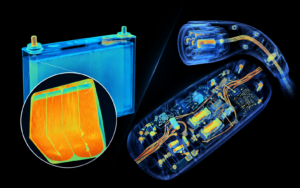
X-ray computed tomography (CT) gives engineers a way to inspect the inside of an electric vehicle (EV) component without taking it apart. The technology creates a three-dimensional view of an assembled part so internal features can be examined while … [Read more...]
Q&A: How GaN can improve EV power architectures
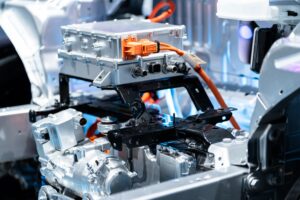
Gallium nitride (GaN) is moving into higher-power electric vehicle (EV) applications as engineers look for ways to improve power-conversion efficiency and reduce the size of vehicle power electronics. While GaN is already established in lower-power … [Read more...]
How can EV systems be reliably tested for cybersecurity vulnerabilities?

Electric vehicle (EV) cybersecurity testing is performed throughout the vehicle development lifecycle. EVs can contain dozens of electronic control units (ECUs) and a battery management system (BMS), communicating over the controller area network … [Read more...]