The publication of International Electrotechnical Commission (IEC) standard 61851-23-3 establishes the international requirements for the Megawatt Charging System (MCS), developed to meet the charging needs of electric trucks and other heavy-duty vehicles.
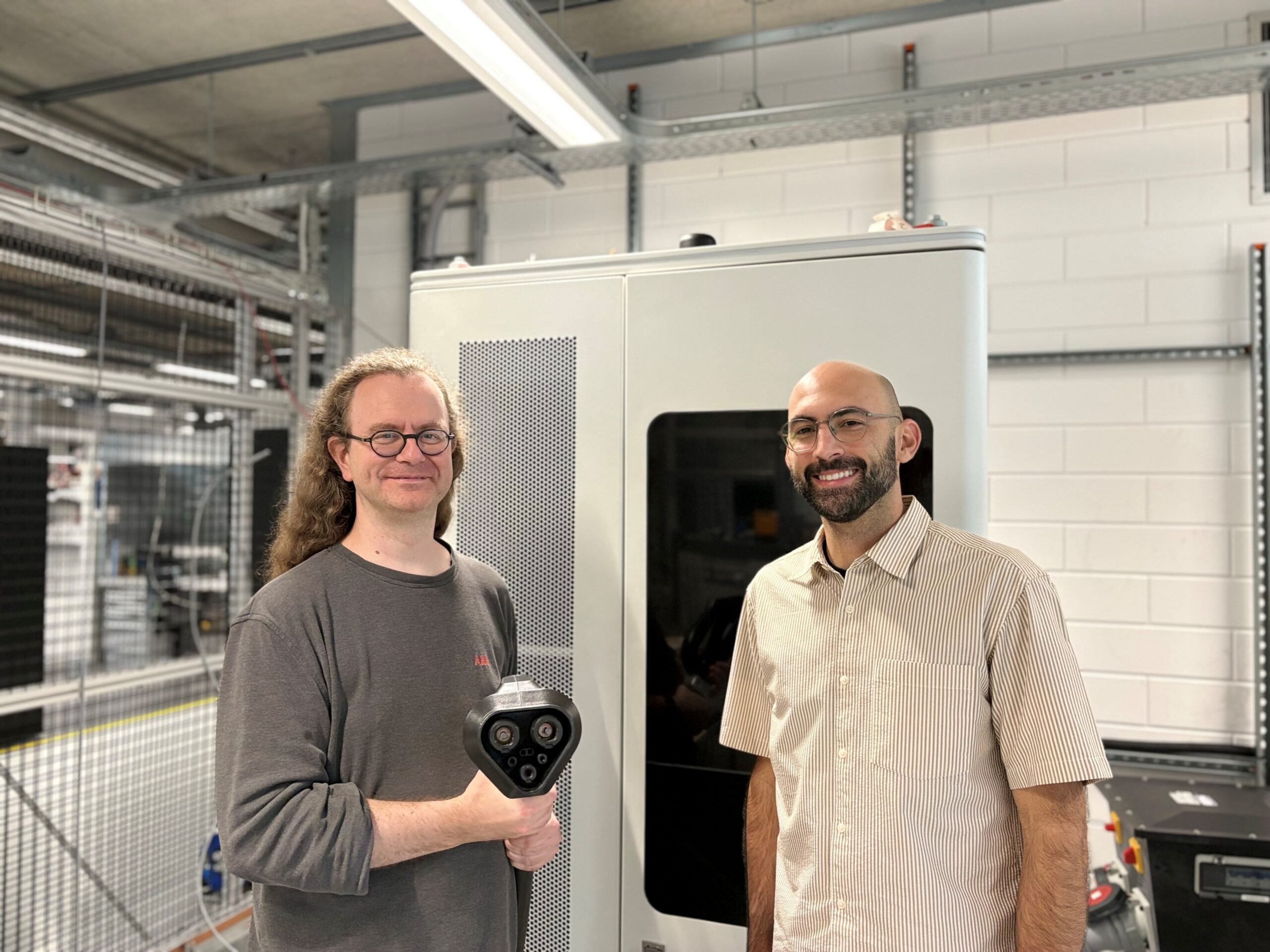
Stefan Raaijmakers, Principal Engineer and Miguel Rodríguez Escudé, Senior R&D engineer, ABB E-mobility
In this interview, Stefan Raaijmakers, principal engineer, and Miguel Rodríguez Escudé, senior research and development (R&D) engineer, both with ABB E-mobility, discuss their roles in the development of IEC 61851-23-3 and the broader MCS initiative.
ABB E-mobility was the first company to implement CHAdeMO in Europe. It also co-developed the Combined Charging System (CCS) standard and was involved in the first versions of those documents.
Drawing on that experience, Raaijmakers and Rodríguez Escudé share insights into the engineering decisions, industry collaboration, and technical challenges that helped shape the next generation of commercial electric vehicle (EV) charging.
Here’s what they had to say…
What was the MCS standard designed to solve?
Raaijmakers: A lot of the early work was about defining the use cases. One of the more difficult use cases is a coach where you have a bus full of people and two drivers. They can drive continuously, switching drivers, but you may get only one opportunity to charge. That has to happen within a small window of time, and then the bus goes back again. That’s one of the reasons we ended up with 3,000 amps as a minimum requirement.
The other issue was what we had already seen with CCS. Originally, we designed for 500 volts, and we went to 1,000 volts fairly quickly, faster than expected. For vehicles, it can make sense to have a higher voltage and lower current because that makes them more efficient. We investigated how far we could stretch that while keeping the same safety requirements. That’s why we ended up with 1,250 volts for MCS.
Right now, systems are still around 1,000 volts, but we expect vehicles to want to go higher in the future. So, it’s future-proofing.
Rodríguez Escudé: That’s one of the things you see when people talk about charging power. They say, “You can do this amount of power,” but maybe you can do it only for a minute. For a passenger car, that can be okay.
The first-generation trucks were around 300 or 400 kWh with CCS. Now, with MCS, you’re seeing 800 kWh, and maybe eventually you go to 1 MWh, 1.2 MWh, plus an e-trailer that could be connected to the dc bus. Maybe in six years you have 1.5 MWh of battery that you need to charge.
And you’re still trying to charge during the compulsory rest periods, which in Europe are 45 minutes after 4.5 hours of driving. So, you have to think about not only the peak power, but how long you need to sustain it.
Why was the connector such a difficult engineering problem?
Raaijmakers: How do you make a connector that’s capable of delivering these high powers, but is still operable by an ordinary person without any special training? The connector manufacturers went through three main iterations. The original design that was selected could do 2,000 amps, and after that there was a redesign for higher current.

Megawatt charging infrastructure is designed to deliver sustained high power within the limited charging windows typical of heavy-duty vehicle operation.
In the development, there were three scenarios we were looking at in the standardization committees. One is a non-cooled cable and a non-cooled inlet. That should be able to charge comfortably at least up to 500 amps without any problems.
Then you have a cooled cable and a non-cooled inlet, which should at least be able to do 1,500 amps. And if both the inlet and the cable are cooled, you could do at least 3,000 amps with this connector.
There’s quite a lot of margin in the design. Overnight, you don’t need more than 500 amps. For now, most vehicles don’t have a cooled inlet. With 1,500 amps, charging for 45 minutes is enough for a 700- or 800-kWh battery.
The whole industry is quite conservative in these things. But we know from experience that all of this will increase over time.
Rodríguez Escudé: For the cooling, with the currents we are expecting with MCS, the copper losses on the cable play an important role. This limits the cable length and requires a thorough thermal analysis to have reliable performance at high ambient temperatures.
The contacts went through a few improvement iterations to reach the current version, which have more contact surface and are better optimized for thermal performance while keeping the IPxxB requirements for touch-safety.
But I think it’s important to point out that MCS is not only about power or current. The system is designed for a wider voltage and current range. We have increased the specifications for the short-circuit current you can expect from the vehicle because it has bigger battery packs, so the system needs to withstand it to keep the user safe.
You can still build an MCS system at 200 kilowatts and have those benefits. You’re not forced to build a one-megawatt system.
What has to happen if something goes wrong during charging?
Rodríguez Escudé: For the shutdowns, we kept the same values and the same logic as CCS. The EV or electric vehicle supply equipment (EVSE) detects an emergency condition, and they have 10 milliseconds to change the control pilot and signal to the counterpart, “Hey, there’s something wrong. I’m doing an emergency shutdown.”
That’s much more reliable than digital communication. After that, you have another 10 to 20 milliseconds to reduce the current down below 5 amps.
That’s also related to the disconnection sequence of the pins. Imagine the connector isn’t locked and you pull it out. The control pilot disconnects first, so that’s your emergency situation, but the dc pins are still connected because they’re longer. That gives you time to trigger the shutdown and reduce the current before the dc pins disconnect.
Otherwise, you can have an arc. So, a lot of those requirements came from CCS. We said, “Okay, this still works, the way we specified it makes sense and the test procedure makes sense. Let’s adapt the parameters.”
Raaijmakers: And we tested this. We even did kind of an internal competition to see who could remove the connector the fastest. I think the fastest was something like 18 milliseconds between disconnecting the pilot pins and disconnecting the dc pins.
That’s important because if the difference between losing the control pilot and losing the dc pins is too small, you cannot ramp down fast enough to prevent arcing. And you don’t want to do that with MCS.
How do you test these requirements without running a full-power charging session every time?
Rodríguez Escudé: We also have the test houses in the standardization committee, and vendors of the test devices, because they’re looking at, “How do I need to improve my system so I can test this and certify it?”
We tried to simplify the tests as much as possible. You don’t want to need a one-megawatt charging session every time you’re going to verify something. You also don’t want a test house to spend millions building a test setup to test two chargers per year.
One example was measuring the reaction to over-temperature at the pins. You could be doing a session at 1,500 amps and then add more heat to the pin, but that’s just more complex.
So, we said, “Okay, what do we want to test?” We want to know that at 100° C, measured at the pins, the charger derates or shuts down.
You can do a session without current. You have voltage there, so the charging session is ongoing, but the request from the vehicle is zero. Then you warm up the pins through an external source, increasing the temperature. The charger sees 70°, 80°, 90° C, and when it reaches 100° C, it has to react.
Your test system is much simpler, and it’s safer. The fewer high-power tests required, the better. Those were some of the considerations when we specified the tests in the standard.
How did the committee build on the CCS standard to develop MCS?
Rodríguez Escudé: For MCS, we took the template of the CCS charging standard and went clause by clause: What needs to be improved here? In some clauses, the requirements are fairly similar. Then you get to something like the thermal requirements and say, “Okay, how do we handle this? How do we test it?”
So, we went section by section and defined what’s needed, what’s missing, and what we know. And sometimes, if we don’t know something, we create a small group of experts to investigate. If it’s surge protection devices, let’s ask the manufacturers.
If it’s short-circuit ratings, do we need to verify something with the connector manufacturers? Then we set up a workshop or even see if a company can support a research project. This gives us additional information to define clear and realistic requirements for the industry.
Raaijmakers: That approach, evaluating and improving on the CCS standard, is how we arrived at one of the most significant aspects of the new standard, the new communication interface. By using single-twisted-pair Ethernet, we have a robust industry standard that is future-proofed while at the same time well supported by suppliers today.
Rodríguez Escudé: Of course, when the wider industry is at the table, there are always a lot of disagreements, as you can imagine. You need to give space for different opinions, solutions, and concerns, to reach an agreement on how to handle a technical issue.
You also don’t want to over-engineer something. Maybe you can specify something that’s fast, but why force something to react in a microsecond if you can do it in 10 milliseconds while keeping the required safety? You want to keep the balance and define requirements that can still improve, so you’re not locking in a solution and preventing further innovation.
Raaijmakers: It’s ultimately about consensus, and relying on a deep pool of industry expertise. That’s how we achieve a standard that can meet the demands of the industry today and tomorrow.
Filed Under: Charging, Featured Contributions, Q&As