Battery-pack assembly becomes significantly more difficult as pack architecture evolves. The challenge is not simply moving a heavy component through a production line. The pack has to remain correctly positioned throughout assembly while the process stays within increasingly tight manufacturing tolerances.

Dr. Andreas Letsch, Director of Factory Automation Battery, Bosch Rexroth
That becomes even more important as manufacturers move toward cell-to-pack and structural battery designs. Larger cell stacks can place greater demands on handling equipment, while the battery itself is becoming more closely integrated with the vehicle structure.
In this interview, Dr. Andreas Letsch, Director of Factory Automation Battery at Bosch Rexroth, discusses how battery-pack design decisions affect the assembly process. He explains how manufacturers account for variation during production and why the workpiece carrier can become such an important part of the process.
He also looks at how handling changes as packs become electrically live and how newer battery architectures are affecting the way assembly lines are designed.
Here’s what he had to say…
Which EV battery-pack design choices create the greatest challenges once the pack reaches assembly?
The greatest assembly challenges usually come from design choices that increase part count, interface complexity and tolerance sensitivity. Every additional part adds dimensional variation, additional handling steps, more logistics effort and more opportunities for misalignment. This directly affects material flow, transport concepts, and cycle time, especially when the goal is to maintain high throughput in pack assembly.
A second major challenge is created by tolerances that are directly linked to product performance. A good example is the application of thermal interface material. In high-power battery packs, the amount and distribution of the thermal interface material must be tightly controlled to ensure optimal thermal performance. Too little material can reduce thermal contact; too much can create assembly force issues, squeeze-out or dimensional conflicts. Therefore, pack designs with many thermally critical interfaces require more precise dispensing, positioning and process control during assembly.
In short, the biggest assembly challenge is a high-performance super sports car battery pack with a large number of small cells, because it combines maximum part count, tight tolerances, complex material handling, and highly performance-critical thermal interfaces.
How do engineers account for pack deflection during lifting and transfer, and how does it affect structural reinforcement or lifting points?
There are different concepts for this, and they’re highly vehicle specific. In the end, the battery pack must fit into the vehicle, and since the battery is increasingly an integral part of the vehicle structure, OEMs apply different design strategies for reinforcement, deflection control, and lifting points.
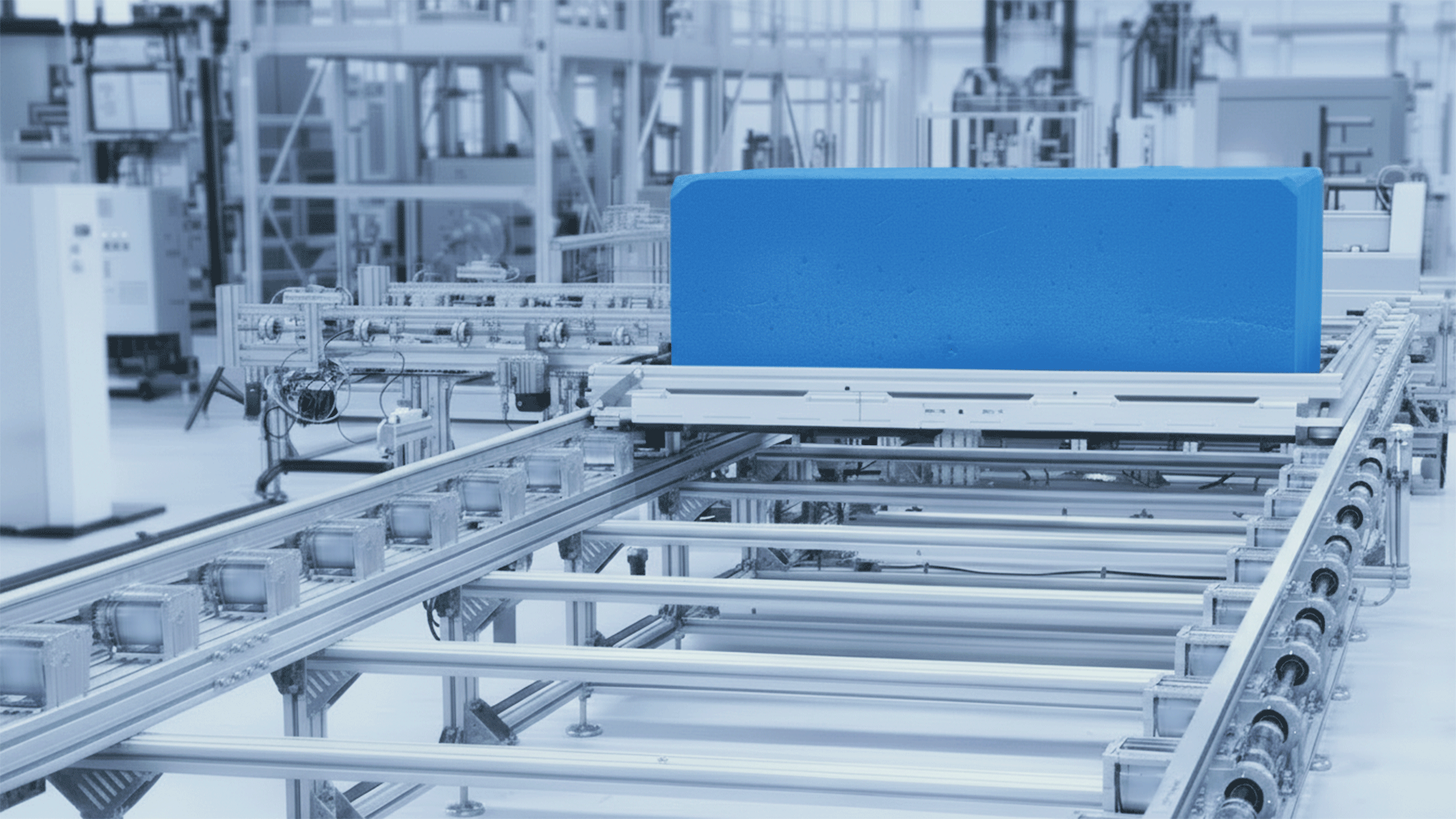
Heavy battery packs and their workpiece carriers place significant demands on material handling systems during assembly. (All images courtesy of Bosch Rexroth)
From an assembly perspective, the most important element is the workpiece carrier. It must keep the battery pack in the correct shape and position throughout every assembly step. This often results in complex fixtures, which in some cases can even exceed the weight of the battery pack itself.
That makes the heavy-load conveyance system equally critical. It must ensure that the pack and its carrier can be moved safely and precisely, while allowing all process steps to be performed efficiently within the required tolerances.
What tolerance stack-up must be accommodated between the battery pack, vehicle structure, and positioning equipment?
The tolerance stack-up between the battery pack, vehicle structure and positioning equipment is driven by three main factors, the dimensional accuracy of the pack enclosure, the larger tolerances of the vehicle underbody, and the repeatability of the assembly equipment. While the battery tray itself can be manufactured with relatively tight tolerances with approx. 0.2mm for a CNC-machined or casted part, the vehicle body typically shows larger variations due to welding, joining, and body-in-white processes (approx. 1 to 2 mm).
In addition, the factory automation equipment like lifting systems, automated guided vehicles (AGVs), robots, and vision systems introduce their own positioning tolerances; however, these are addressed in the machinery to enable a robust assembly.
Where is that variation typically absorbed?
The above-introduced variations must be absorbed during assembly to avoid misalignment, bolt issues, interference or structural pre-stress. Typical solutions include pin-and-slot concepts, oversized clearance holes, floating or self-centering interfaces, and compensating shims or collars in the z-direction. The key is to define where the variation is allowed to move, and where the battery pack must be precisely located.
Equally important is the early alignment between vehicle and battery product engineering, the manufacturing organization, and the machine builders supplying the assembly equipment. This coordination is critical to ensure high quality, stable processes and high line availability, because this is the point where some of the most expensive components of an electric vehicle are finally joined together. Battery production equipment must also provide the required availability, process quality, throughput and positioning accuracy across material handling, conveyance, and joining operations.
Do cell chemistry and cell format materially change handling requirements, or are those requirements driven primarily by pack mass and geometry?
Cell chemistry is typically not the main driver for assembly handling requirements. The cell size and cell format are more relevant. In general, hardcase cells are significantly easier to handle than pouch cells, because they’re mechanically more robust and easier to position, grip and transport.
Looking at the complete battery pack, mass and geometry are the first indicators for the required handling concept. However, the required tolerances and assembly processes also have a major impact, especially on the design and weight of the workpiece carrier. Therefore, selecting the right transport system for pack assembly must consider the battery pack and the workpiece carrier. In practice, the combined weight can easily exceed two tons.
At what point in assembly does a battery pack become electrically live, and how do movement and handling requirements change after energization?
Each individual cell is already electrically active when it arrives at the assembly line, typically at around 30% state of charge. Once the cells are electrically connected, the complete battery pack becomes electrically live and behaves like a partially charged high-voltage battery pack. There’s normally no additional “energization” step during assembly.
From this point on, handling and assembly requirements become more demanding. Only specially trained “high voltage” personnel are allowed to work on the pack, and the process must be designed to prevent accidents. This is particularly true for those creating a short circuit. This includes, for example, insulated tools for screwdriving operations and additional monitoring systems to detect heat, smoke or fire at an early stage.
In the event of a thermal runaway or overheating, the affected battery pack is immediately routed off the main assembly line to an isolated, automated fire-rejection lane (or thermal buffer zone). It’s then typically transported to an outdoor containment area where it’s submerged in a specialized cooling bath or sealed inside an inert-gas extinguishing container.
How have handling requirements changed as battery packs move from module-based designs toward cell-to-pack and structural architecture?
As battery packs move from module-based designs toward cell-to-pack and structural architecture, two main challenges arise.
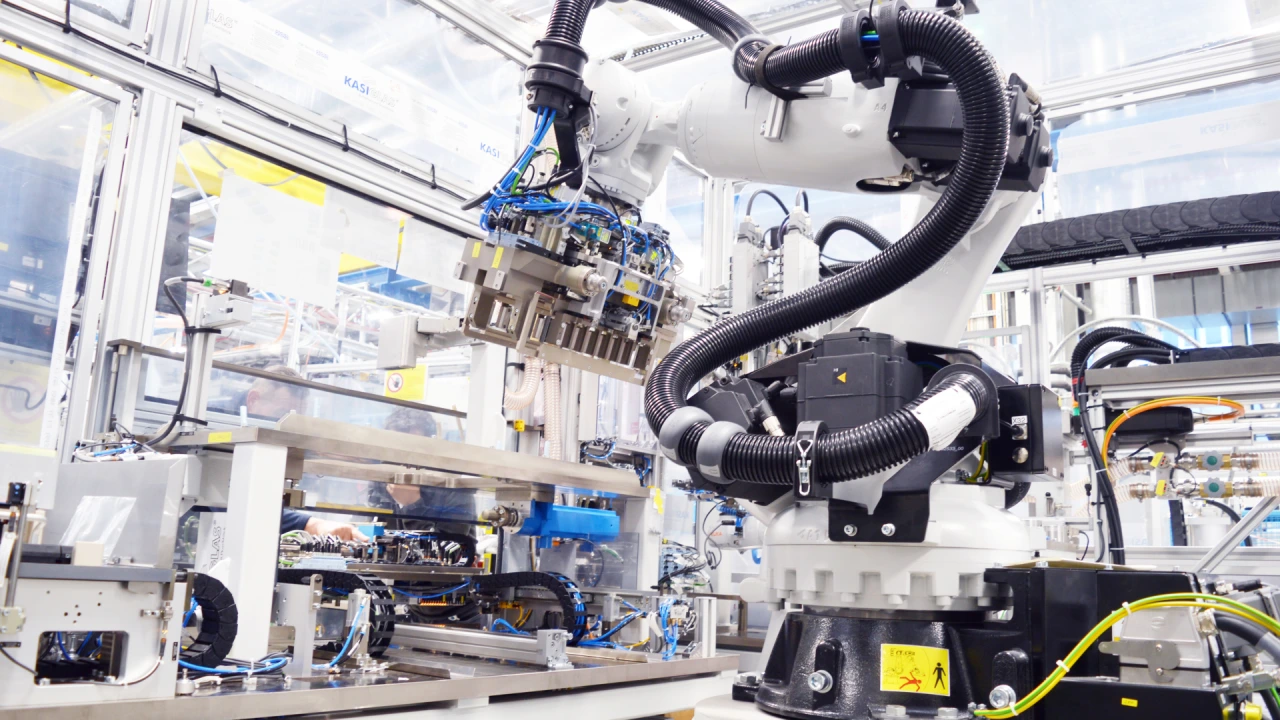
Automated battery-stack assembly requires precise positioning and process control as cell stacks become larger and heavier.
First, the number of parts handled directly on the cell-to-pack line increases significantly compared with a classical module-line approach. Processes that were previously applied to shoebox-sized modules now must be applied to much larger cell stacks, which can be up to nearly two meters long. This means more parts, higher throughput requirements, and larger tolerance stack-ups due to the increased number of components and joining processes that still need to be performed with the same precision, but at higher speed.
Second, these cell stacks are much heavier than traditional modules. As a result, an already challenging module-assembly process becomes even more demanding. Precise machinery and robust processes are required, including handling and transport systems that can accommodate different weights and formats. During stack compression, both force and travel must be controlled accurately to stay within the required tolerances.
Another important aspect is safety. Due to the higher number of cells in a cell stack compared with a conventional module, the stack itself may already qualify as a high-voltage component, which has a direct impact on handling, process design, and worker safety requirements.
Filed Under: Featured Contributions, Q&As