
As of late 2025, the US had over 12,300 EV charging stations and nearly 64,500 individual charging ports deployed.
Electric vehicle (EV) charging continues to evolve in response to higher power levels, new vehicle architectures, and expanding use cases across home, public, and fleet environments.
Throughout 2025, engineers addressed charging challenges that span power electronics, thermal management, safety systems, battery behavior, and operational control, often across both the vehicle and infrastructure sides of the interface.
Charging performance and reliability are increasingly shaped by how voltage, current, heat, materials, and control strategies interact across the system. Design decisions related to onboard chargers, powertrains, connectors, cooling methods, and grid integration now influence not only charge time, but safety margins, battery health, and long-term operating cost.
The articles below highlight key EV charging–related engineering topics published throughout 2025. Each focuses on a specific aspect of charging system design, operation, or future development, offering practical insight into how charging requirements are influencing vehicles, infrastructure, and energy management at scale.
How do onboard chargers differ between 400 and 800-V EV architectures?

A 25-kW fast dc EV charger consisting of 1200-V rating SiC half-bridge modules. (Image: onsemi)
The move from 400 to 800-V onboard charger architectures reflects a broader push toward faster charging and higher power density in EVs. Higher system voltage reshapes the power electronics stack, driving adoption of wide-bandgap semiconductors such as 1200-V SiC MOSFETs and emerging GaN devices.
These technologies support higher blocking voltage, faster switching, and improved efficiency while enabling more compact charger designs.
Higher voltage operation does not inherently increase losses. Adjustments to transformer turns ratios reduce secondary-side current, lowering copper and diode conduction losses and, in some cases, delivering lower total losses than comparable 400-V systems at the same power level. Control and magnetics design also evolve, with higher switching frequencies and wider voltage swings increasing the need for microcontrollers (MCUs) with higher-resolution analog-to-digital converters (ADCs) and more precise pulse-width modulation (PWM) control.
Overall, these changes position 800-V onboard chargers as system-level redesigns that enable faster, more efficient EV charging rather than simple voltage upgrades.
Why residual current monitoring is critical for ac charging in EVs
As ac charging infrastructure expands and bidirectional use cases such as V2X become more common, residual current monitoring has become a critical safety requirement in EV charging systems. Ac chargers rely on onboard chargers to convert grid power for battery charging and, in bidirectional configurations, to export energy back to external loads. These operating modes introduce the risk of ac and dc leakage currents, making accurate detection essential to protect users and equipment from electric shock while avoiding nuisance interruptions.
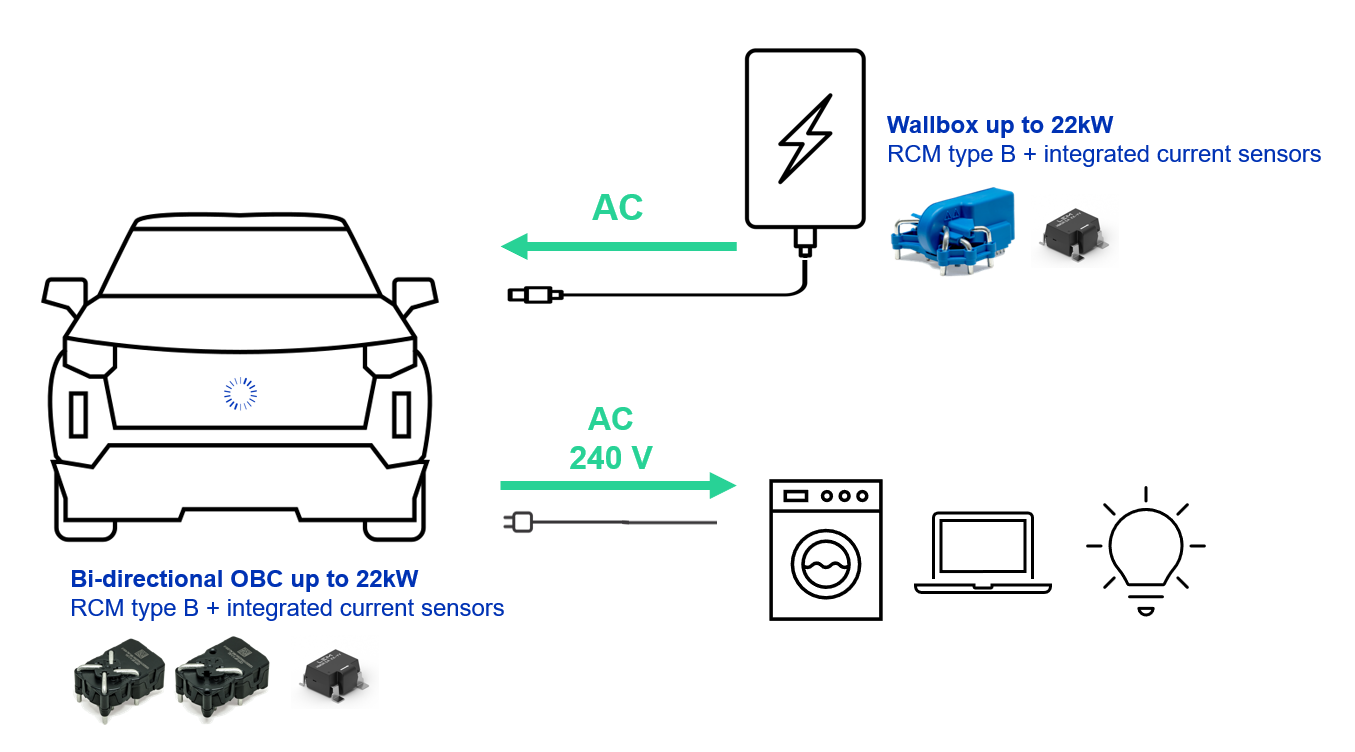
Example of bidirectional ac charging enabled by RCM type B devices with integrated fluxgate-based current sensors. These systems support energy flow to and from the vehicle, powering household appliances or feeding back to the grid in V2X scenarios. (Image: LEM)
Conventional Type-A residual current devices struggle to detect dc leakage reliably, creating safety gaps in modern EV charging scenarios. Automotive-grade residual current monitoring solutions, particularly those based on fluxgate sensing technology, provide precise detection of low-level ac and dc leakage currents across single and three-phase systems. Their integration into wallboxes, charging cables, and bidirectional onboard chargers supports compliance with evolving safety standards while enabling reliable ac charging and energy export.
As charging systems grow more complex, residual current monitoring has become a foundational element of safe and scalable EV charging design.
How high-power dc fast chargers manage heat and impact EV batteries
High-power dc fast chargers now operate at power levels approaching 500 kW, pushing current densities to the point where thermal management defines system performance and safety. Heat generation increases sharply at these power levels, making liquid cooling essential for power electronics, cables, and connectors.
Modern chargers rely on closed-loop water-glycol cooling systems, while liquid-cooled EVSE connectors focus cooling directly at high-current contact points to sustain ultra-fast charging rates that air-cooled designs cannot support.

An illustration of a liquid-cooling system used in CHAdeMO charging cables and connectors, showing coolant flow, integrated cooling tubes, and temperature sensors for efficient thermal dissipation. (Image: Fujikura)
Thermal control extends into the vehicle, where battery thermal management systems regulate pack temperatures within a narrow operating range during high C-rate charging. Liquid-cooled battery systems provide precise temperature control that limits degradation mechanisms such as lithium plating, electrolyte breakdown, and excessive solid-electrolyte interface growth.
While laboratory studies associate fast charging with accelerated aging at high states of charge, real-world data indicates that effective thermal management and charging control strategies can preserve battery health even with frequent use of dc fast charging.
Designing EV powertrains for high voltage and ultra-fast charging
Ultra-fast charging is reshaping EV powertrain architecture by pushing vehicles toward higher operating voltages and more advanced power electronics. Platforms in the 800 to 1,000-V range reduce current for a given power level, lowering resistive losses, thermal load, and cable mass while enabling significantly faster charging. Supporting these voltages requires coordinated changes across traction inverters, dc-dc converters, onboard chargers, and thermal management systems, particularly when bridging compatibility with legacy 400-V charging infrastructure.
Wide-bandgap semiconductors are central to this transition. Silicon carbide enables high-efficiency, high-voltage operation in inverters, dc-dc converters, and onboard chargers, supporting higher switching frequencies, reduced losses, and smaller magnetics. Gallium nitride is emerging in 400-V systems where high power density and fast switching are prioritized. As architectures approach 1,000 V, challenges extend beyond efficiency to include electromagnetic interference, insulation and clearance requirements, post-crash discharge safety, battery management complexity, and thermal competition with cabin systems. The result is a tighter coupling between charging capability and powertrain design, making voltage selection and semiconductor choice system-defining decisions rather than isolated optimizations.
Why EV engineers are turning to liquid-cooled charging systems
As dc fast-charging currents climb beyond 350 A, connectors and cables are becoming a primary limiting factor in charging system design.

A liquid-cooled charging cable assembly showing integrated temperature sensors within the power contacts for precise thermal monitoring during high-current dc fast charging. (Image: Mouser)
Conventional air-cooled cables struggle to dissipate heat at sustained high currents without becoming thick, heavy, and difficult to handle. Liquid-cooled charging systems address these constraints by removing heat directly from conductors and contact interfaces, enabling higher current density while maintaining manageable cable size and ergonomics.
Liquid cooling allows fast chargers to sustain high power levels without thermal throttling, improving station uptime and charging consistency. By stabilizing connector temperatures, these systems reduce contact wear, limit oxidation, and prevent derating under continuous use. While liquid-cooled designs introduce added complexity in sealing, coolant management, and cost, they’re becoming essential as charging power pushes toward 400 to 500 A and beyond.
For high-power charging infrastructure, liquid-cooled cables and connectors are emerging as a key enabler rather than an optional enhancement.
How could advances in solid-state batteries impact EV charging designs and requirements?
Advances in solid-state battery materials are expected to reshape EV charging design by tightening requirements around voltage control, thermal management, and mechanical stability. Sulfide-based solid electrolytes offer high ionic conductivity and fast charge potential but introduce narrow voltage windows, pressure sensitivity, and dendrite risks that demand more precise charging protocols. Oxide-based electrolytes provide stronger air stability and higher voltage tolerance, simplifying connector design and enabling higher-voltage charging, though manufacturing constraints influence pack architecture and system integration.

Comparison of conventional lithium-ion and solid-state batteries, highlighting key differences, including the solid electrolyte that functions as a separator. (Image: muRata)
Polymer-based solid electrolytes improve safety and electrode contact stability, allowing more flexible charging behavior, but lower ionic conductivity limits achievable charge rates. Across all solid-state variants, charging systems must balance speed with tighter control of temperature, voltage, and interface conditions than is typical for liquid electrolyte batteries. While alternative chemistries such as metal-air, sodium-based, zinc-ion, and magnesium-ion systems show promise, they remain constrained by maturity and integration challenges.
These developments indicate that future EV charging designs will be increasingly shaped by battery material properties rather than charging hardware alone.
What is the future of onboard and offboard EV charging?
The future of EV charging is being shaped by a balance between onboard and offboard solutions, each optimized for different use cases. Onboard chargers support convenient ac charging at home and work, where efficiency, cost, and grid integration matter more than speed. Advances in wide-bandgap semiconductors, bidirectional charging, and smart charging controls are improving onboard charger performance, but power levels remain limited compared to external dc fast chargers.
Offboard charging systems handle the demands of long-distance travel and high-utilization vehicles by shifting power conversion out of the vehicle and into high-power dc infrastructure. Ultra-fast chargers paired with 800-V vehicle architectures enable significantly shorter charging sessions, while charging hubs integrate load management, renewable energy, and energy storage to reduce grid strain.
Rather than converging on a single approach, EV charging is evolving toward a hybrid model in which onboard and offboard systems complement each other, balancing convenience, speed, infrastructure cost, and energy management across a growing range of applications.
How are V2X and V2E reshaping EV power architecture?
Vehicle-to-Everything (V2X) capabilities are turning EVs into flexible energy assets, with Vehicle-to-Equipment (V2E) standing out as the most practical near-term application.

The five V2X applications driving bidirectional power architecture evolution in EVs. (Image: ResearchGate)
V2E enables EVs to deliver standard ac power directly to external loads using onboard inverters, allowing vehicles to function as mobile power sources without relying on grid synchronization or external bidirectional chargers. This simplicity positions V2E as a natural entry point into bidirectional power architectures.
Enabling bidirectional operation requires fundamental changes to EV power architecture. Modern designs use multi-stage, bidirectional onboard chargers that separate grid interface, battery management, and power export functions for improved efficiency and control.
Advanced dc-dc converter topologies and wide-bandgap semiconductors, including silicon carbide and gallium nitride, support higher switching frequencies, improved efficiency, and increased power density.
These developments position EVs as active participants in the energy ecosystem, capable of consuming and supplying power.
How AI is supporting EV fleet operations
As EV fleets scale, charging success depends less on installed hardware and more on day-to-day operational coordination. Fleet operators must align vehicle routes, state-of-charge targets, energy tariffs, charger availability, and uptime requirements, often across large depots with limited grid capacity. AI-enabled platforms are emerging to manage this complexity by integrating data from vehicles, chargers, utility pricing, and fleet operations into a single decision layer.

AI-enabled platforms connect vehicles, chargers, and grid systems to keep fleets charged and mission-ready. (Image:
AI supports fleet charging by optimizing charge schedules to match routes and duty cycles, shifting load to off-peak periods, and reducing exposure to demand charges. Predictive analytics applied to charger and vehicle data help identify faults, incomplete charging events, and early signs of equipment failure before they impact operations. Combined with human oversight through network operations centers, these systems improve charger uptime, reduce operating costs, and ensure vehicles are deployment-ready. In this context, AI becomes a critical enabler of reliable, scalable EV charging for fleet operations rather than a standalone optimization tool.
How fast and ultra-fast charging are changing the overall EV experience

Several key players in the e-mobility space plan to expand Plug & Charge interoperability and accessibility. The goal is to streamline EV charging across global markets, making it easier for charge point operators, vehicle manufacturers, and software providers to work across different networks and systems.
Fast and ultra-fast charging have become central to EV adoption, with charging power now ranging from 50 kW to well beyond 350 kW. These higher power levels are reducing charging time from nearly an hour to well under 30 minutes for compatible vehicles, narrowing the gap with conventional refueling.
Achieving these speeds depends on coordinated advances in vehicle architecture, power electronics, and charging infrastructure, particularly the shift toward 800-V platforms that reduce current, heat, and cable bulk while enabling higher sustained power delivery.
Thermal management, liquid-cooled charging cables, and high-efficiency power electronics allow ultra-fast chargers to operate reliably at hundreds of amps without derating. At the same time, standards such as CCS, ISO 15118, Plug & Charge, and NACS are improving interoperability, authentication, and payment simplicity across networks.
Rapid infrastructure expansion, supported by federal programs and private investment, is pairing higher power levels with improved uptime and site reliability. Together, these changes are transforming charging from a constraint into a predictable, time-efficient part of the EV driving experience.
Filed Under: Charging, FAQs