Researchers at California State University, Fresno and Chungnam National University have developed a state of charge (SoC) estimation method that accounts for battery capacity degradation caused by mechanical vibration in electric vehicles (EVs).
Conventional SoC estimation methods commonly combine equivalent circuit models (ECMs) with an extended Kalman filter (EKF). However, these models generally don’t account for the mechanical loading and vibration-induced capacity changes that EV batteries experience during operation.
The researchers developed a framework that pairs an electrochemical single-particle model (SPM) with an EKF. The approach treats effective battery capacity as a dynamic state influenced by vibration intensity, allowing the model to account for capacity changes while estimating SoC. Measured current, terminal voltage, and vibration signals serve as inputs, and the EKF corrects the predicted states against terminal voltage measurements.
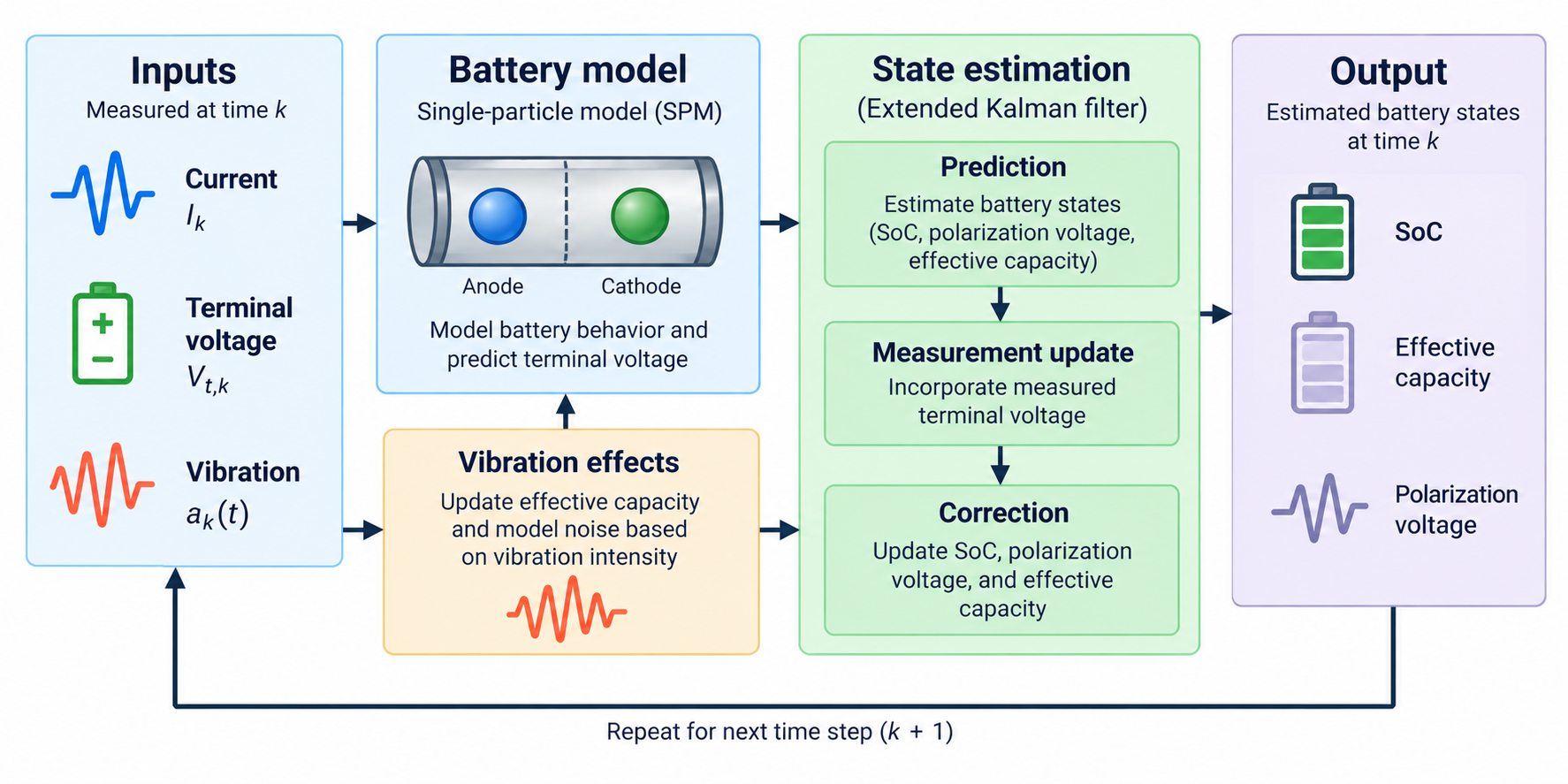
The framework feeds measured current, terminal voltage, and vibration into an electrochemical single-particle model, and an extended Kalman filter corrects the estimates against measured voltage. (Illustration by EV Engineering based on Xie et al., Discover Electronics, 2026)
The team evaluated the method on commercial 18650 cylindrical cells from Samsung, testing eight cells each of nickel cobalt aluminum (NCA), nickel manganese cobalt (NMC), and lithium iron phosphate (LFP) chemistries. In 50-cycle testing on the NCA cells, the estimator converged from initial SoC errors as large as 50% and remained stable over the full test without diverging.
After approximately 50 charge-discharge cycles at 1 C, the cells were mounted on a mechanical shaker and subjected to two hours of random vibration between 10 and 100 Hz. The NCA cells lost about 2.1% of their capacity on average, while the NMC and LFP cells showed smaller reductions of about 1.4% and 1.5%, respectively. The researchers noted that vibration-induced degradation appears to depend on chemistry as well as cell structure and manufacturing.
Following vibration, the SPM-EKF model’s voltage estimates closely matched measured charge and discharge curves for the NCA and NMC cells. LFP cells showed larger errors around the transition between their two flat voltage plateaus, where small voltage changes weaken the EKF’s voltage-based SoC correction.
A sensitivity analysis found that errors in vibration intensity had a greater effect on SoC accuracy than errors in the model’s degradation coefficient. A 50% overestimate of the degradation coefficient kept SoC error below about 0.1% for NCA and NMC cells, while a 50% overestimate of vibration intensity pushed LFP error to nearly 0.39%.
The authors concluded that “accurate vibration measurement is more important than precise calibration of the empirical degradation coefficient.” They added that reliable accelerometer placement, signal filtering, and root-mean-square vibration extraction are critical for implementing vibration-aware SoC estimation in practical battery management systems.
The study, authored by Yuanyuan Xie, Shuo Wu, and Woonki Na of California State University, Fresno and Jonghoon Kim of Chungnam National University, was published September 27 in Discover Electronics. The work was supported by the National Science Foundation and the California State University Transportation Consortium.
Reference
Xie, Y., Kim, J., Wu, S., Na, W. Modeling based SOC estimation for commercial EV Li-ion batteries under vibration conditions. Discover Electronics 3, 137 (2026). https://doi.org/10.1007/s44291-026-00291-y
Filed Under: Batteries, BMS, Technology News