EV Engineering & Infrastructure

  • News
  • Articles
    • Q&As
    • Tech Spotlight
  • Batteries
  • Charging
    • Wireless Charging
    • Vehicle-to-Grid (V2G)
  • Electrification
  • Testing and Safety
  • Learn
    • Learning Center
    • Tech Toolboxes
    • Webinars
  • Resources
    • Digital Editions
    • Diversity & Inclusion
    • Voices
  • Advertise
  • Subscribe

Three new thermal adhesives introduced for EV battery applications

By Michelle Froese | October 13, 2026

Parker Hannifin‘s Performance Materials Division has introduced three new thermally conductive adhesives to its CoolTherm portfolio for electric vehicle (EV) battery manufacturing and other electrification applications.
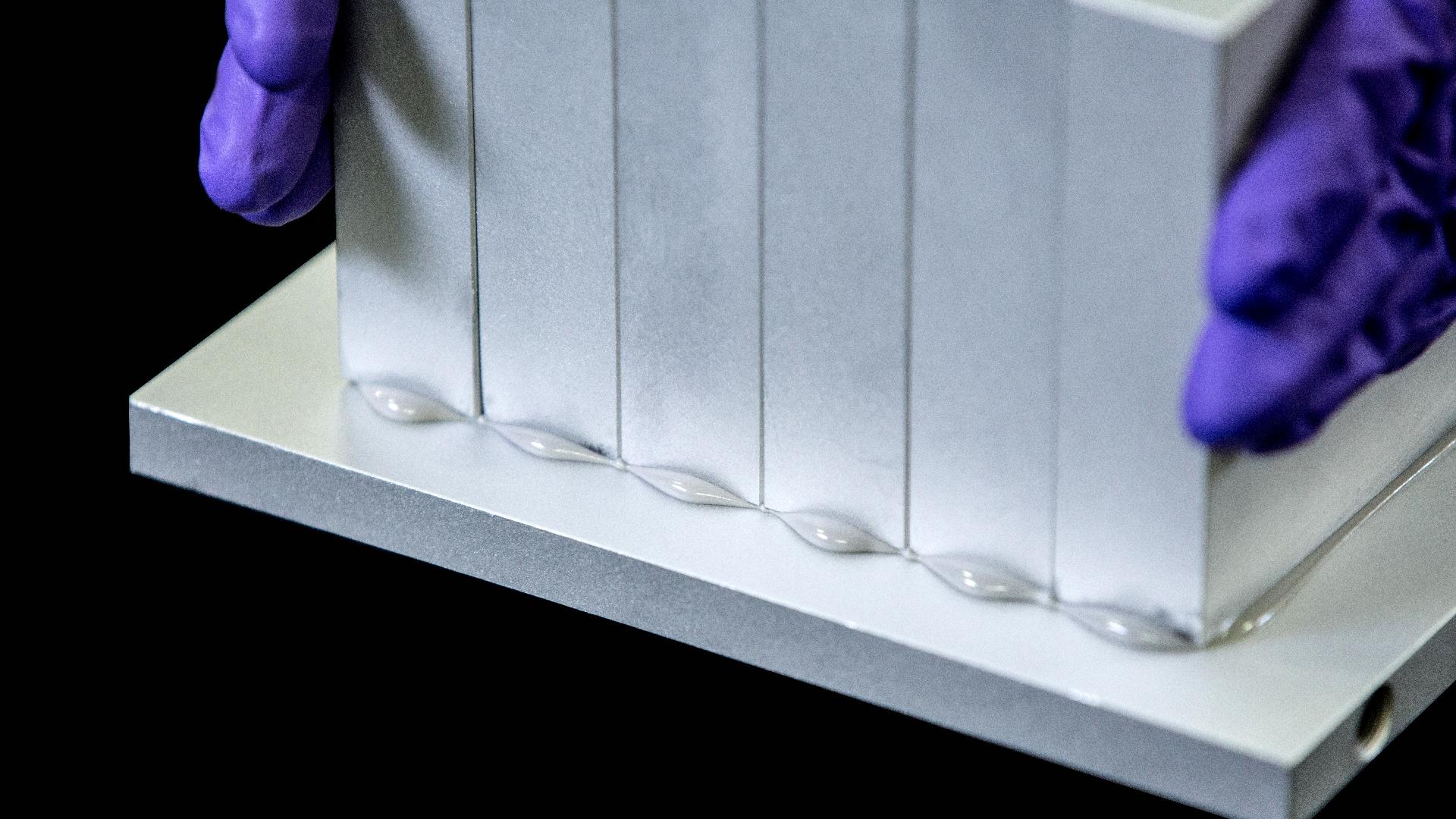
The new formulations address different bonding and thermal management requirements, with variations in cure time, substrate compatibility, and dispensing characteristics.

CoolTherm UR-2800 is a thermally conductive urethane adhesive designed to bond to a broader range of substrates while providing higher bond strength and faster curing. These characteristics are intended to improve bonding reliability and accommodate production processes where shorter cure times are required.

CoolTherm UR-2400 SLW is a slow-curing urethane adhesive with approximately 2.0 W/m·K thermal conductivity. It combines moderate-to-high bond strength with high toughness and an extended working period, allowing additional time for adjustments or rework during assembly.

The third product, CoolTherm TC-2080, is designed for applications requiring large adhesive beads. Developed to retain key properties of the existing CoolTherm TC-2002 formulation, it eliminates glass spacers while improving resistance to sagging during dispensing.

Thermally conductive adhesives provide both mechanical bonding and a pathway for heat transfer between components. In EV battery assemblies, material selection can affect thermal performance and manufacturing processes, particularly where adhesive strength and application characteristics must be balanced with heat dissipation requirements.

The three additions expand Parker’s CoolTherm materials portfolio, giving EV battery designers and manufacturers additional options for selecting adhesives based on their assembly and thermal management requirements.

The company is presenting their new products at the Electric & Hybrid Vehicle Technology Expo, held alongside The Battery Show North America, October 12–15 at Huntington Place in Detroit, Michigan (Booth 1822). Parker will also hold a CoolTherm Thermal Adhesives Spotlight Presentation on October 13, from 11:30 to 11:45 a.m. at Booth 1822.


You might also like


Filed Under: Adhesives, Technology News, Thermal Management
Tagged With: adhesives, parkerhannifin, thermalmanagement
 

Next Article

← Previous Article
Next Article →


“ee
EXPAND YOUR KNOWLEDGE AND STAY CONNECTED
Get the latest info on technologies, tools and strategies for EV professionals.

Tech Spotlight

  • Why high-power EV charging is pushing control integration into one ECU
  • Designing safety into the cell: The case for system-level solid-state batteries
More Tech Spotlight

Featured Contributions

  • Q&A: What the shift to chrome-free coatings means for EV design
  • How do two-level and three-level inverter topologies compare in EVs?
  • Inside the development of the Megawatt Charging Standard
  • How does fault-tolerant control keep an EV operating after a sensor failure?
  • Q&A: How EV architectures are changing high-speed connectivity
More Featured Contributions

EV TECH TOOLBOX

“ee
Explore the EV Engineering Tech Toolboxes: a collection of high-impact articles that break down the latest EV design trends and technologies. Download to stay aligned with today’s evolving EV design challenges.

Learning Center

EE Learning Center

Sponsored Content

  • Converting custom materials for EV applications
  • Advantech Powers Versatile Electric Vehicle Charging Systems

EV Training Days

ev
Q&A
EV Engineering & Infrastructure
  • 5G Technology
  • Analog IC Tips
  • Battery Power Tips
  • Connector Tips
  • EDABoard Forums
  • Electro-Tech-Online Forums
  • Engineer’s Garage
  • Microcontroller Tips
  • Power Electronic Tips
  • Sensor Tips
  • Test and Measurement Tips
  • Contact Us

Copyright © 2026 Arrowfly LLC. All Rights Reserved. The material on this site may not be reproduced, distributed, transmitted, cached or otherwise used, except with the prior written permission of Arrowfly
Privacy Policy | Advertising | About Us

Search EV Engineering & Infrastructure

  • News
  • Articles
    • Q&As
    • Tech Spotlight
  • Batteries
  • Charging
    • Wireless Charging
    • Vehicle-to-Grid (V2G)
  • Electrification
  • Testing and Safety
  • Learn
    • Learning Center
    • Tech Toolboxes
    • Webinars
  • Resources
    • Digital Editions
    • Diversity & Inclusion
    • Voices
  • Advertise
  • Subscribe