Sakuu has produced a fully dry-printed lithium-ion battery cell using carbon fiber and a polymeric current collector (PCC) on its Kavian manufacturing platform. The 0.5-Ah test cell was manufactured at the company’s research and development facility in Silicon Valley.
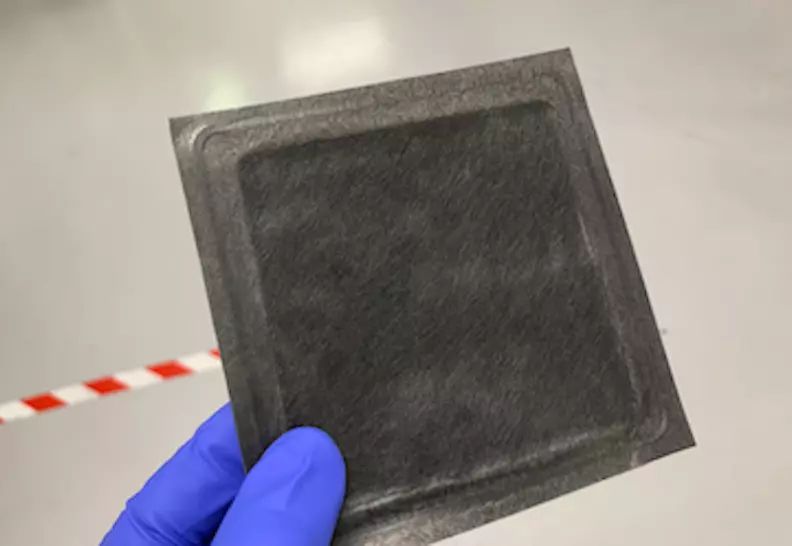 The cell incorporates dry-printed anode and cathode layers with a carbon fiber veil and a conductive polymer current collector, eliminating the need for conventional metal current collectors. According to Sakuu, the resulting structure combines electrical conductivity with mechanical reinforcement while remaining lightweight and flexible.
One challenge in developing PCC-based cells is maintaining electrical contact between layers. Thin polymer films can wrinkle during manufacturing, potentially disrupting contact between adjacent materials. Sakuu addresses this by embedding carbon fibers within the dry-powder electrodes and current collector structure.
“Carbon fiber doesn’t wrinkle. It has unique properties that add strength and electrical conductivity to the composite in a PCC cell,” said Karl Littau, chief technology officer at Sakuu.
The fibers penetrate the current collector and are embedded in both the anode and cathode layers. According to the company, this arrangement improves interfacial contact and provides a conductive reinforcing network throughout the cell.
Unlike conventional lithium-ion cells that use parallel-connected electrode structures, Sakuu’s PCC architecture connects individually sealed layers in series. Current flows vertically through the stacked layers across their contact surfaces.
Sakuu claims the architecture prevents thermal runaway by allowing energy to dissipate gradually in the event of a short circuit, puncture, or internal defect. The company has not provided independent test results in the announcement to substantiate that performance claim.
The manufacturing demonstration could also have implications for structurally integrated batteries, where battery materials contribute to the mechanical structure of a vehicle or other application.
Sakuu reports that the test cell demonstrated mechanical integrity, interfacial contact, and low contact resistance. However, the announcement does not provide detailed electrochemical performance data or results from cycle-life testing.
The company’s Kavian platform uses a dry-printing process for electrode manufacturing, avoiding the solvent-based coating and drying steps associated with conventional wet-process production. Sakuu is also developing the platform for supercapacitor electrode manufacturing.
Kavian was named a finalist in the battery manufacturing technology category of the Battery Awards at The Battery Show North America in Detroit, MI.
Filed Under: Batteries, Technology News