Researchers at the University of Osaka, working with Tokai Rika and the University of California San Diego, have developed an ultra-wideband (UWB) positioning method to help align coils during wireless charging of electric vehicles (EVs).
In laboratory tests using a scaled-down vehicle mockup, the method achieved median errors of 2.32 mm in position and 0.25° in orientation. The study was published in the IEEE Open Journal of Vehicular Technology.
Inductive charging transfers power from a ground-mounted pad to a receiver coil beneath the vehicle. Misalignment of just a few centimeters can reduce power transfer efficiency and increase charging time. Existing magnetic positioning systems generally work best when the receiver coil is already close to the charging pad, while camera-based methods can be affected by rain or dirt and by poor lighting.
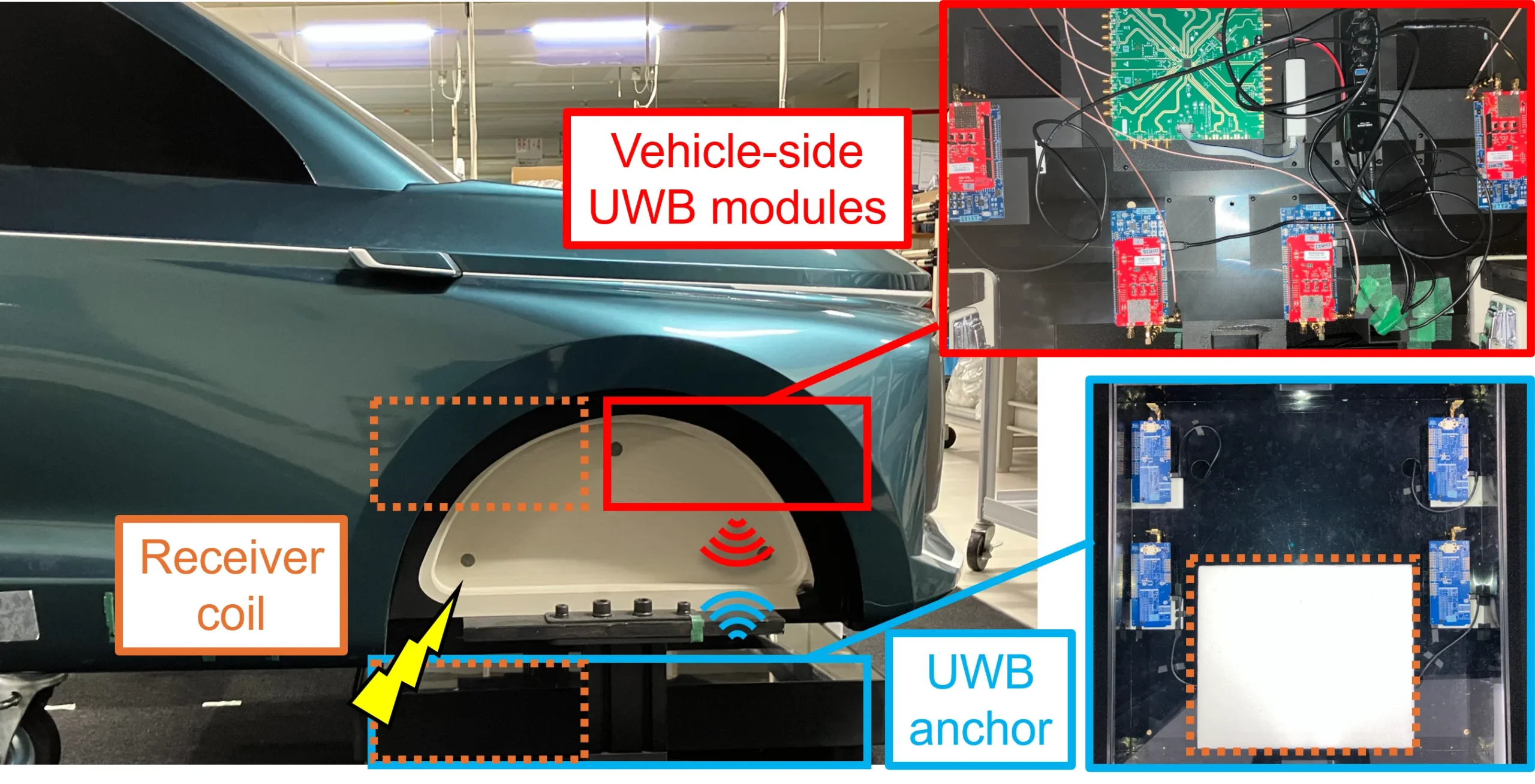
Four synchronized UWB modules are mounted around the receiver coil region of a scaled vehicle mockup (red), while a ground-side UWB anchor unit with four antenna elements is positioned around the charging pad (blue). Insets show the vehicle-side modules and the ground-side anchor unit. (Image: Ryotaro Hada et al., licensed under CC BY 4.0)
The researchers’ approach uses UWB radio signals, the same short-range wireless technology used in some digital car keys, to determine the position and orientation of the vehicle’s receiver coil relative to the charging pad. Four synchronized UWB modules mounted around the receiver coil communicate with a ground-side anchor unit containing four antenna elements.
The positioning method combines signal travel times and phase differences. Signal travel times provide an initial estimate of the vehicle’s location, while phase differences refine the position and orientation measurements.
Calibration improves positioning accuracy
The method also incorporates a calibration process that measures and corrects signal distortions specific to each installation. Without this phase-bias correction, the median positioning error was approximately five times greater.
The laboratory results were obtained through repeated measurements at a fixed stopping position. Additional testing on full-sized vehicles is still needed, including outdoor trials and measurements taken during active wireless power transfer.
The researchers say the technology could eventually allow autonomous EVs and robotaxis to align with wireless charging equipment without driver assistance.
“Turning a computational method into a working system required considerable trial and error,” said Ryotaro Hada, first author of the study.
References
- Toward Precise Pad-to-Coil Alignment in EV Inductive Charging With UWB, IEEE Open Journal of Vehicular Technology
- Radio waves pave the way for effortless EV charging, The University of Osaka
Filed Under: Charging, Technology News