When a battery cell goes into thermal runaway, the enclosure around it is one of the last barriers between the failure and the rest of the vehicle. It has to hold up against fire and blasts of hot debris while keeping high-voltage components electrically isolated.
DOWSIL FC-2024 Coating applied to the inside of a battery pack lid forms a protective ceramic layer when a cell vents during thermal runaway.
That job gets harder as battery packs become more compact, leaving engineers less room for protective materials and little tolerance for anything that slows down production.
Dow developed DOWSIL FC-2024 Coating, a one-part room-temperature vulcanizing (RTV) silicone, to address these challenges. When exposed to extreme heat, the material forms a protective ceramic layer that resists fire and particle blast while still insulating the enclosure.
“DOWSIL FC-2024 Coating was developed to address the challenge of extending the burn-through time of electric vehicle (EV) battery pack housings during a thermal event,” said Ryan Thomas, associate TS&D scientist at Dow Consumer Solutions, who specializes in silicone solutions for mobility and transportation, including battery-fire protection materials. “Extending that window gives passengers and first responders more time to respond safely, a requirement increasingly codified in global EV safety regulations.”
Protection during thermal runaway
Battery thermal runaway can produce more than flames. High-temperature gases and molten material may be expelled at considerable velocity, creating mechanical and thermal hazards for neighboring cells and enclosure components. This is known as particle blast.
“During thermal runaway, this fire-resistant coating forms a ceramic layer that protects the EV battery housing from particle blast,” said Thomas. “It also resists flames exceeding 1,200°C and maintains its high dielectric strength (>10 kV/mm) and electrical insulation (>11 GΩ) even after high-temperature exposure.”
“The dangers of battery fires are well-understood, but particle blast is also a key concern because ejected particles can breach physical barriers, penetrate neighboring battery cell casings and ignite adjacent modules,” he said.
The coating’s protective behavior comes down to its silicone chemistry.
“When an EV battery cell experiences a thermal event exceeding 300°C, standard organic coatings combust and release flammable gases and high thermal energy,” said Thomas. “By contrast, Dow’s silicone-based coating transforms its low-carbon/hydrogen siloxane backbone into a solid silicon oxide ceramic shield. This prevents the material from feeding additional fuel into the battery pack, curtails overall gas generation, and creates a durable barrier capable of surviving flames and particle blasts.”
“Ceramics resist fire and extreme heat because of their strong atomic bonds, low thermal conductivity and structural stability,” he said. “They also withstand violent particle blast.”
Why non-intumescent protection matters
Battery-pack engineers must balance protective performance with limited available space. Some fire-resistant coatings expand when exposed to heat, which can create additional packaging concerns.
“Conventional intumescent coatings expand significantly, enough to encroach upon internal modules or block pressure relief vents in tight battery enclosures,” said Thomas. “By contrast, Dow’s non-intumescent ceramic layer maintains precise geometry and structural integrity. Its dense ceramic shell also resists mechanical particle-blast abrasion and preserves the high dielectric strength needed to prevent electrical arcing between high-voltage components and the battery pack housing.”
“[Particle-blast protection] is critical in the increasingly compact geometries of cell-to-pack and cell-to-chassis architectures,” he said. “As battery designs adopt these formats, individual cell vents are closer to primary structural covers.”
The coating also offers an alternative to mica sheets, which have long been used as thermal barriers in battery packs.
“Compared to mica sheets, Dow’s coating is lighter, more flexible, and less susceptible to cracking from vehicle vibrations,” said Thomas. “Compared to intumescent coatings, DOWSIL FC-2024 Coating provides more predictable performance, has higher mechanical integrity, and doesn’t produce conductive char.”
Continuous electrical insulation
Dow designed the coating to address flame propagation, particle-blast abrasion, and electrical arcing in a single applied layer.
“When it ceramifies, this material withstands direct flame, e-coat autoignition, and high-velocity particle venting during battery failure while preserving its high dielectric strength,” said Thomas.
That protection also continues during normal battery operation.
“Importantly, this material’s electrical insulation properties are more than an emergency safeguard because they also serve as a continuous dielectric barrier throughout the battery’s operational life,” said Thomas. “As a silicone-based material, it serves as an electrical insulator that helps prevent electrical arcing, short-circuiting or dielectric breakdown during normal EV battery operations. It maintains both its electrical insulation and its dielectric strength before and during a thermal event.”
Engineering for automated battery production
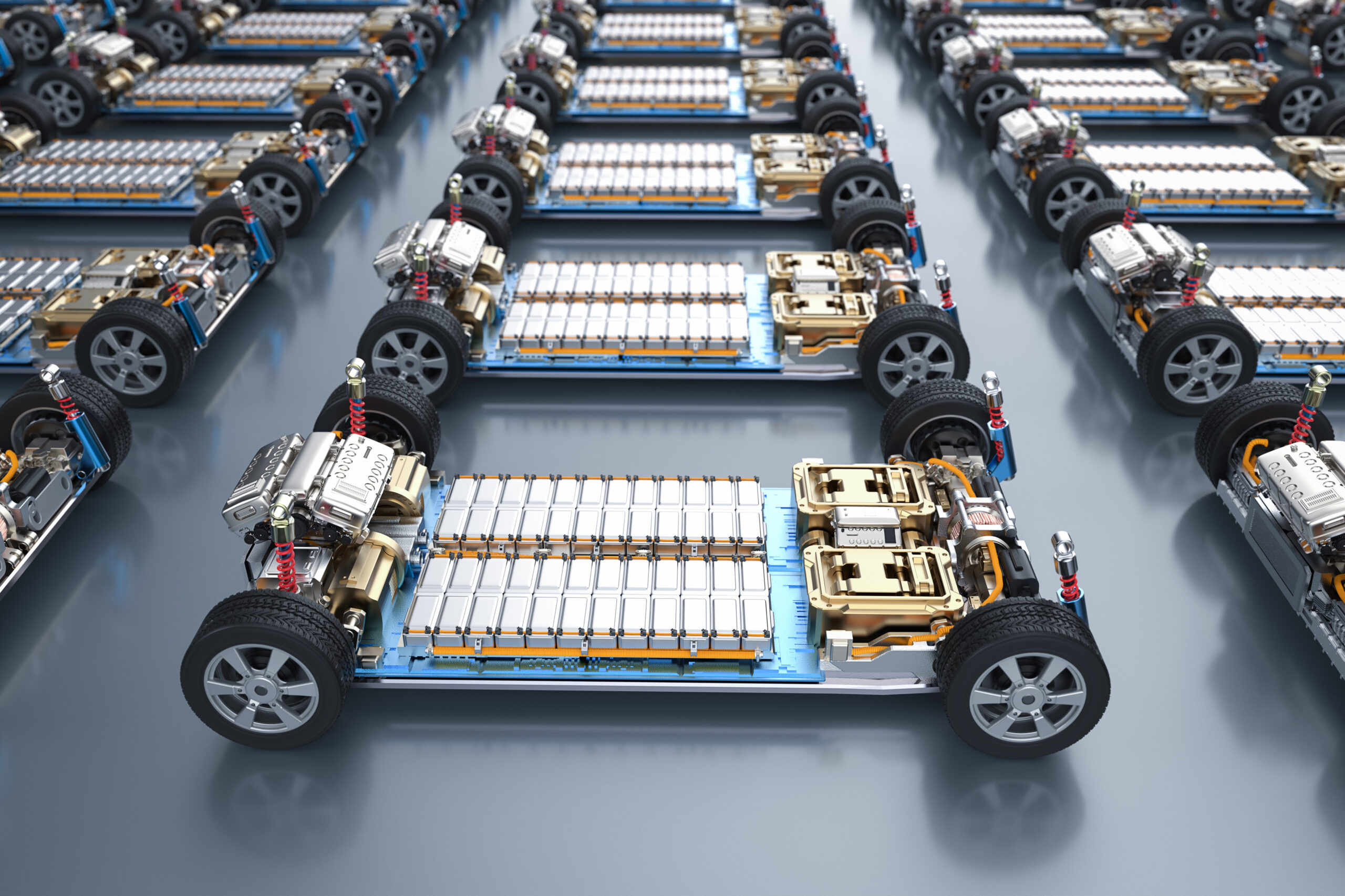
Beyond thermal and electrical performance, protective coatings must fit into high-volume battery manufacturing processes.
Beyond thermal and electrical performance, protective coatings must fit into high-volume battery manufacturing processes.
“DOWSIL FC-2024 Coating was formulated specifically to address the manufacturing bottlenecks, cycle time requirements and quality control challenges associated with high-volume EV battery pack assembly,” said Thomas. “As a single-component room-temperature vulcanizing (RTV) silicone, Dow’s coating simplifies inventory management, eliminates mixing equipment maintenance and removes the risk of off-ratio curing in high-throughput lines.”
“By contrast, two-part thermal or flame-barrier systems require static mixers, meter-mix-dispense (MMD) monitoring and precise pot-life management,” he said.
“Dow’s coating also exhibits strong shear-thinning behavior,” said Thomas. “It flows freely under pump pressure for rapid dispensing but instantly recovers its yield stress once applied, preventing sag on vertical surfaces or inverted pack lids.”
The coating also reflects a broader shift in how thermal barriers are applied. Dow says fully automated robotic application can reduce labor and cycle time to roughly two to 10 minutes per lid.
“The EV industry is transitioning from the manual placement of pre-cut mica sheets and ceramic blankets toward liquid-applied thermal barriers,” said Thomas. “Automated liquid dispensing improves line speed, but it also supports frequent design revisions through software and robotic reprogramming instead of physical retooling.”
“Because this coating uses room-temperature curing, battery manufacturers can avoid installing massive thermal curing ovens for large battery pack lids,” he said. “This reduces capital expenditure and factory energy consumption, while supporting environmental sustainability initiatives.”
Design and integration considerations
The coating is optimized for high-volume robotic dispensing equipment, such as the Graco PF Metering System, which uses flat-stream nozzles.
“Depending on an application’s structural and flame barrier requirements, engineers can target patterns 30 to 80 mm wide and 1.0 to 2.0 mm thick,” said Thomas. “To maintain uniform thickness and complete coverage across varying topographies, automated dispensing systems can use a robotic arm to switch between multiple nozzles.”
The coating adheres to aluminum and e-coated steel, though surface preparation still matters.
“This specialized material offers durable, primerless adhesion to battery pack enclosure metals, but surfaces must be cleaned of oils, scale and dust to achieve maximum bond strength,” said Thomas. “If heavy stamping residual lubricants or contaminants remain, integrate solvent-based or plasma surface treatments into the production line.”
Dow also advises against applying the coating to non-polar plastic or rubber substrates that exude plasticizers, which disrupt adhesion.
“Because this material remains workable for approximately 15 minutes after application, it can be scraped, reworked, or re-applied both before or after full room-temperature cure,” said Thomas. “This important feature allows modifications to a pack lid during production and helps minimize scrap.”
Beyond EV battery packs, Dow identifies module and pack-level barriers and battery energy storage systems (BESS) as potential applications.
How well any protective coating performs ultimately depends on the enclosure design, the failure conditions it has to survive, and how it fits into production.
“During material selection, engineers need to balance technical performance during thermal runaway events with manufacturing integration requirements,” said Thomas.
Filed Under: Featured Contributions, Tech Spotlight