Cooling design has a direct effect on how an electric vehicle (EV) battery pack handles fast charging and high loads, and how long its cells last. Every change to the cell chemistry or pack layout can mean another round of thermal simulation, and some of those simulations take hours to run.
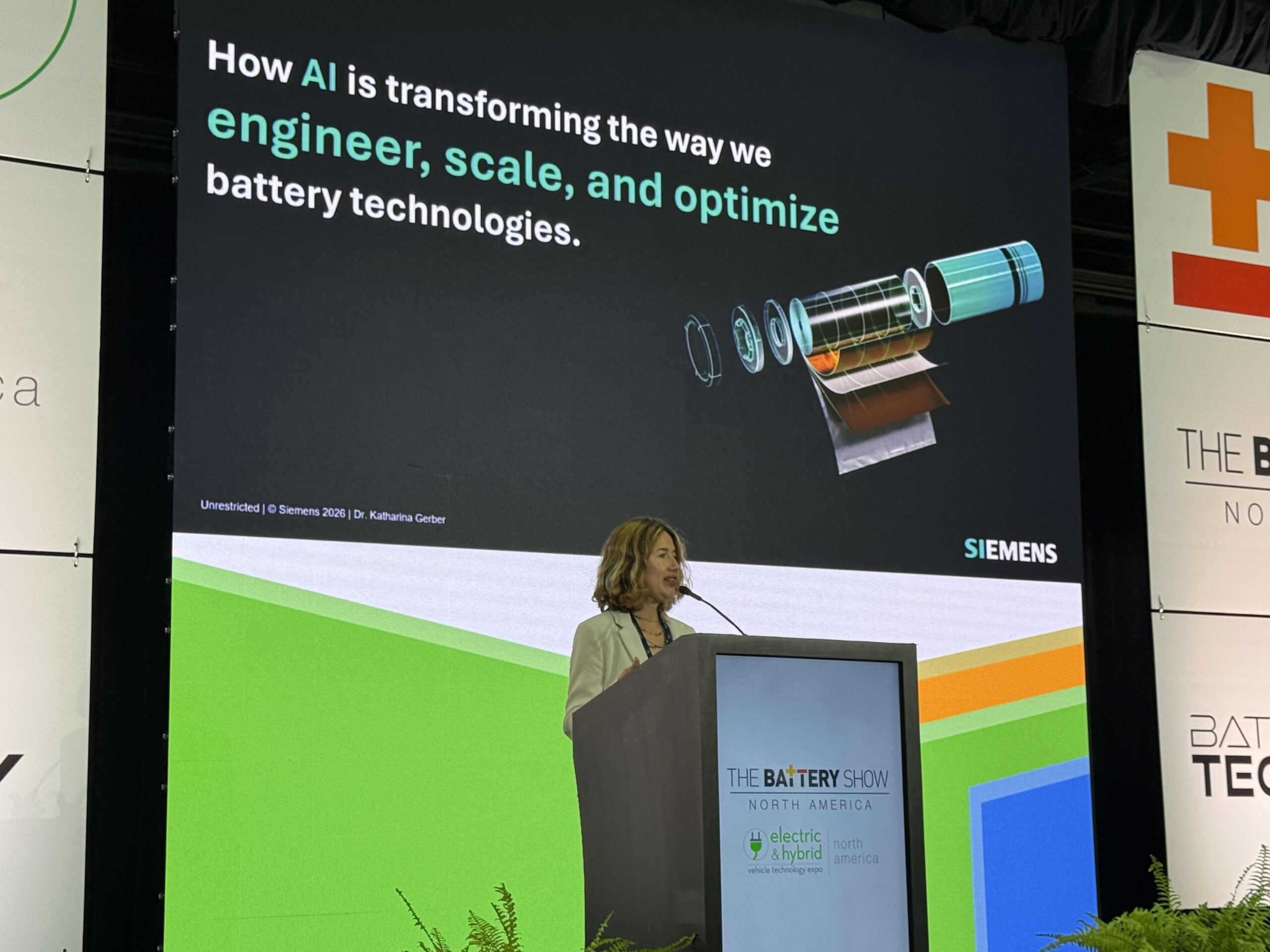
Katharina Gerber, global battery industry developer at Siemens, presents a technical session on AI in battery engineering at The Battery Show North America 2026.
Much of the information engineers need for a new cooling design may already exist in results from earlier projects. The difficulty is putting that data to use.
AI surrogate models use previous simulation data to estimate thermal behavior in seconds instead of hours. This lets engineers test more design ideas before committing to a full physics-based simulation.
Why data quality comes first
That speed depends on the quality of the engineering data behind the model. By the time a battery design reaches gigafactory scale, a manufacturer may be generating terabytes of data every day, and that information is usually scattered across design and manufacturing systems that don’t share it with each other.
“AI is about data. If you have bad data, you have bad AI. It is not about the model, it is about the data,” said Katharina Gerber, global battery industry developer at Siemens, who worked in battery research and development (R&D) before joining the company. Gerber made these points during a technical session at The Battery Show North America.
Data without context is one of the biggest risks. Information placed in a data lake with no connection to the product or process it came from can lead AI tools to conclusions that look reasonable but aren’t correct.
“If you put a model or an AI tool on top of that data lake, it may come up with some very creative interpretations of the data, but those interpretations are not necessarily true, and then you cannot trust the results,” Gerber said.
A knowledge graph addresses this by mapping relationships between data sets that already live in separate systems. When a material specification changes, for example, engineers can quickly see which parts and teams the change affects. The data stays in its original systems, so existing access controls remain in place.
“You now have a clustered view of the data for the entire life cycle of each product, whether it is an energy storage system, an EV pack, or a drone,” she said.
Building a surrogate model from past simulations
Gerber illustrated the approach with a battery energy storage system (BESS) cooling redesign, and the same modeling principles apply to EV battery packs. Redesigning a pack’s cooling system normally starts with its power requirements and the thermal behavior of the new cells. Engineers then run simulations that use considerable computing resources, often for several configurations.
Most engineering teams have run similar simulations before. An AI model can use those results to build a correlation matrix showing how design parameters relate, such as how a given cell temperature affects the cooling design required. That matrix becomes the basis for a surrogate model.
“The surrogate model is still based on your previous engineering data and your physical data, but it runs much faster. Instead of 24 hours, a simulation can run within seconds,” Gerber said.
That speed lets engineers evaluate many more cooling configurations early in pack development. Surrogate models also give AI agents a faster way to run calculations. Instead of opening simulation and computer-aided design (CAD) tools for every task, an agent can query the surrogate model, which reduces the computing resources each calculation needs.
Where physics-based simulation still fits
Surrogate models approximate the relationships in their training data, so their results still need to be checked against the physics. Engineers can use the surrogate to narrow down options and save detailed simulation for the design they plan to build.
“Of course, once you have a design that you think will work, you can still run it through the original physical model to validate it. In the end, you have saved your team weeks of work,” Gerber said.
Filed Under: FAQs, Featured Contributions