Inside a lithium-ion battery cell, electrode binders hold active materials together, while separator coatings maintain alignment between layers during manufacturing. Both play an important role in the cell’s structural integrity throughout its life. In electric vehicle (EV) batteries, which have to hold up through years of fast charging and daily driving, that integrity has a direct effect on how long the battery lasts.
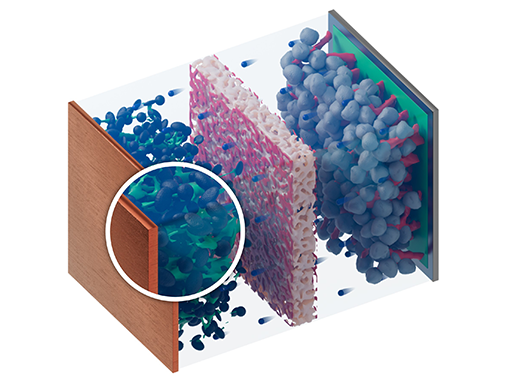
Illustration of a lithium-ion battery cell’s electrode structure, highlighting the role of acrylic binders in maintaining anode integrity.
“Inside the cell, our offerings include electrode binders for both the cathode and the anode, as well as coatings and binders for the separator,” says Dana Swan, North America Battery R&D manager at Arkema.
An electrode is made of active material particles mixed with a binder and a conductive additive, then coated onto a thin metal foil. The binder has two jobs. It has to bond the electrode coating to the foil, and it has to hold the particles to one another within the coating.
“On the cathode side, we have our Kynar PVDF binder,” Swan says. “It helps the active materials in the electrode adhere to the film, and it also provides cohesion between the binder and the active material within the electrode.”
These polyvinylidene fluoride (PVDF) binders are designed to provide strong adhesion at lower loading levels while remaining stable in the electrolyte and under high-voltage conditions. Using less binder leaves more room in the electrode for active material, which can improve a cell’s energy density.
The anode needs the same structural support, but its materials behave differently. Silicon offers a higher theoretical capacity than graphite, but it expands and contracts significantly as the battery charges and discharges. That movement puts strain on the binder and can break down the electrode over time.
“For the anode, we have our Incellion binder,” Swan explains. “Incellion is an acrylic binder that performs the same functions for the anode that PVDF performs for the cathode.”
Incellion EL binders are being designed for both pure graphite and silicon-based anodes. Thee intent is to maintain the anode’s mechanical integrity as it expands and contracts. This can support higher silicon content and potentially improve cell energy density, an important consideration for increasing EV range without adding battery weight.
The binders are also being designed to provide strong cohesion and adhesion at low loading levels, which helps reduce degradation from repeated expansion and contraction over many charge cycles. A more stable anode structure also lowers the risk of internal shorts, and the water-based formulation avoids the solvents used with some other binder systems.
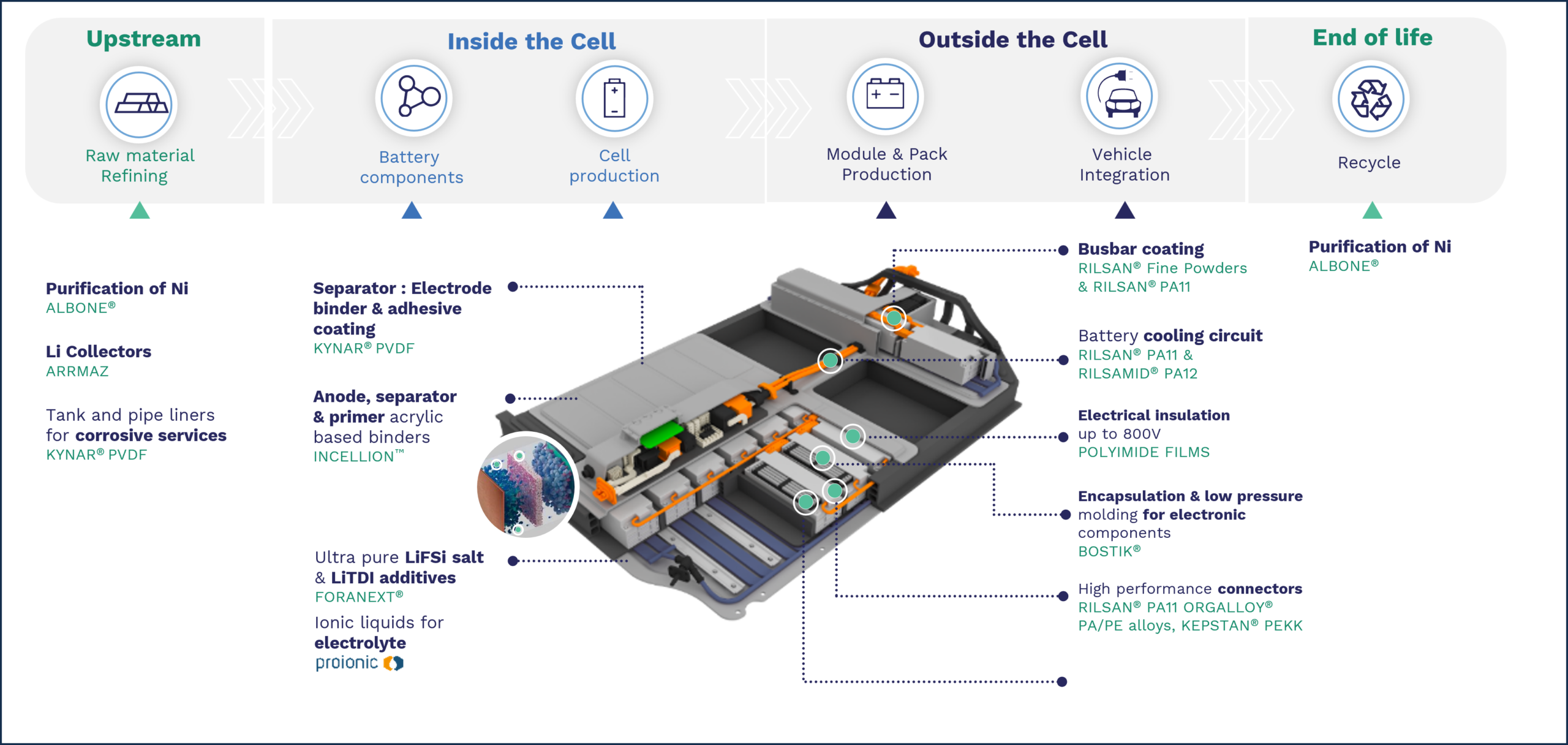
Electrode binders and separator coatings, including Kynar PVDF and Incellion binders, are used inside lithium-ion battery cells to support structural integrity and performance.
Between the two electrodes sits the separator, which keeps them electrically isolated while allowing lithium ions to pass through. During manufacturing, the electrode and separator layers have to stay aligned as they move through the production line.
“The adhesive coating on the separator helps overall battery performance,” Swan says. “It ensures good adhesion between both electrodes during manufacturing, so you don’t get slippage, which could cause failures, shorts, and scrap.”
PVDF separator coatings are designed to promote the rapid absorption of electrolyte more readily than standard polyolefin separators and help the separator hold its shape at higher temperatures, particularly when paired with a ceramic layer.
“On the separator, we also offer ceramic binders,” Swan says. The adhesive coating continues to matter once electrolyte is added to the cell. “During wet handling of the battery, the coating also ensures everything stays intact and provides good ion transport.”
Filed Under: Batteries, Featured Contributions, Tech Spotlight