Researchers at Chalmers University of Technology in Sweden, working with industry partners, have investigated a reconfigurable battery architecture that could extend electric vehicle (EV) battery life by more than 20% under certain conditions. The approach allows deteriorating cells to be bypassed rather than limiting the performance and lifespan of an entire battery pack.
Battery packs contain many interconnected cells that can age at different rates. Manufacturing variations and differences in operating conditions mean some cells lose capacity faster than others. In conventional battery packs, the cells are connected in fixed configurations, allowing the weakest cells to limit the usable capacity of the entire system.
The researchers investigated a system that uses electronically controlled switches to change the connections between cells. This allows the battery management system to isolate deteriorating cells while continuing to use the capacity available in the remaining cells.
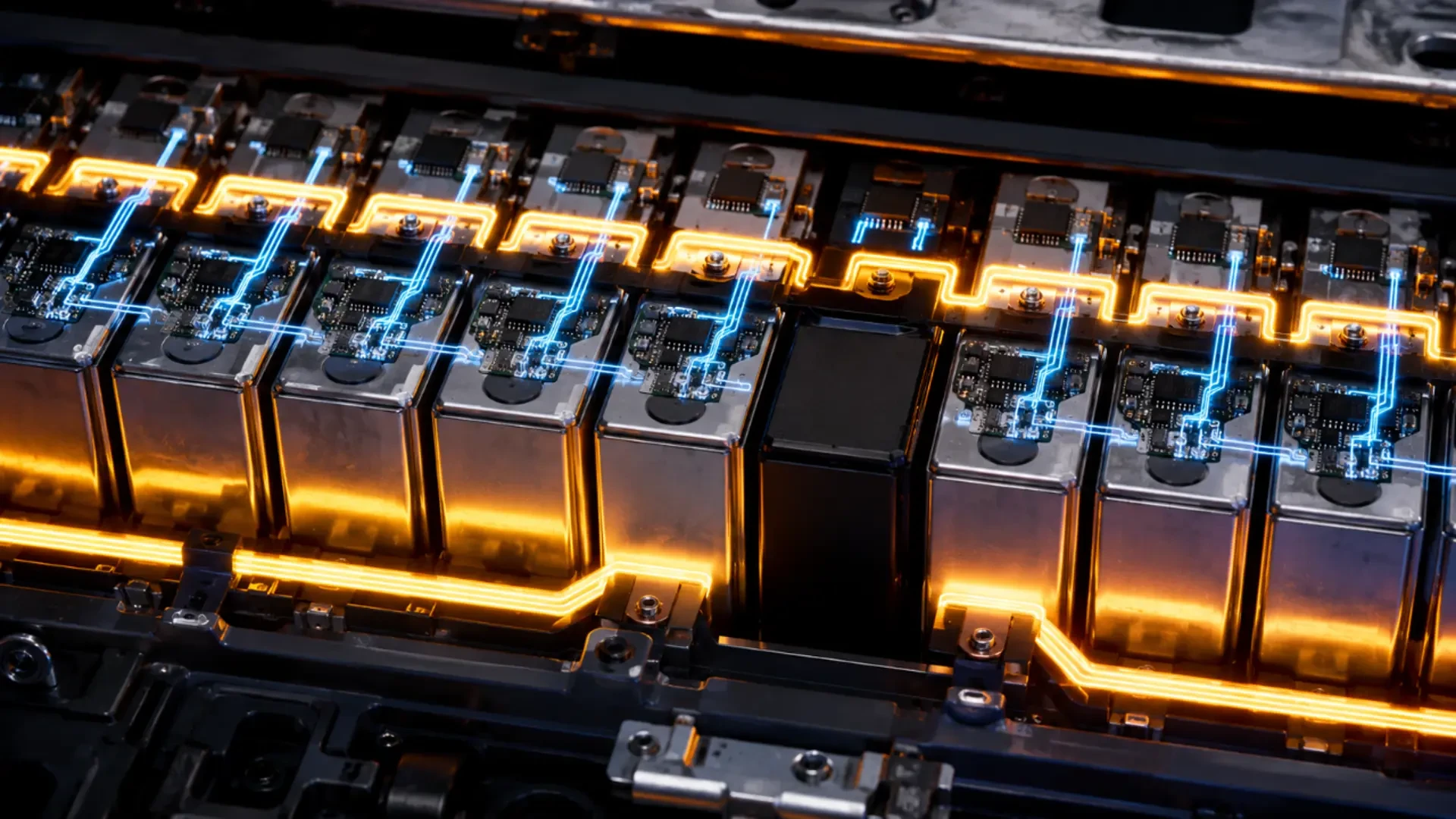
A reconfigurable EV battery pack can bypass weaker cells to extend battery life. (Illustration: Albert Škegro, Chalmers University of Technology, AI-assisted.)
The study, published in Nature Communications, found that an idealized architecture with individual cell-level control could extend battery life by more than 20% in certain high-voltage vehicle applications. However, the researchers emphasize that this represents a theoretical upper limit rather than an expected improvement in commercial EV batteries.
Practical implementations would likely control groups of cells rather than individual cells, reducing the amount of additional electronic hardware required but also limiting some of the potential lifetime benefits.
“Reconfiguration is not an on-or-off choice. It is a spectrum. Where a manufacturer chooses to position itself on that spectrum determines how much of the potential benefit can be realised,” said Changfu Zou, professor at Chalmers’ Department of Electrical Engineering.
To assess the potential economic benefits, the researchers modeled an EV with an 80-kWh battery driven 12,000 kilometres annually over an expected vehicle lifetime of 18.8 years. Under these assumptions, the reconfigurable architecture delayed battery replacement by approximately 14 months while increasing the battery’s residual value.
The researchers also examined the cost of the additional switching hardware and control systems. Their component-level analysis estimated an increase of approximately 9% in total battery pack cost, with a break-even threshold of around 12%. The architecture was found to be economically viable under a range of modeled operating conditions.
The greatest potential benefits were identified in high-voltage EVs, particularly long-range passenger vehicles and electric trucks. As the number of cells connected in series increases, so does the likelihood that an individual cell will age faster and restrict overall pack performance.
Although experimental reconfigurable battery systems and automotive demonstrators already exist, the architecture examined in the study has not yet been deployed in mass-produced electric vehicles. Long-term vehicle testing is still needed to establish how closely practical systems can approach the modeled benefits.
Beyond extending battery service life, the researchers identified potential advantages for manufacturing and end-of-life battery reuse. Allowing greater variation between cells could reduce the need for precise cell matching during production and make it easier to reuse retired battery packs.
“A battery pack that is retired prematurely represents both wasted materials and wasted energy. Keeping battery packs in use for longer is therefore a sustainability argument even before the economics are considered,” said Albert Škegro, PhD student at Chalmers’ Department of Electrical Engineering.
References
Tavakoli, S. (2026, October 8). New battery architecture could extend EV battery life and lower ownership costs. Chalmers University of Technology. https://www.chalmers.se/en/current/news/e2-new-battery-architecture-could-extend-ev-battery-life-and-lower-ownership-costs
Filed Under: Batteries, Technology News