EV Engineering & Infrastructure

  • News
  • Articles
    • Q&As
    • Tech Spotlight
  • Batteries
  • Charging
    • Wireless Charging
    • Vehicle-to-Grid (V2G)
  • Electrification
  • Testing and Safety
  • Learn
    • Learning Center
    • Tech Toolboxes
    • Webinars
  • Resources
    • Digital Editions
    • Diversity & Inclusion
    • Voices
  • Advertise
  • Subscribe

High-voltage current sensor platform adds 100-A RMS capability

By Michelle Froese | September 18, 2026

Melexis has introduced the MLX91224 and MLX91225 isolated current sensors for high-voltage automotive and industrial applications. The devices provide current measurement up to 100 A RMS and are designed for applications, including electric vehicle (EV) powertrains, dc-dc converters, and ac and dc chargers.
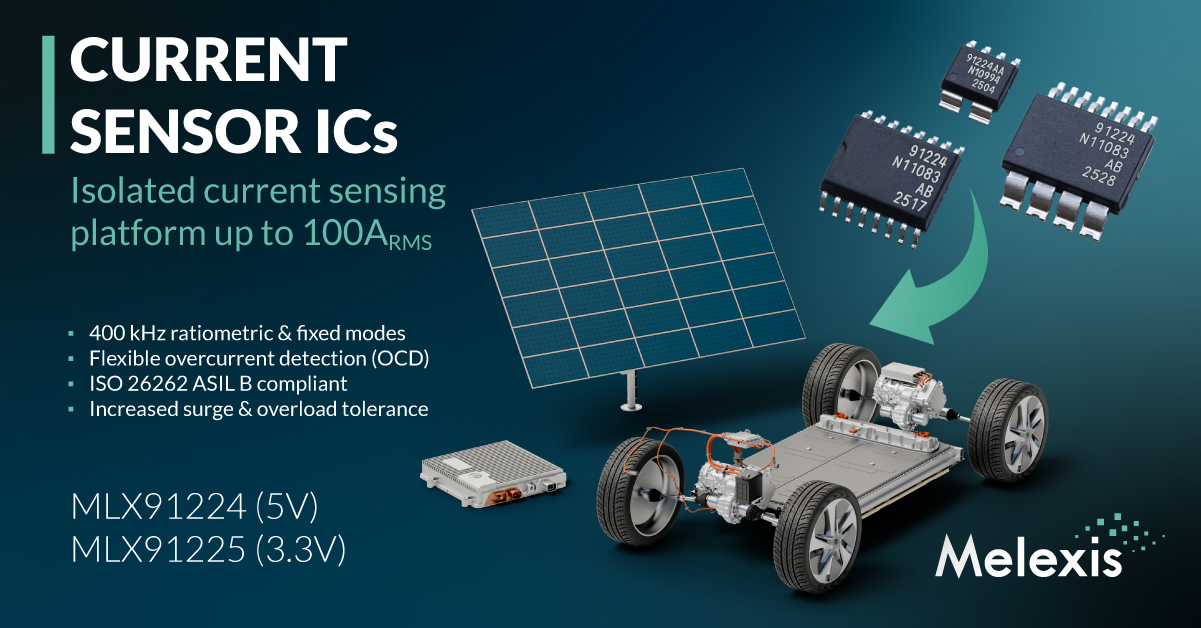
The sensors integrate the current conductor, sensing element, signal conditioning, and isolation within a compact SOIC package. Current flows through the package’s low-impedance lead frame, while differential Hall plates measure the resulting magnetic flux.

The differential sensing architecture is designed to reduce the influence of external magnetic fields and provides a linear analog output proportional to the measured current. Depending on the package, the devices support working voltages up to 1,640 V RMS.

For automotive applications, the MLX91224 and MLX91225 are developed as ISO 26262 Safety Elements out of Context and provide ASIL B readiness for safety-related current measurement in high-voltage systems.

The devices are available in three package configurations to accommodate different current and isolation requirements. The DE and DG versions support continuous current measurement up to 50 A RMS, while the DH package extends continuous operation to 100 A RMS and supports surge currents up to ±29 kA.

Both devices support ac and dc current measurement as well as bipolar and unipolar sensing. The MLX91224 operates with 5-V systems, while the MLX91225 supports 3.3-V systems, allowing integration with different microcontroller and power architectures.

A dedicated overcurrent-detection output provides additional protection and monitoring capability, with thresholds that can be configured internally or externally. The sensors operate across an ambient temperature range of -40 to 150 °C.

The MLX91224 and MLX91225 are intended for automotive and power-conversion applications where isolated current measurement is required, including electric drives, charging systems, and dc-dc converters.

You might also like


Filed Under: Sensors, Technology News
Tagged With: melexis, sensors
 

Next Article

← Previous Article
Next Article →


“ee
EXPAND YOUR KNOWLEDGE AND STAY CONNECTED
Get the latest info on technologies, tools and strategies for EV professionals.

Tech Spotlight

  • Why high-power EV charging is pushing control integration into one ECU
  • Designing safety into the cell: The case for system-level solid-state batteries
More Tech Spotlight

Featured Contributions

  • Engineering reliable charging hubs for autonomous EV fleets
  • How is EV charging interoperability tested?
  • Q&A: How adaptive charging responds to shifting battery limits
  • Part II: What CT can reveal about EV component design
  • Part I: How x-ray CT can improve EV component inspection and validation
More Featured Contributions

EV TECH TOOLBOX

“ee
Explore the EV Engineering Tech Toolboxes: a collection of high-impact articles that break down the latest EV design trends and technologies. Download to stay aligned with today’s evolving EV design challenges.

Learning Center

EE Learning Center

Sponsored Content

  • Converting custom materials for EV applications
  • Advantech Powers Versatile Electric Vehicle Charging Systems

EV Training Days

ev
Q&A
EV Engineering & Infrastructure
  • 5G Technology
  • Analog IC Tips
  • Battery Power Tips
  • Connector Tips
  • EDABoard Forums
  • Electro-Tech-Online Forums
  • Engineer’s Garage
  • Microcontroller Tips
  • Power Electronic Tips
  • Sensor Tips
  • Test and Measurement Tips
  • Contact Us

Copyright © 2026 Arrowfly LLC. All Rights Reserved. The material on this site may not be reproduced, distributed, transmitted, cached or otherwise used, except with the prior written permission of Arrowfly
Privacy Policy | Advertising | About Us

Search EV Engineering & Infrastructure

  • News
  • Articles
    • Q&As
    • Tech Spotlight
  • Batteries
  • Charging
    • Wireless Charging
    • Vehicle-to-Grid (V2G)
  • Electrification
  • Testing and Safety
  • Learn
    • Learning Center
    • Tech Toolboxes
    • Webinars
  • Resources
    • Digital Editions
    • Diversity & Inclusion
    • Voices
  • Advertise
  • Subscribe