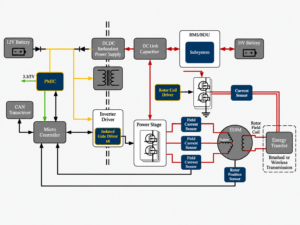
The rotor in an electric vehicle (EV) traction motor delivers torque through the motor shaft to the drivetrain. A rotor-position sensor, such as a resolver, reports the rotor angle needed for accurate torque control. If the sensor fails, … [Read more...]
High-voltage current sensor platform adds 100-A RMS capability
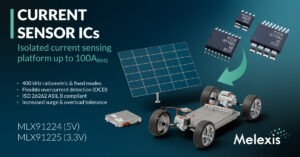
Melexis has introduced the MLX91224 and MLX91225 isolated current sensors for high-voltage automotive and industrial applications. The devices provide current measurement up to 100 A RMS and are designed for applications, including electric vehicle … [Read more...]
New infrared sensor aims to improve driver and occupant monitoring systems
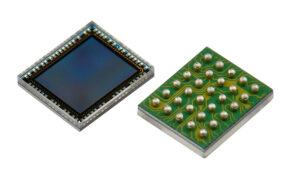
STMicroelectronics has introduced the ST SafeSense VD56GA, a 1.1-MP automotive image sensor designed for infrared in-cabin sensing and driver and occupant monitoring. The sensor uses a backside-illuminated pixel architecture called ST DeepNIR, which … [Read more...]
New R290 sensor combines pressure and temperature measurement for EVs

Sensata Technologies has introduced an R290 pressure and temperature sensor for automotive thermal management systems using R290 propane refrigerant. As automakers evaluate lower-global-warming-potential and PFAS-free refrigerants, R290 is drawing … [Read more...]
Melexis signs direct supply agreement with BYD for EV programs
Melexis signed a Master Purchase Agreement with BYD, establishing Melexis as a direct supplier in BYD’s global procurement structure. The agreement formalizes an existing collaboration tied to electric vehicle programs. Under the agreement, BYD … [Read more...]
Multiaxial current sensor improves EV traction inverter accuracy
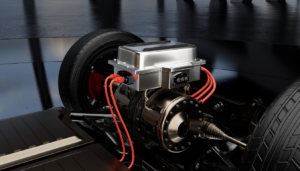
Texas Instruments (TI) has introduced the TMCS2100-Q1 multiaxial coreless Hall-effect current sensor for hybrid electric vehicle (HEV) and electric vehicle (EV) traction inverters. The sensor combines multiaxial magnetic-field measurement with a … [Read more...]
Split-core current sensors simplify in-vehicle EV testing
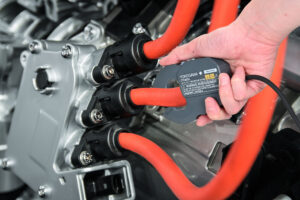
Yokogawa Test & Measurement has introduced the CT500SA and CT200SA ac/dc split-core current sensors for high-accuracy current measurement in space-constrained applications, including in-vehicle EV testing. The sensors cover 500 and 200 A ranges … [Read more...]
Part II: Why inductive sensing is replacing resolvers in EV traction inverters

Rotor position sensing has long relied on resolvers because of their reliable performance in demanding automotive environments. Resolvers are still reliable, but the technology landscape has changed, and equally dependable alternatives can now do the … [Read more...]
Part I: Rotor position sensing challenges in EV traction inverters

Rotor position sensing plays a critical role in electric vehicle (EV) traction inverters by providing the angle feedback needed for precise motor control. As inverter systems move toward higher efficiency and power density, enabled by higher … [Read more...]
How sensor placement and density impact thermal mapping in EV battery packs
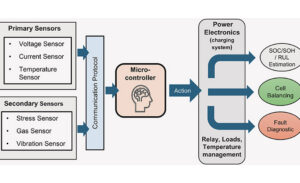
Temperature sensors in electric vehicle (EV) battery packs measure temperature only where they are mounted. Nevertheless, a battery management system (BMS) must use limited local readings to reconstruct the pack temperature field, detect developing … [Read more...]
How to implement sensor security in connected systems

Editor’s note: This article focuses on industrial and the Internet-of-Things (IoT) sensor security, but the same threat model applies to EVs. As vehicle systems become more connected and software-defined, sensors become exposed to similar attack … [Read more...]
How are zonal architectures reshaping sensor redundancy strategies?
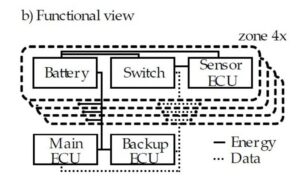
Zonal sensor redundancy begins with a structural shift in vehicle wiring. The industry is moving from function-based networks to geometry-based ones. That single change ripples through sensor placement, latency, and fault tolerance. This article … [Read more...]
Vision DSP technology addresses automotive LiDAR processing in EVs

Cadence announced that Aeva has licensed Cadence Tensilica Vision DSP IP for signal processing in its 4D LiDAR systems, with the technology aimed primarily at automotive applications including electric vehicles (EVs) equipped with advanced driver … [Read more...]
Ouster introduces Rev8 Lidar sensors for EVs and automated vehicles

Ouster, Inc. has announced Rev8, a new family of OS digital lidar sensors powered by its next-generation L4 Ouster Silicon. The Rev8 platform is aimed at EV and automated vehicle applications, where perception range, object detection and functional … [Read more...]
How sensing technologies improve EV connector and contactor safety
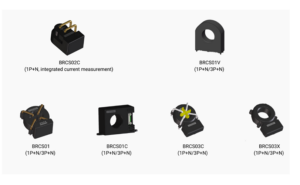
Electric vehicle (EV) connectors, contactors, and charging interfaces operate under continuous electrical stress, mechanical loading, and elevated temperatures. With battery voltages approaching 800 V and charging power exceeding 350 kW, early … [Read more...]
Hydrogen sensing technology advances early detection in EV battery systems
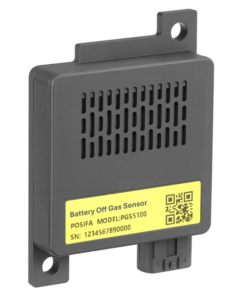
Posifa Technologies has introduced its new PGS5100 series of MEMS thermal conductivity hydrogen sensors, designed to provide early warning of abnormal conditions inside electric vehicle (EV) battery packs and other safety-critical … [Read more...]