EV Engineering & Infrastructure

  • News
  • Articles
    • Q&As
    • Tech Spotlight
  • Batteries
  • Charging
    • Wireless Charging
    • Vehicle-to-Grid (V2G)
  • Electrification
  • Testing and Safety
  • Learn
    • Learning Center
    • Tech Toolboxes
    • Webinars
  • Resources
    • Digital Editions
    • Diversity & Inclusion
    • Voices
  • Advertise
  • Subscribe

High-voltage contactors designed for EV batteries and dc fast charging

By Michelle Froese | October 29, 2026

TDK Corporation has introduced the HVC28 and HVC29 series of gas-filled, high-voltage direct current (dc) contactors for electric vehicles (EVs), dc fast-charging infrastructure, and other high-power applications. Both series are available with continuous current ratings of 300, 400, 500, and 600 amperes (A), with an optional mechanical auxiliary contact for switching-state monitoring.
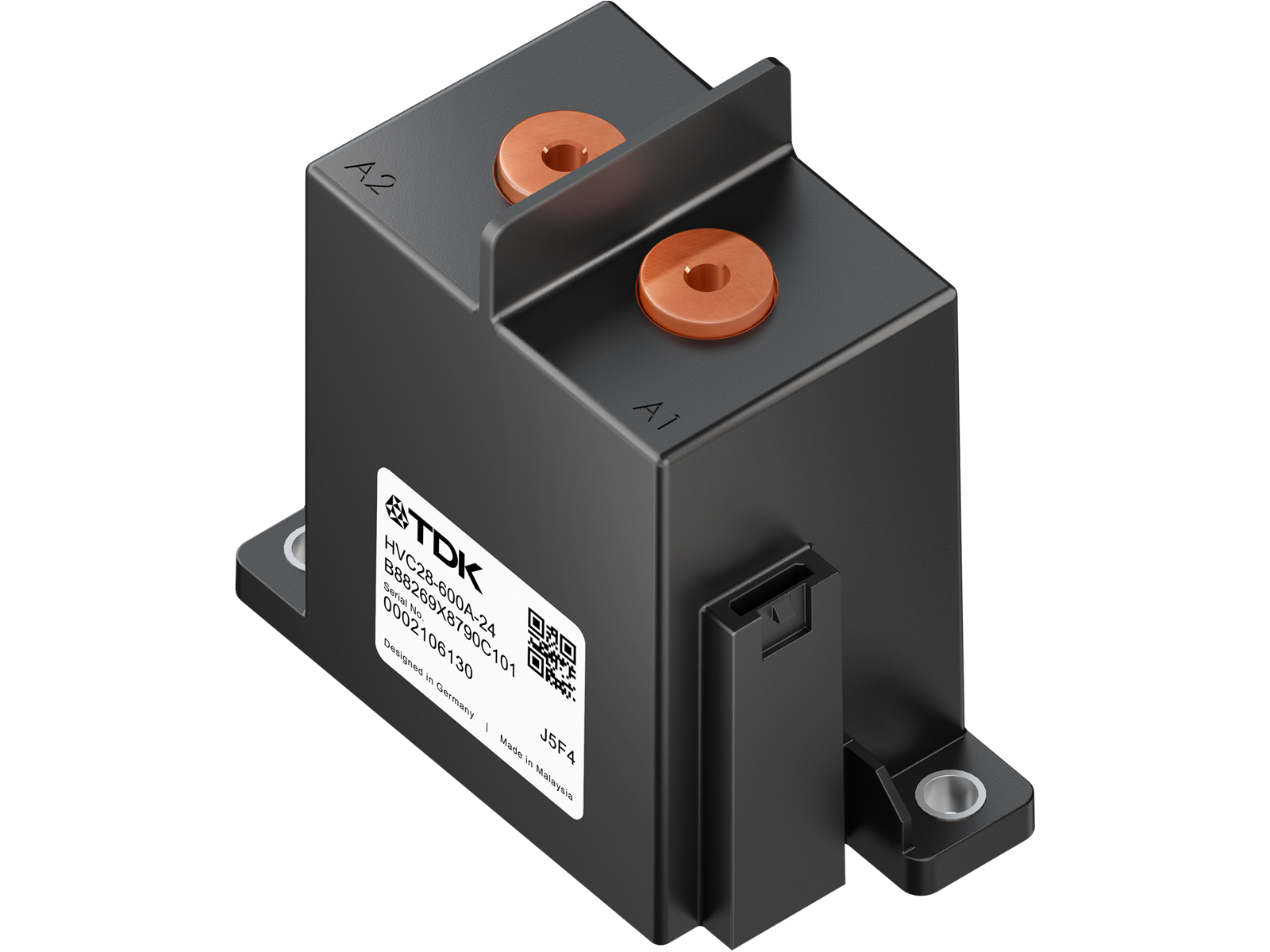
The HVC28 is designed primarily for automotive applications operating at dc voltages up to 1,000 volts (V), including battery disconnect units, high-voltage junction boxes, and traction battery systems in passenger and commercial EVs. The HVC29 is designed for industrial power systems operating at up to 1,500 V, including dc fast-charging stations.

The HVC28 offers continuous current capability up to 600 A and can withstand short-circuit currents of 16 kiloamperes (kA) for 5 milliseconds (ms). Under specified resistive-load test conditions, the contactor can perform one maximum current interruption at 1,600 A and 1,000 V.

The HVC29 also provides continuous current ratings up to 600 A, with short-circuit current handling capability of 6 kA for 5 ms. Its higher voltage rating makes it suitable for dc fast-charging infrastructure and other high-voltage power systems.

Both contactor series use a ceramic, gas-filled arc chamber to interrupt DC currents. Their polarity-free main terminals allow bidirectional current flow, making them suitable for applications where electrical power may flow in either direction. An integrated connector simplifies low-voltage connections and installation.

For additional switching-state monitoring, an optional normally closed mirror contact provides mechanically linked feedback on the position of the main contact. The auxiliary contact complies with IEC 60947-4-1 and can be used to verify whether the main contact has opened or closed, supporting safety-related monitoring in EV electrical systems and charging equipment.

Both series are available with 12 or 24-V single-coil configurations, each consuming six watts (W) at nominal voltage. The contactors measure 95.5 × 96 × 49 millimeters (mm), with the HVC28 weighing approximately 640 grams (g) and the HVC29 weighing approximately 630 g.

The devices operate across a temperature range of −40° to +85° C. Both series are CE and UKCA-compliant, certified to UL 60947-4-1, and compatible with Restriction of Hazardous Substances (RoHS) requirements. China Compulsory Certification (CCC) is pending.

You might also like


Filed Under: Charging, Power Electronics, Technology News
Tagged With: charging, fastcharging, powerelectronics, tdk, tdkcorporation
 

Next Article

← Previous Article
Next Article →


“ee
EXPAND YOUR KNOWLEDGE AND STAY CONNECTED
Get the latest info on technologies, tools and strategies for EV professionals.

Tech Spotlight

  • How binders and coatings hold EV battery cells in place
  • Why high-power EV charging is pushing control integration into one ECU
More Tech Spotlight

Featured Contributions

  • How binders and coatings hold EV battery cells in place
  • How do 800-V EVs charge on 400-V dc fast chargers?
  • Engineering challenges in EV high-voltage connections
  • How hydrogen fits into electric vehicle powertrains
  • How do current-sensing errors propagate through EV motor control systems?
More Featured Contributions

EV TECH TOOLBOX

“ee
Explore the EV Engineering Tech Toolboxes: a collection of high-impact articles that break down the latest EV design trends and technologies. Download to stay aligned with today’s evolving EV design challenges.

Learning Center

EE Learning Center

Sponsored Content

  • Converting custom materials for EV applications
  • Advantech Powers Versatile Electric Vehicle Charging Systems

EV Training Days

ev
Q&A
EV Engineering & Infrastructure
  • 5G Technology
  • Analog IC Tips
  • Battery Power Tips
  • Connector Tips
  • EDABoard Forums
  • Electro-Tech-Online Forums
  • Engineer’s Garage
  • Microcontroller Tips
  • Power Electronic Tips
  • Sensor Tips
  • Test and Measurement Tips
  • Contact Us

Copyright © 2026 Arrowfly LLC. All Rights Reserved. The material on this site may not be reproduced, distributed, transmitted, cached or otherwise used, except with the prior written permission of Arrowfly
Privacy Policy | Advertising | About Us

Search EV Engineering & Infrastructure

  • News
  • Articles
    • Q&As
    • Tech Spotlight
  • Batteries
  • Charging
    • Wireless Charging
    • Vehicle-to-Grid (V2G)
  • Electrification
  • Testing and Safety
  • Learn
    • Learning Center
    • Tech Toolboxes
    • Webinars
  • Resources
    • Digital Editions
    • Diversity & Inclusion
    • Voices
  • Advertise
  • Subscribe