Researchers at Cornell University, working with battery manufacturer Charge CCCV (C4V), have developed a real-time diagnostic approach that reduced lithium-ion battery cell formation time by up to approximately 60% while maintaining comparable cell performance in testing.
Battery formation involves the initial charge and discharge cycles that establish protective interfaces within a cell. These layers play an important role in battery stability and long-term performance, making formation an important consideration for lithium-ion cells used in electric vehicles (EVs) and other applications.
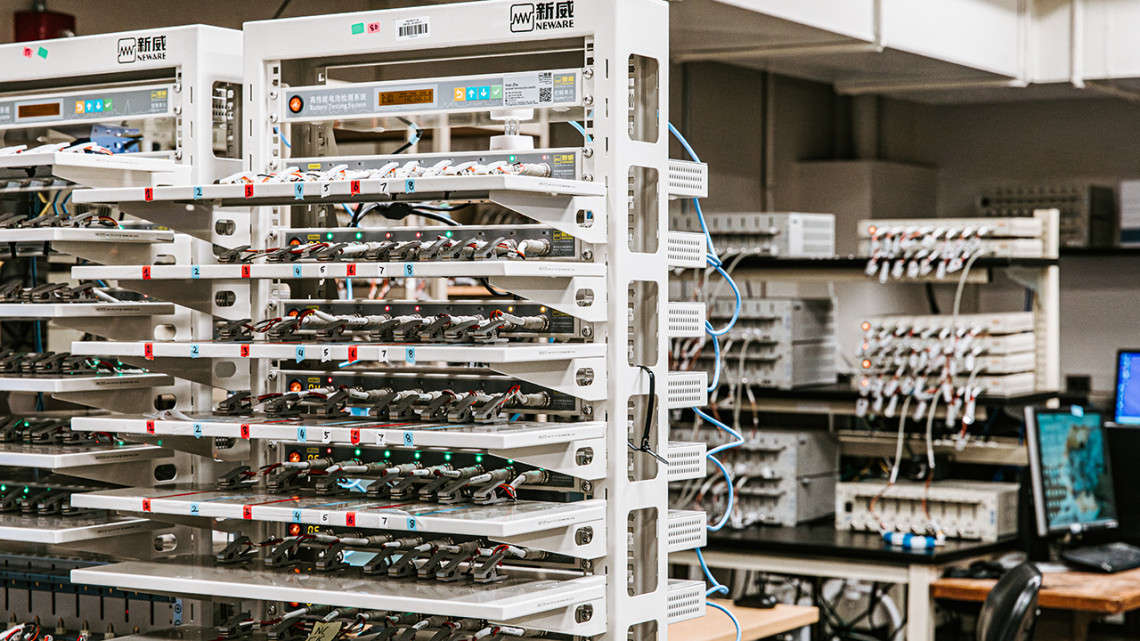
Battery cycler system used by Cornell University’s Kalra research group to evaluate battery performance in collaboration with Charge CCCV. (Image: Allison Usavage/Duffield Engineering).
The research, published October 28 in the journal Energy Storage Materials, combines operando Raman spectroscopy with electrochemical impedance spectroscopy to monitor changes inside battery cells during formation.
Raman spectroscopy allows researchers to observe the chemistry of the protective layers as they develop, while impedance measurements track changes in electrical resistance. Together, the techniques provide insight into processes that are difficult to evaluate using conventional testing methods.
“Evaluating formation processes is typically very trial and error,” said Vibha Kalra, professor of chemical engineering at Cornell University and principal investigator of the study.
The researchers found that slower initial charging helped create more uniform, inorganic-rich protective layers. They also identified opportunities to increase the discharge rate without compromising the formation process.
Resistance measurements stabilized after approximately 1.5 charge-discharge cycles, providing an indication of when key interfacial changes had occurred.
Using these findings, the team developed two accelerated formation protocols. Testing at C4V’s facility demonstrated performance comparable to the company’s conventional process, with formation times reduced by up to approximately 60%.
The results could help battery manufacturers optimize formation procedures while reducing processing time and energy consumption. According to the researchers, formation accounts for approximately one-quarter of a battery plant’s electricity use. Shortening the process could reduce overall factory electricity consumption by an estimated 10% to 15%.
The findings also demonstrate how real-time electrochemical measurements can inform cell processing decisions without relying solely on extended trial-and-error testing.
The research was conducted through the National Science Foundation’s Energy Storage Engine in Upstate New York program, with Cornell and C4V collaborating to translate laboratory findings into manufacturing protocols.
References
- Real-time view inside batteries leads to faster, cheaper battery production, Cornell Chronicle
- Original research paper by Jantakan Nedsaengtip et al., Energy Storage Materials
Filed Under: Batteries, Technology News