Hydrogen is increasingly appearing in heavy-duty vehicle electrification, particularly in applications where battery capacity and charging infrastructure present challenges. Although hydrogen-powered trucks are often discussed separately from electric vehicles (EVs), those using fuel cells still rely on electric motors for propulsion.
The difference is how the electricity is supplied. A battery electric vehicle (BEV) stores energy in a rechargeable battery. A fuel cell electric vehicle (FCEV) carries hydrogen in onboard tanks and converts it into electricity as the vehicle drives. Hydrogen can also be used to generate electricity at a charging site, allowing conventional BEVs to charge where grid capacity is limited.
How a fuel cell powers an electric drivetrain
A proton exchange membrane (PEM) fuel cell generates electricity through an electrochemical reaction between hydrogen and oxygen from the air. The process produces heat and water without combustion.
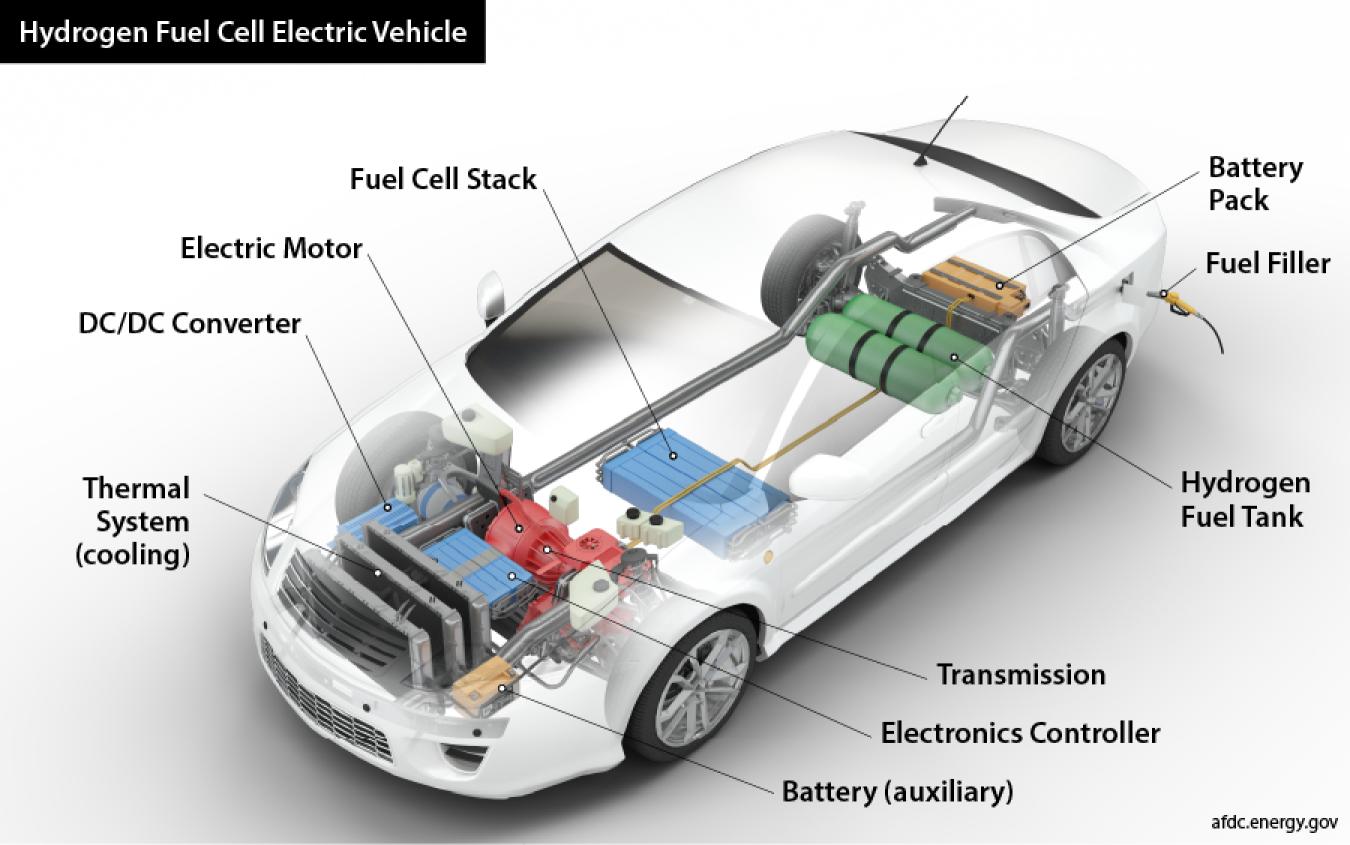
A hydrogen fuel-cell EV generates electricity onboard to power its traction motor, with a battery providing supplemental energy. (Image: US Department of Energy, Alternative Fuels Data Center)
A single cell produces less than one volt under load, so hundreds of cells are connected in series to form a stack. Stack voltage also falls as current increases, which means the output varies with power demand. A dc-dc converter boosts and regulates that output for the vehicle’s high-voltage bus, which supplies the inverter and electric traction motor.
Most FCEVs also incorporate a battery to store energy recovered through regenerative braking. The battery provides additional power when demand increases, allowing the fuel cell to operate more steadily rather than respond directly to every change in motor load. Limiting rapid load changes also helps reduce stack degradation.
PEM stacks typically operate at about 60° to 80° C, which is cooler than a diesel engine. The smaller temperature difference between the coolant and ambient air means heavy-duty FCEVs need larger radiators to reject the same amount of heat.
Hydrogen in heavy-duty electric trucks
For heavy-duty transport, the main benefit of hydrogen is refueling time. A long-haul battery electric truck needs a large battery pack to cover its daily route, and recharging that pack at high power can still take 30 minutes or longer, depending on the charger and the battery’s state of charge (SoC).
Fleets running multiple shifts or tight delivery windows have less room for that downtime. A fuel cell truck carries its energy as compressed hydrogen, allowing refueling times that can approach those of diesel trucks when suitable high-flow infrastructure is available.
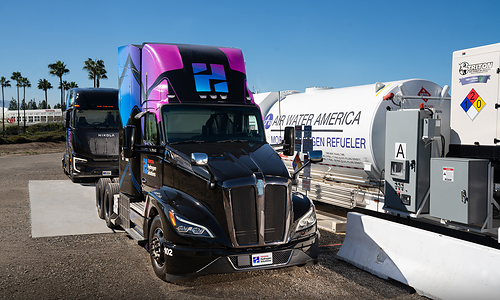
Toyota fuel cell electric trucks at the company’s North American Parts Center in Ontario, California. The vehicles use hydrogen to generate electricity onboard for electric propulsion. (Image: Toyota Motor North America)
Toyota recently demonstrated high-flow hydrogen refueling with the US Department of Energy’s National Laboratory of the Rockies (NLR), which co-developed the technology.
The 70-MPa (700-bar) system delivers hydrogen at rates of up to 300 grams per second, allowing heavy-duty fuel cell trucks to refuel in approximately eight minutes for a reported driving range of up to 450 miles. Testing followed SAE J2601-5, which covers high-flow hydrogen fueling for heavy-duty vehicles.
For long-haul trucks, reducing the time required to replenish energy could limit downtime between freight assignments. Hydrogen contains about 33 kWh/kg on a lower heating value basis, but storing it at 700 bar requires large carbon fiber-wrapped tanks that add mass and take up chassis space. The fuel cell system, cooling hardware, and dc-dc converter also have to be packaged into the vehicle.
Battery electric trucks use electricity directly from the grid, whereas fuel cell trucks add conversion steps. When hydrogen is produced through electrolysis, energy is lost in production, compression, and conversion back to electricity onboard. The result is generally lower overall energy efficiency than direct battery electric operation, although the size of the gap depends on how the hydrogen is produced and where the comparison starts.
Not every hydrogen-electric truck uses the fuel cell as its primary energy source. The SISU Escalate research truck, built by Sisu Auto and under evaluation by VTT Technical Research Centre of Finland, uses a 650-kWh lithium-ion battery alongside a 120-kW fuel cell system. It charges through the Megawatt Charging System (MCS) using infrastructure from Kempower, and its energy management is designed to maximize battery electric driving, with the fuel cell supplying additional energy on longer runs.
A six-month pilot in Finland will evaluate how the two power sources perform during freight operations on a 540-km daily route, including in winter conditions. The architecture keeps plug-in charging while using hydrogen to extend operating range, and the pilot will measure how much battery driving the truck can achieve in daily service.
Generating electricity at EV charging sites
Hydrogen can also play a role in charging infrastructure without any changes to the vehicle’s electric powertrain. Instead of installing a fuel cell onboard the truck, a stationary or portable fuel cell generator produces electricity for a conventional EV charger.
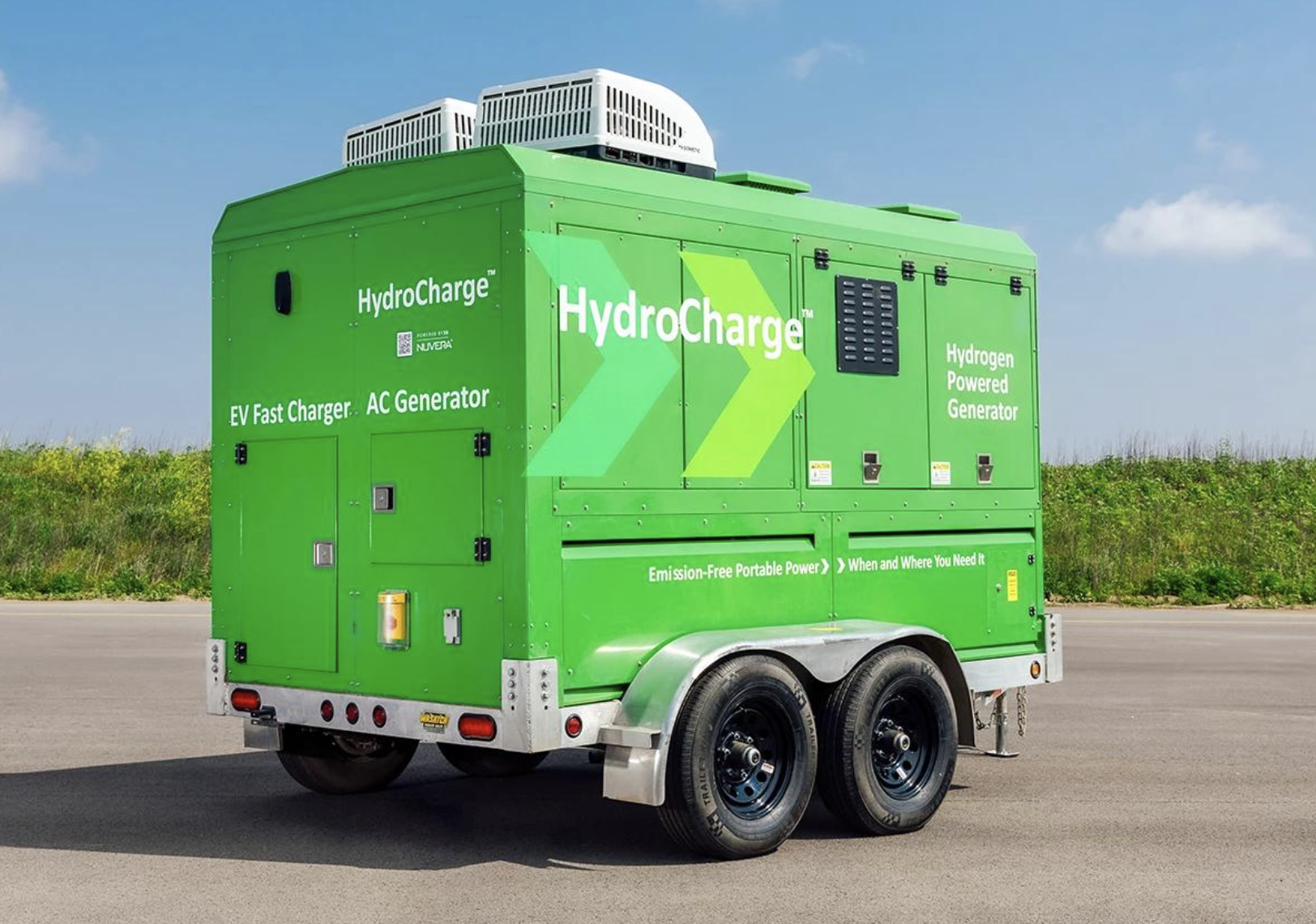
Nuvera’s trailer-mounted HydroCharge unit uses a hydrogen fuel cell generator to power a dc fast charger and ac outlets at sites with limited grid access. (Image: Nuvera)
Nuvera’s HydroCharge system is one example. It combines hydrogen fuel cell generation with dc fast-charging capability for locations where sufficient grid power may not be available.
For fleet depots awaiting utility upgrades, this approach could provide temporary charging capacity. It may also be relevant to remote worksites, where off-highway electric equipment often operates far from a permanent high-power grid connection.
The engineering requirements shift from vehicle integration to managing electrical power at the charging site. Fuel cell output responds slowly to sudden load changes, so it has to be matched to the charger’s operating requirements, particularly where charging demand changes rapidly.
Stationary battery storage can help manage those fluctuations by supplying power during short periods of high demand while the fuel cell operates more steadily.
Hydrogen-generated electricity still carries the energy conversion losses associated with fuel cell operation, so its usefulness depends on the available infrastructure and the requirements of the charging installation.
When hydrogen is used in an FCEV, it isn’t a separate alternative to electric propulsion. It’s another way to supply energy to an electric drivetrain. In heavy-duty transport, engineers must determine whether a battery-only configuration can meet the required duty cycle or whether onboard hydrogen provides a meaningful advantage. For hydrogen-powered charging, the question is whether generating electricity onsite can make up for a grid connection that can’t meet charging demand.
References
- Toyota demonstrates eight-minute hydrogen refueling for heavy-duty trucks, EV Engineering & Infrastructure;
evengineeringonline.com/toyota-demonstrates-eight-minute-hydrogen-refueling-for-heavy-duty-trucks - Sisu truck runs on hydrogen and electricity, VTT; vttresearch.com/en/news-and-ideas/sisu-truck-runs-hydrogen-and-electricity-chargeable-battery-fuel-cell-hybrid-answers
- Introducing HydroCharge, a versatile portable power and EV charging solution, Nuvera; nuvera.com/introducing-hydrocharge-a-versatile-portable-power-and-ev-charging-solution
- How do fuel cell electric vehicles work using hydrogen?, U.S. Department of Energy Alternative Fuels Data Center; afdc.energy.gov/vehicles/how-do-fuel-cell-electric-cars-work
- How fuel cells work, FuelEconomy.gov; fueleconomy.gov/feg/fcv_pem.shtml
- Fuel cells, US Department of Energy Hydrogen Program; hydrogen.energy.gov/program-areas/fuel-cells
- CharIN e. V. officially launches the Megawatt Charging System (MCS) at EVS35 in Oslo, Norway, CharIN; charin.global/news/charin-e-v-officially-launches-the-megawatt-charging-system-mcs-at-evs35-in-oslo-norway
Filed Under: FAQs, Featured Contributions