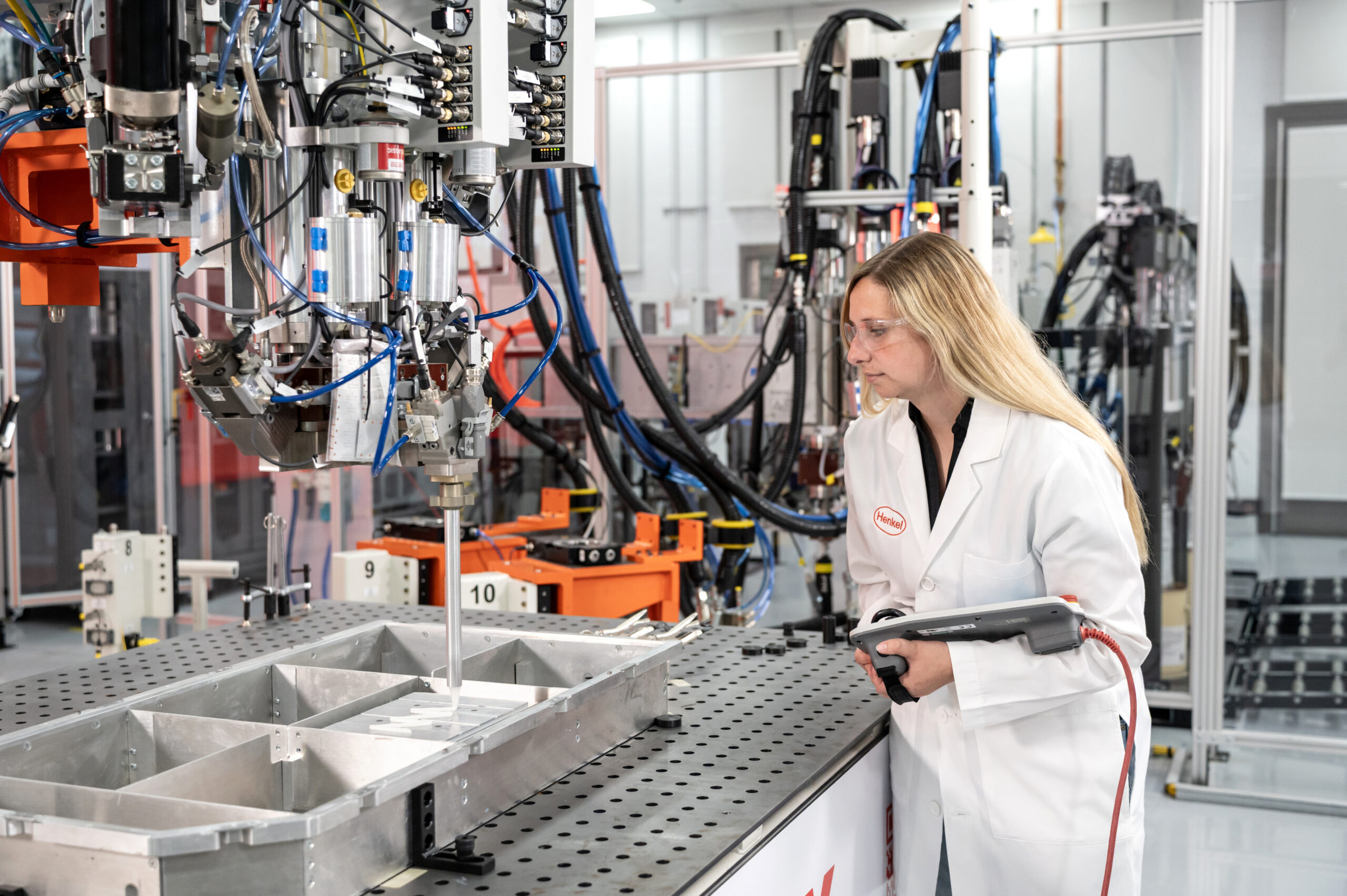
 Henkel will present a range of material technologies for electric vehicle (EV) battery development at The Battery Show North America 2026, with a focus on battery performance, design flexibility, lightweighting, and circularity (Booth 2200).
Conductive coatings & lightweight battery solutions
Henkel will feature battery conductive coatings designed to improve electrode adhesion and conductivity. The coatings provide adhesion between battery current collectors and active material films and can be used in traditional wet slurry and emerging dry electrode manufacturing processes, depending on product specifications and application requirements.
Henkel’s adhesive solutions are designed for lightweight battery architectures, including designs using thermoplastic composite substrates. Depending on the materials, component design, and application, these solutions can reduce weight while maintaining structural integrity, thermal performance, and safety.
Adhesive samples for integrating thermoplastic composite substrates will be displayed.
Battery specialty tapes
Henkel is expanding its portfolio beyond liquid adhesives with a complementary range of battery specialty tapes. The portfolio includes water based technologies formulated with reduced volatile organic compound (VOC) content compared with applicable Henkel solvent based alternatives. Specialty tape samples and representative applications will be displayed at the show.
Loctite Solve
Live demonstrations will feature Loctite Solve, a simulation platform designed to help reduce reliance on physical prototyping and shorten development cycles. Using simulation ready material data cards, the tool provides mechanical, thermal, and viscoelastic property data for standard computer aided engineering environments.
This allows automotive designers to evaluate interfacial stress, adhesive fatigue, and crashworthiness.
Debonding on demand
Henkel will demonstrate its thermal and electrical debonding on demand technologies, which are designed to facilitate component disassembly for repair, reuse, or recycling where suitable recovery processes are available.
Electrical debonding applies a controlled voltage to reduce bond strength, while thermal debonding uses localized heat to detach components under defined process conditions.
Filed Under: Adhesives, Batteries, Technology News