Audi has introduced bidirectional charging capabilities and an updated battery management system in its A2 e-tron electric vehicle (EV). The system combines vehicle-to-load (V2L) and vehicle-to-home (V2H) functionality with coordinated battery thermal management, charging electronics, and software-based energy control. Vehicle-to-grid (V2G) functionality is also planned for future implementation.
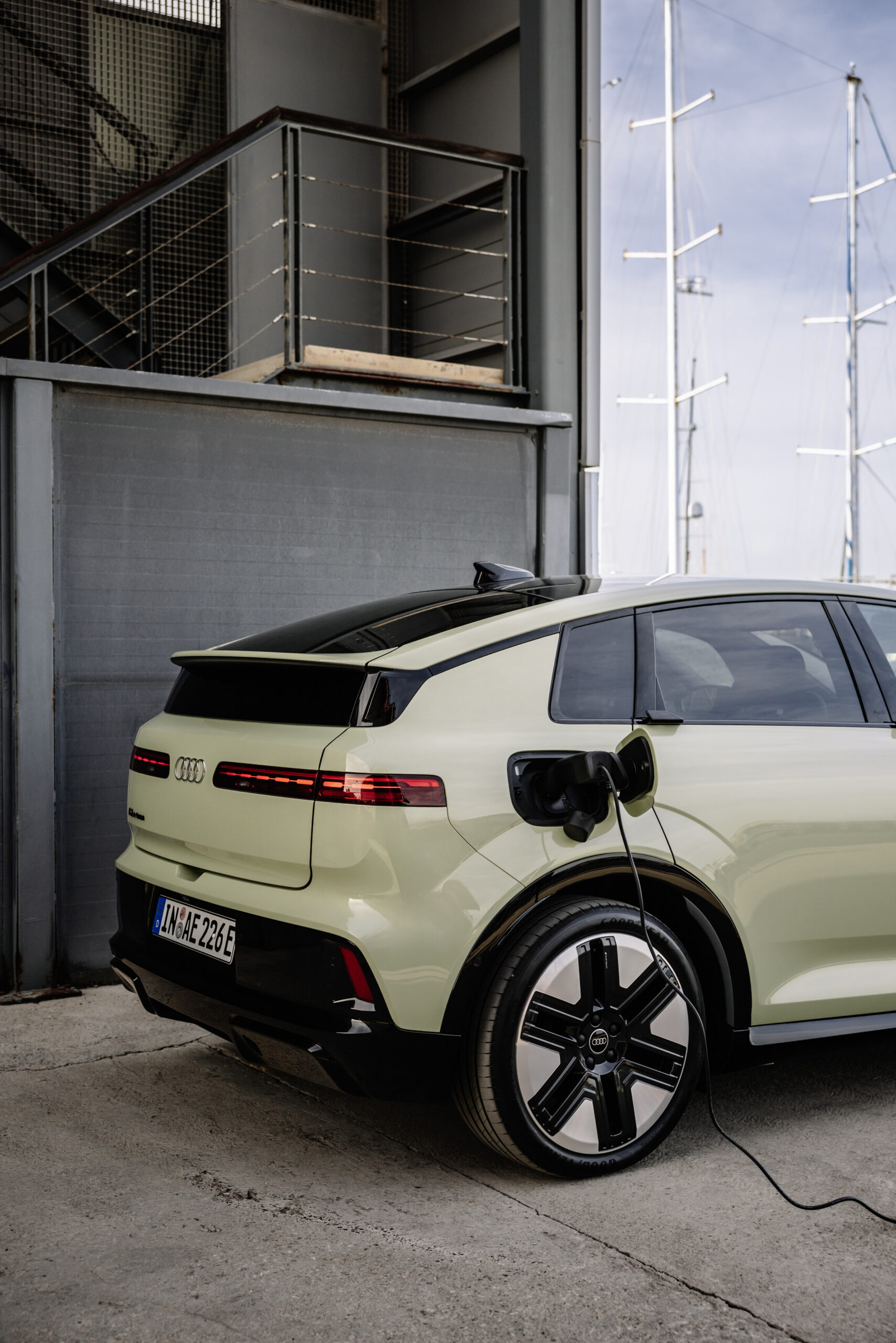 The A2 e-tron is available with three battery capacities: 52, 61, and 84 kWh. The 52- and 61-kWh variants use lithium iron phosphate (LFP) batteries, while the 84-kWh version uses nickel-manganese-cobalt (NMC) chemistry.
The LFP variants incorporate a cell-to-pack architecture that integrates battery cells directly into the pack, increasing packaging efficiency and reducing space requirements.
The battery thermal management system coordinates temperature, current flow, and state of charge during charging and discharging. Its control strategy maintains the battery within defined operating temperature ranges to improve charging consistency and battery performance.
The vehicle also incorporates Audi’s OCDC 2.0 system, which combines the onboard charger and dc/dc converter. The updated design includes additional metal-oxide-semiconductor field-effect transistors (MOSFETs), modified ac output management, and software adjustments to manage power conversion and charging operations.
For battery monitoring, Audi uses an adapted algorithm to improve state-of-charge and aging estimates, particularly for LFP batteries. The relatively flat open-circuit voltage (OCV) curve of LFP cells makes accurate state-of-charge estimation more challenging. The resulting data inform range calculations, charging behavior, and battery operating strategies.
Depending on the configuration, the A2 e-tron provides dc charging capabilities ranging from 100 to 183 kW, with a reported charging time of 24 to 29 minutes from 10% to 80% state of charge under specified test conditions.
The bidirectional charging system extends battery functionality beyond vehicle propulsion. V2L enables the high-voltage battery to power compatible external electrical devices, while V2H allows stored energy to be transferred to a household electrical system through a compatible bidirectional dc wallbox.
V2L operation requires a minimum battery state of charge of 20%. V2H energy transfer operates within a battery charge range of 20% to 80%, with charging and discharging behavior governed by the battery state and configured limits.
Audi also plans to introduce V2G functionality, which would allow stored battery energy to be supplied to the electrical grid. Implementation will depend on compatible charging hardware, electrical infrastructure, regulatory requirements, and market availability.
Filed Under: Charging, Technology News, Vehicle-to-Grid (V2G)