Battery safety is one of the most demanding challenges in electric vehicle (EV) design. When mechanical, electrical, or thermal stress causes a cell to overheat, it can trigger thermal runaway, an uncontrolled chain reaction that leads to self-heating (up to 400° to 1000° C) and can propagate to other cells.

The Smart BPS sensor is a MEMS-based, automotive-grade sensor that provides 24/7 pressure monitoring for early thermal runaway detection in EV battery packs, featuring ultra-low power consumption (<0.2 mA) and a wake-up function for the BMS during parking mode.
As many thermal events occur when the thermal management system is off, continuous pressure monitoring provides the earliest and most reliable warning of such events, even when the vehicle is not operating.
Enter the Smart BPS, an advanced pressure sensor designed specifically for automotive battery management systems (BMS). The sensor combines ultra-low power consumption, flexible configuration, and integrated intelligence to support safer and more efficient battery operation in electric and hybrid vehicles.
Thermal monitoring
The Smart BPS continuously monitors battery pack pressure across all driving, charging, and parked states to detect early signs of thermal runaway before heat or gas buildup can spread between cells.
What makes this sensor truly intelligent is how it operates when the vehicle is turned off. Because most battery management systems are inactive during parking, this period is often overlooked in safety design, even though many real-world thermal incidents occur when vehicles are stationary and unmonitored.
“Thermal runaway detection during parking is essential for safety of life and asset, as well as legislation compliance,” explains Todd La Londe, Director, Churod Americas, Inc. This aligns with new global safety standards such as EVS-GTR Phase 2 and China’s MIIT regulations, which require early detection and warning of thermal events to protect passengers and prevent battery fires.
While in high-power mode, used during driving and charging, the sensor transmits pressure data to the BMS ten times per second while consuming only 7 mA, one-fifth the current draw of previous-generation sensors.
However, in low-power or sleep mode, typical when the vehicle is parked, consumption drops to 0.06 mA, with scan intervals configurable up to two seconds. The sensor can also trigger a wake-up alert to the BMS if it detects pressure above a defined threshold.
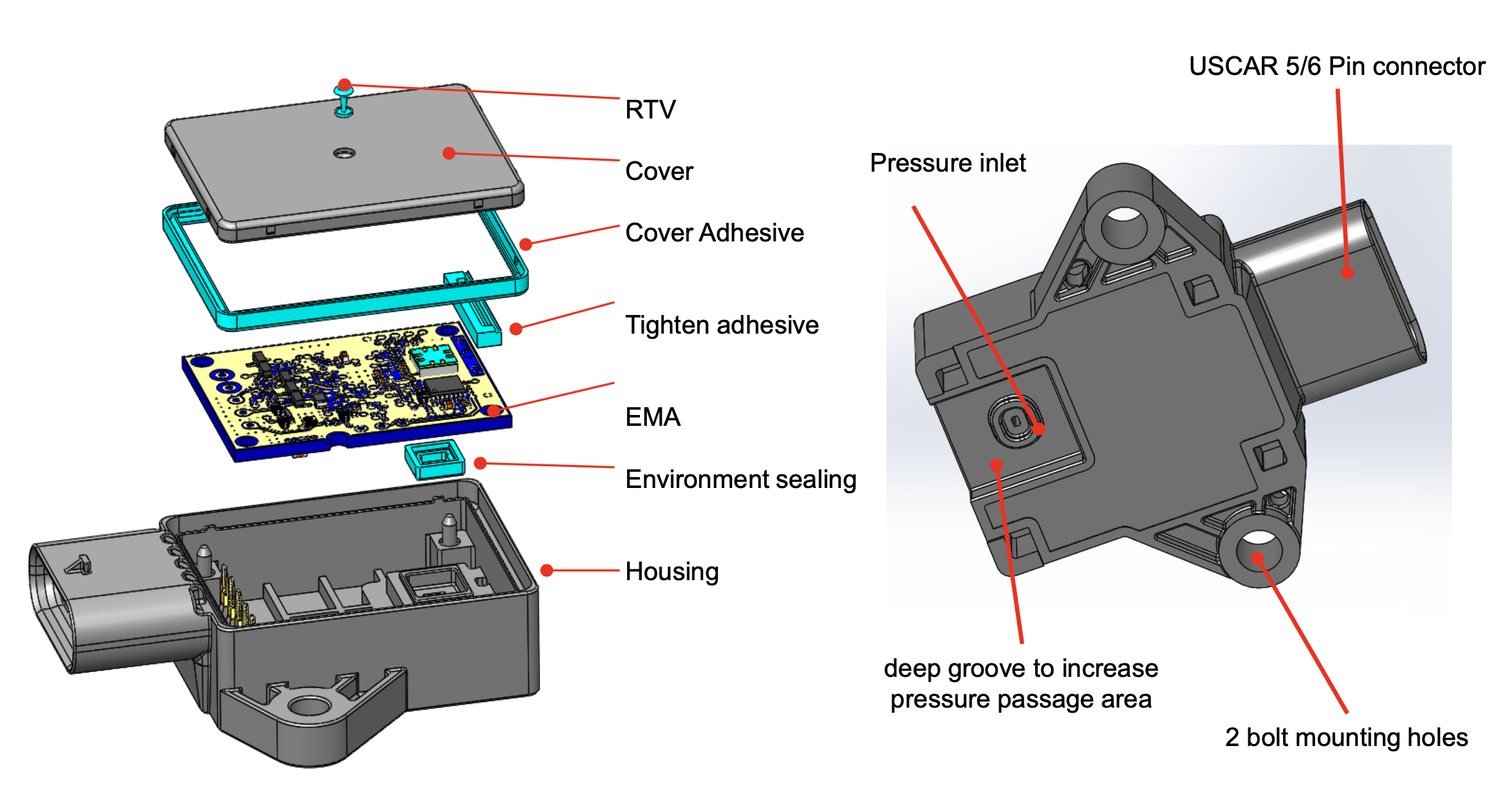
An internal view of the Smart BPS sensor, showcasing the sealed housing, MEMS sensing element, and USCAR connector. Its compact, automotive-grade construction ensures reliable pressure monitoring in harsh EV battery environments.
What’s more: a deep-sleep mode disables monitoring and communication entirely for vehicles in long-term storage, preserving battery life. Configuration of operational thresholds and warning parameters can be customized in software or pre-set at the factory.
Powered directly by the vehicle’s lead-acid battery, the Smart BPS operates in three distinct modes to balance performance and energy efficiency.
“Communication with the BMS occurs via standard automotive network protocols, including CAN, allowing flexible integration across different battery architectures and vehicle platforms,” adds La Londe.
Pressure as the most reliable signal
Research comparing temperature, gas, smoke, and pressure detection has shown that gas and pressure respond fastest to thermal events, with pressure offering the highest feasibility. Pressure sensing is not position-dependent within the pack and provides a clear, early signal that can be enhanced through software algorithms.
“Pack pressure is the best add-on signal for thermal runaway detection,” says La Londe, “Which is well recognized by most OEMs.”
Developed using advanced MEMS technology, the Smart BPS integrates the microprocessor, sensing elements, and electronics into a compact, sealed package measuring 4 × 5.5 mm. The unit is designed for direct mounting on the BMS, eliminating connectors and simplifying system design.

The sensor element uses piezoresistive resistors in a silicon diaphragm to convert pressure changes into precise electrical signals for early thermal runaway detection.
Features include:
- Elimination of false thermal-runaway warnings with high reliability
- Extremely low power consumption in sleep and deep-sleep modes
- Digital communication with BMU wake-up functionality
- Automotive-grade design for harsh environments
- Compact single-unit construction with no position requirement
- Fast response to single-cell thermal events
- Integrated self-diagnostics for safety-critical operation
- Compatibility with pack designs using thermal-electric separation schemes
The Smart BPS provides an intelligent, efficient solution for detecting early pressure changes linked to thermal events, supporting the growing demand for reliable, low-power safety components in advanced EVs.
Filed Under: Featured Contributions, Sensors, Tech Spotlight, Technology News