Navitas Semiconductor has introduced a 2,300-volt silicon carbide (SiC) power module designed for high-power conversion applications, including megawatt electric vehicle (EV) charging infrastructure.
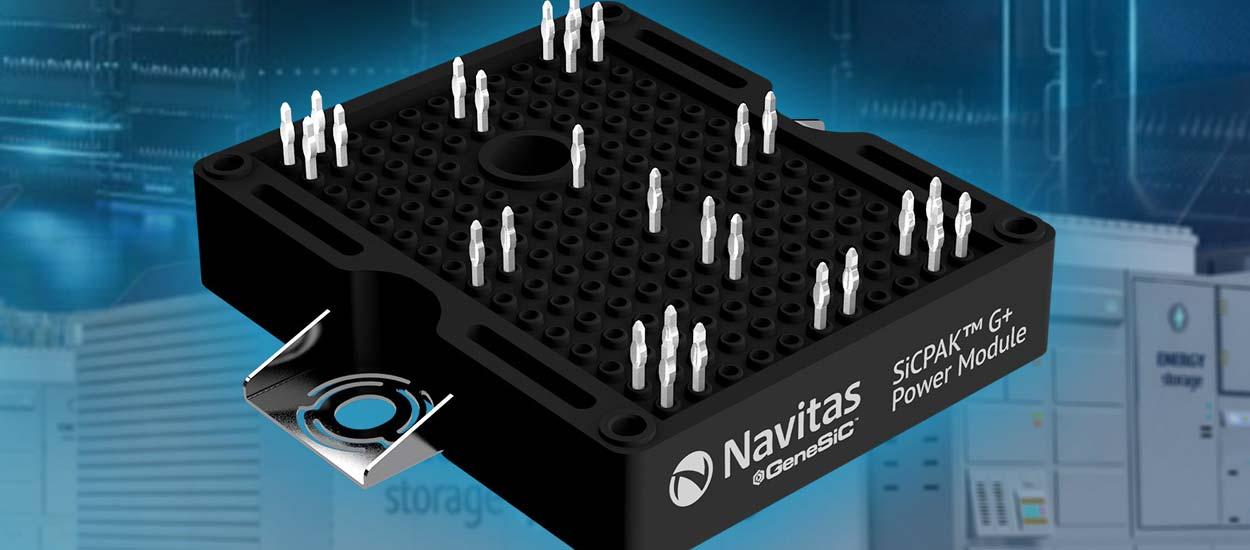 The G4H08MT23GB4 full-bridge module uses Navitas’ fourth-generation GeneSiC Trench-Assisted Planar technology and provides an on-resistance of 8 mΩ. The design is intended to reduce conduction losses and support higher power density in high-voltage converters used for megawatt charging systems.
The module uses an aluminum nitride (AlN) active-metal-braze substrate to improve heat spreading while providing electrical isolation exceeding 5 kV. Its epoxy-resin encapsulation is designed to limit moisture ingress and offers approximately 10 times the thermal conductivity of conventional silicone gel encapsulation, according to Navitas.
High-current press-fit pins provide twice the current-carrying capability per pin compared with standard press-fit connections. An optional pre-applied thermal interface material is also available to simplify heatsink assembly.
The module family is intended to undergo Navitas’ AEC-Plus reliability qualification, which extends beyond standard AEC-Q101 and JEDEC requirements. Testing includes extended power and temperature cycling to evaluate performance under demanding operating conditions.
Samples are available in standard and high-current configurations. Navitas also offers a double-pulse test system for engineers evaluating the module’s switching performance.
The company identifies megawatt EV charging as a primary application, although it has not announced a specific charging installation using the new module.
Filed Under: Charging, Technology News