EV Engineering & Infrastructure

  • News
  • Articles
    • Q&As
    • Tech Spotlight
  • Batteries
  • Charging
    • Wireless Charging
    • Vehicle-to-Grid (V2G)
  • Electrification
  • Testing and Safety
  • Learn
    • Learning Center
    • Tech Toolboxes
    • Webinars
  • Resources
    • Digital Editions
    • Diversity & Inclusion
    • Voices
  • Advertisers
    • Advertise
    • PR Submissions
    • Eblast Submissions
  • Subscribe

Higher-voltage capacitors simplify EV charger designs

By Michelle Froese | November 18, 2026

Vishay Intertechnology has expanded its 259 PHM-SI series of snap-in aluminum electrolytic capacitors with new 550 and 600-V ratings. The devices are designed for high-voltage power electronics, including stationary electric vehicle (EV) chargers and wallboxes.
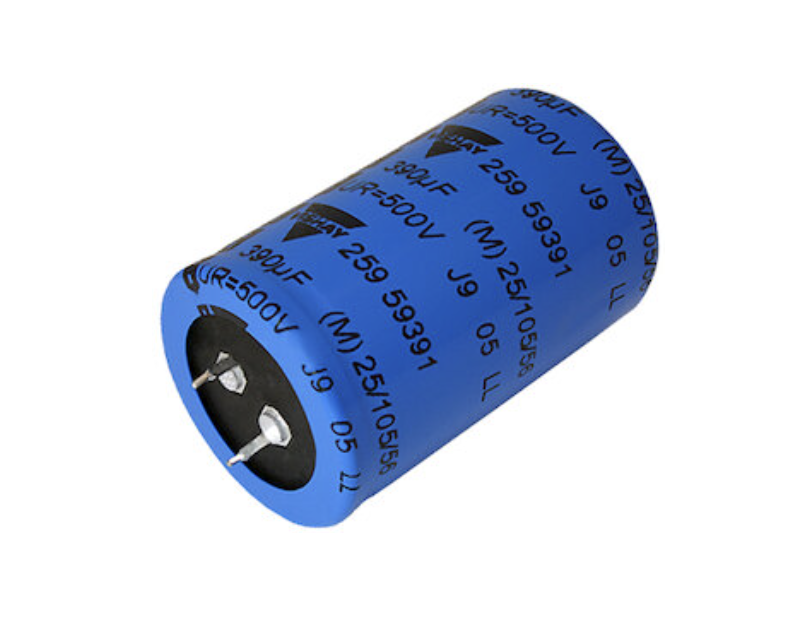
In high-voltage charging systems, capacitors help stabilize dc bus voltage, filter electrical fluctuations, and temporarily store energy during power conversion.

For dc bus voltages between 800 and 1,100 V, engineers have traditionally used three 400 to 450-V capacitors connected in series. This arrangement requires additional voltage-balancing resistors to distribute voltage across the components.

The new higher-voltage capacitors allow designers to reduce the number of devices connected in series, simplifying the overall circuit.

For EV charging applications, the higher voltage ratings affect several aspects of circuit design, including:

  • Fewer components: Higher voltage ratings can reduce the number of capacitors needed in high-voltage charging circuits, simplifying system design.
  • Smaller circuit boards: Using fewer capacitors and balancing components frees up space, helping engineers develop more compact charging equipment.
  • Lower manufacturing costs: Reduced component counts can decrease bill-of-materials (BOM) costs.
  • Improved reliability: Fewer components mean fewer potential points of failure, while additional voltage headroom can help support longer operating life.
  • High ripple-current capability: The capacitors are designed to handle electrical current fluctuations associated with high-power converters, helping maintain stable operation.

The new devices are available in several capacitance and voltage combinations, including 330 µF at 550 V and 600 V in a 35 × 45-mm case. Larger 35 × 55-mm versions offer 470 µF at 550 V and 390 µF at 600 V.

These configurations provide ripple-current ratings ranging from 2.14 to 2.58 A, supporting the demands of high-power conversion equipment.

The capacitors feature cylindrical aluminum cases with insulated sleeves and are available with three-pin keyed-polarity snap-in terminals. Their operating temperature range extends to +105° C, with a specified useful life exceeding 3,000 hours at that temperature.

According to Vishay, the devices can provide more than ten years of service at ambient temperatures up to 60° C under the stated operating conditions. Beyond EV charging equipment, the 259 PHM-SI series supports industrial motor drives, renewable energy inverters, uninterruptible power supplies, and other high-voltage applications requiring energy buffering and filtering.


You might also like


Filed Under: Charging, Technology News
Tagged With: capacitors, charging, powerelectronics, vishayintertechnology
 

Next Article

← Previous Article
Next Article →


“ee
EXPAND YOUR KNOWLEDGE AND STAY CONNECTED
Get the latest info on technologies, tools and strategies for EV professionals.

Tech Spotlight

  • What EV battery health data isn’t telling us
  • How ceramifying coatings protect EV battery enclosures
More Tech Spotlight

Featured Contributions

  • The engineering challenges of high-power EV charging
  • EV Talk: How grid limits are changing EV charging site design
  • What EV battery health data isn’t telling us
  • How are EV battery packs designed for repairability?
  • What field failures reveal about heavy-duty e-axle validation
More Featured Contributions

EV TECH TOOLBOX

“ee
Explore the EV Engineering Tech Toolboxes: a collection of high-impact articles that break down the latest EV design trends and technologies. Download to stay aligned with today’s evolving EV design challenges.

Learning Center

EE Learning Center

Sponsored Content

  • Converting custom materials for EV applications
  • Advantech Powers Versatile Electric Vehicle Charging Systems

EV Training Days

ev
Q&A
EV Engineering & Infrastructure
  • 5G Technology
  • Analog IC Tips
  • Battery Power Tips
  • Connector Tips
  • EDABoard Forums
  • Electro-Tech-Online Forums
  • Engineer’s Garage
  • Microcontroller Tips
  • Power Electronic Tips
  • Sensor Tips
  • Test and Measurement Tips
  • Contact Us

Copyright © 2026 Arrowfly LLC. All Rights Reserved. The material on this site may not be reproduced, distributed, transmitted, cached or otherwise used, except with the prior written permission of Arrowfly
Privacy Policy | Advertising | About Us

Search EV Engineering & Infrastructure

  • News
  • Articles
    • Q&As
    • Tech Spotlight
  • Batteries
  • Charging
    • Wireless Charging
    • Vehicle-to-Grid (V2G)
  • Electrification
  • Testing and Safety
  • Learn
    • Learning Center
    • Tech Toolboxes
    • Webinars
  • Resources
    • Digital Editions
    • Diversity & Inclusion
    • Voices
  • Advertisers
    • Advertise
    • PR Submissions
    • Eblast Submissions
  • Subscribe