Commercial fleets often charge many electric vehicles (EVs) at the same time, overnight or between shifts, at depots originally built for diesel vehicles.

Jed Routh, VP of markets and products, Kempower
Distributed charging systems place the power electronics in central cabinets and assign power to individual charging points throughout each session. That design requires careful planning at the site level, from the utility connection to the cable runs between cabinets and chargers.
The architecture also influences how a depot is designed for future expansion. Decisions made during the initial installation can determine how easily additional charging points are added later, particularly when the depot needs to remain operational during construction.
In this interview, Jed Routh, VP of markets and products at Kempower, explains how these systems allocate power and what engineers should plan for as a fleet grows.
Here’s what he had to say…
What are the biggest engineering challenges in scaling distributed EV charging systems for large commercial fleets?
As fleets scale, the grid connection, rather than the charging hardware, typically becomes the primary constraint. The engineering challenge, therefore, is to serve as many vehicles as possible from a fixed amount of power. Distributed charging addresses this by sharing power from centralized power units across multiple charging points, so capacity is not left idle at unused chargers.
One 2026 analysis of connected public charging sites in North America found that plug count predicts site utilization roughly three times as strongly as installed power, and that distributed charging sites achieve 83% higher utilization than fixed-power dispensers. Other key challenges include planning for future expansion, fitting equipment into constrained depots, and maintaining operations during construction.
How does distributed charging differ from standalone dc fast chargers, and what are the advantages and limitations?
Standalone dc fast chargers each have dedicated power electronics, so capacity can sit unused when a vehicle tapers off or a charger is idle. In a distributed system, power electronics are centralized, and available power is shared dynamically across multiple charging points, with load management built in.
This enables more efficient use of the grid connection, higher utilization, and easier future expansion. However, a potential drawback is higher upfront installation costs, as dc cabling and conduit between centralized power equipment and charging points require more extensive site planning.
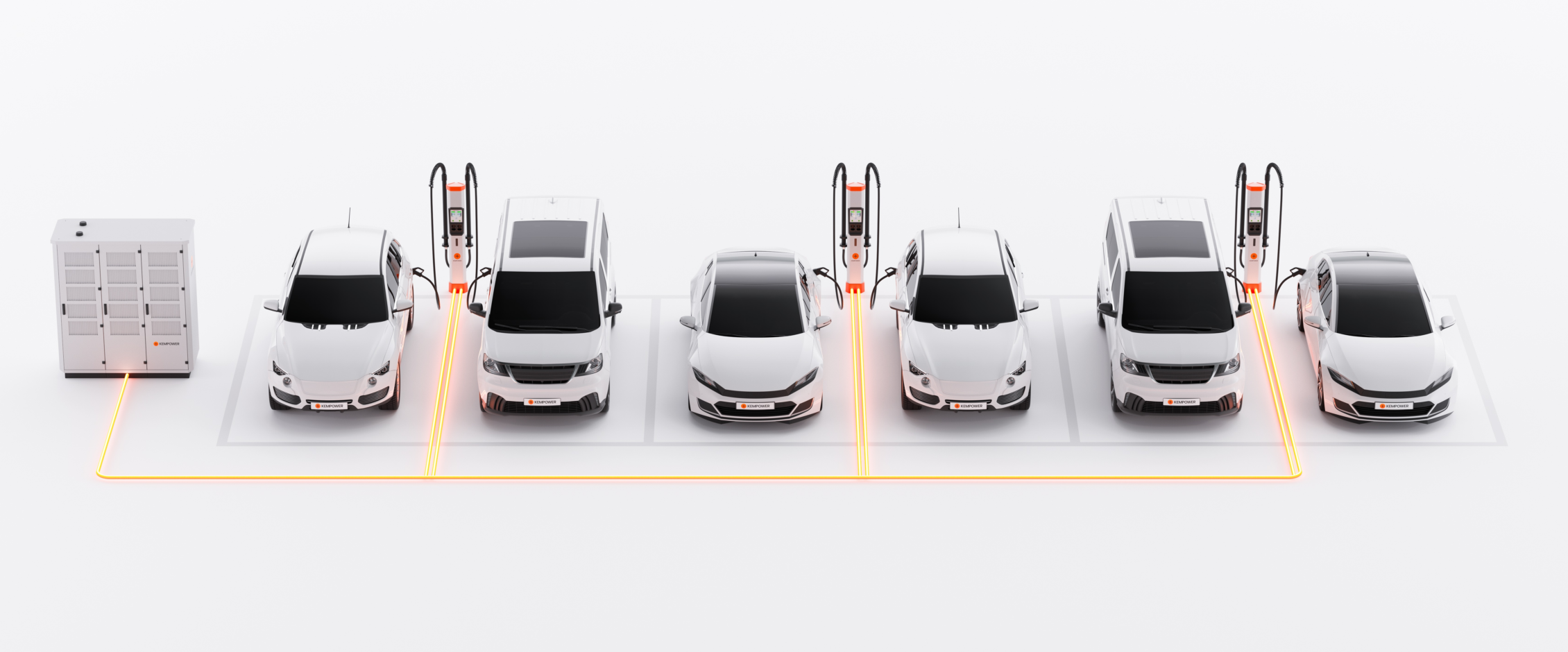
A distributed charging system supplies power from a central cabinet to multiple charging points. (All images: Kempower)
How do distributed charging systems allocate power among vehicles, and what determines how much each receives?
A distributed system continuously monitors each vehicle’s power request, based on its charging capability and state of charge, and allocates power from a shared pool in real time.
Power can be shared in small increments, allowing it to be redirected precisely as one vehicle tapers off and another requires more. The power each vehicle receives depends on its acceptance rate, the total power available at the site, and the rules set by the operator, which can distribute power equally or prioritize vehicles by departure time or operational need.
How can engineers plan for fleet growth when installing high-power charging systems at existing depots?
Engineers should design charging infrastructure with the fleet’s future capacity needs in mind, while taking a phased approach to installation. This includes planning utility connections for future expansion while adding charging power as vehicles arrive. Installing conduit for future charging points during initial construction can allow additional equipment to be added later without extensive groundwork.

Modular charging systems allow operators to add capacity as their electric fleets grow, while continuing to use existing charging equipment.
A modular system can be sized to the depot’s existing capacity and expanded as the fleet grows. Software-based load management and scheduling help keep simultaneous charging demand within available capacity.
Engineers should also consider compatibility with evolving charging standards, including the Combined Charging System (CCS) and Megawatt Charging System (MCS), while planning for future vehicle requirements.
Civil works, including trenching, demolition, and groundwork, can add significant cost, and construction must be phased so the fleet remains operational. Where space is limited, compact equipment is key.
How does distributed charging affect fleet reliability and uptime, and how can engineers incorporate redundancy?
A distributed charging architecture can improve reliability by allowing available power to be shared across multiple charging points. If one charging point is out of service, vehicles may be able to use another while power is redistributed.
Modular power equipment can also provide redundancy, potentially allowing a system to continue operating if an individual module experiences a fault. Additional charging points and power capacity can be incorporated into the site design to provide further redundancy.
What should engineers consider when designing ceiling-mounted charging systems, particularly for cable management and installation?
Safety is the primary consideration. In active depots, cables and connectors must stay clear of vehicles and personnel while remaining easy for drivers to reach.
Overhead installations also typically require integration with third-party equipment such as pantographs and cable reels, as well as gantries, cable trays, and structural approvals. Because every site has different physical and operational requirements, engineers must consider the depot’s layout, equipment placement, and cable management needs when designing an overhead charging system.
Looking ahead, what technical developments could improve the efficiency and scalability of distributed charging systems?
Battery energy storage will play a growing role, enabling sites to scale beyond the limits of their grid connection and manage peak demand. The adoption of MCS across heavy-duty vehicles will also enable larger deployments on common, interoperable infrastructure.
In the longer term, bidirectional charging, which allows energy to flow both to and from vehicles, could enable fleets to support the grid with the energy stored in their vehicles.
Filed Under: Charging, Featured Contributions, Q&As