The COMSOL Boston conference 2026 featured talks, sessions, and posters on simulating the effects of PCB trace geometry on ESD, charging of EV batteries, and simulations in the design of electric race cars.
Engineers and scientists gathered near Boston to learn how others use COMSOL Multiphysics simulation software and what to expect from COMSOL version 2027. The three-day conference ran for three days, consisting of keynote addresses, one-hour mini courses, application posters, and exhibits from COMSOL partners.
In a popular mini-course, COMSOL’s Bjorn Sjodin introduced COMSOL 2027. The 2027 release highlights (Figure 1) include:
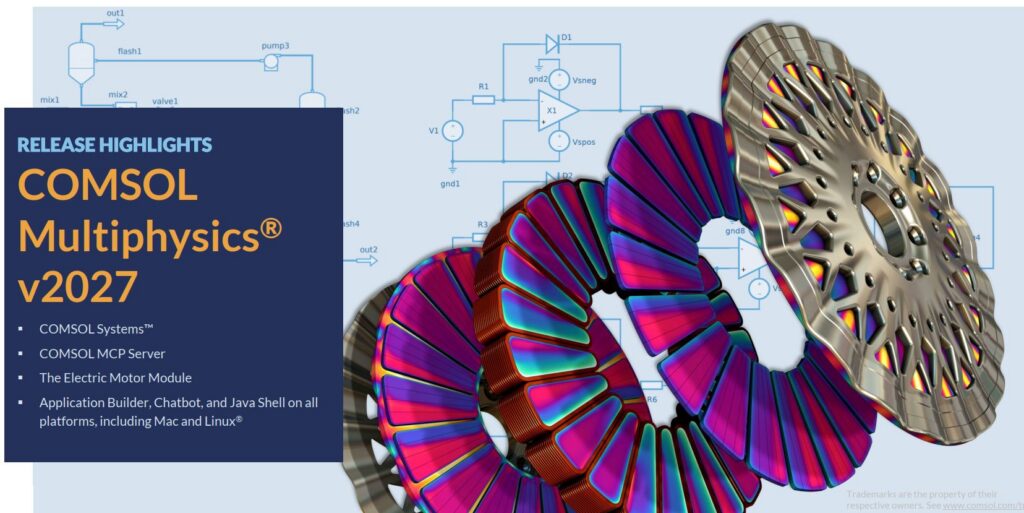
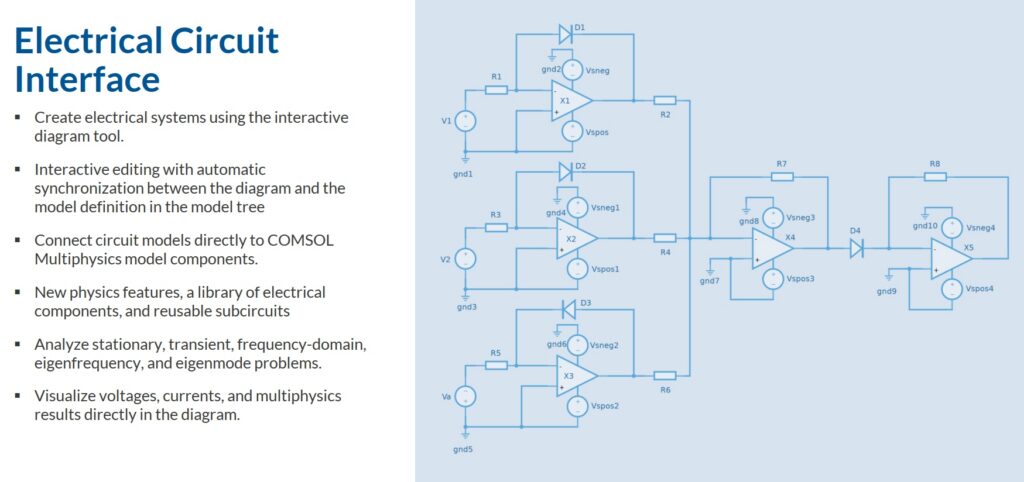
COMSOL Systems, which integrates COMSOL’s Electrical Circuit (Figure 2), Flowsheet, and Generic System through interfaces. An electrical component library includes 5000 models of analog components such as op amps, capacitors, resistors, and transistors. Engineers can import SPICE models to bring more components into the library.
COMSOL’s MCP server connects AI Agents so that scientists and engineers can use them to develop solutions to problems by creating models, processes, and equations.
The Electric Motor Module lets users simulate motors and create efficiency maps. Simulations take into account the motor’s material properties and lets engineers It’s time-periodic solver can find when a motor reaches steady state.
COMSOL 2027 also includes a host of other new features. One such feature declutters diagrams, letting users see some details while hiding others from view but not from the models themselves. For example, a line or curve may consist of many data points. If you’re not interested in seeing every data point, COMSOL 2027 can remove them, producing a smooth curve from one that shows discrete data points.
Another feature hides parts of a system model, letting you see only those components of interest. Finally, COMSOL 2027 brings the software’s chatbots, Application Builder, and Java Shell to Mac and Linux versions, in addition to already having those features on Windows.
Mini-courses
COMSOL engineers provided a series on mini-courses, each aimed at a specific audience. A mini-course presented by Xiaojun Zhu focused on electric discharge; Zhu looked at the physics of sparks and why they occur. Simulations take into account the physics and chemistry of circuits, which is different from what EEs usually think of ESD. EEs tend to focus on how current from static discharges couples into PCB traces, creating current that can damage sensitive components, and how to prevent damage.
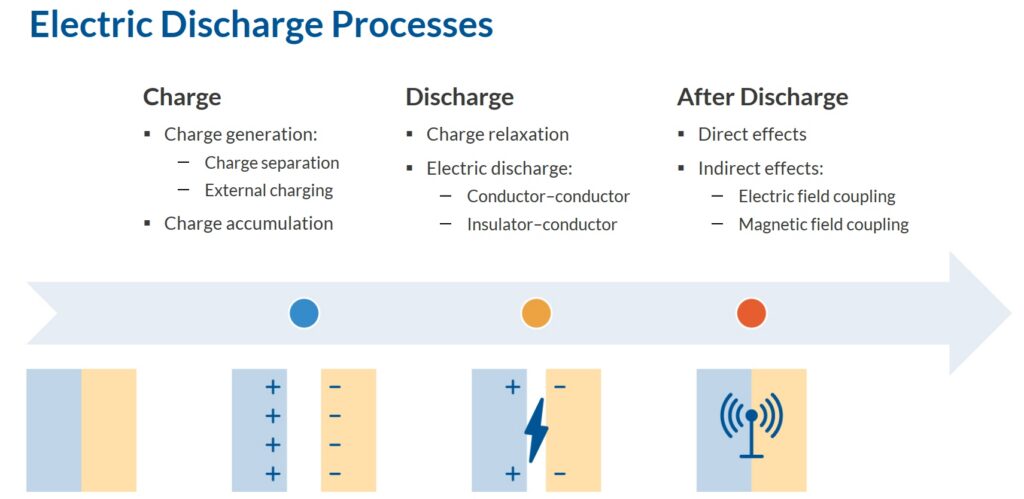
Instead, the course covered the chemistry of insulation and various types of discharges: gas, liquid, and solid. While showing Figure 3, Zhu discussed why charges build, how they discharge, and how electric and magnetic fields couple into other components and systems. It’s the coupling and the damage it can cause that are of most interest to board and system designers.
Poster: PCB design effects e-fields from ESD
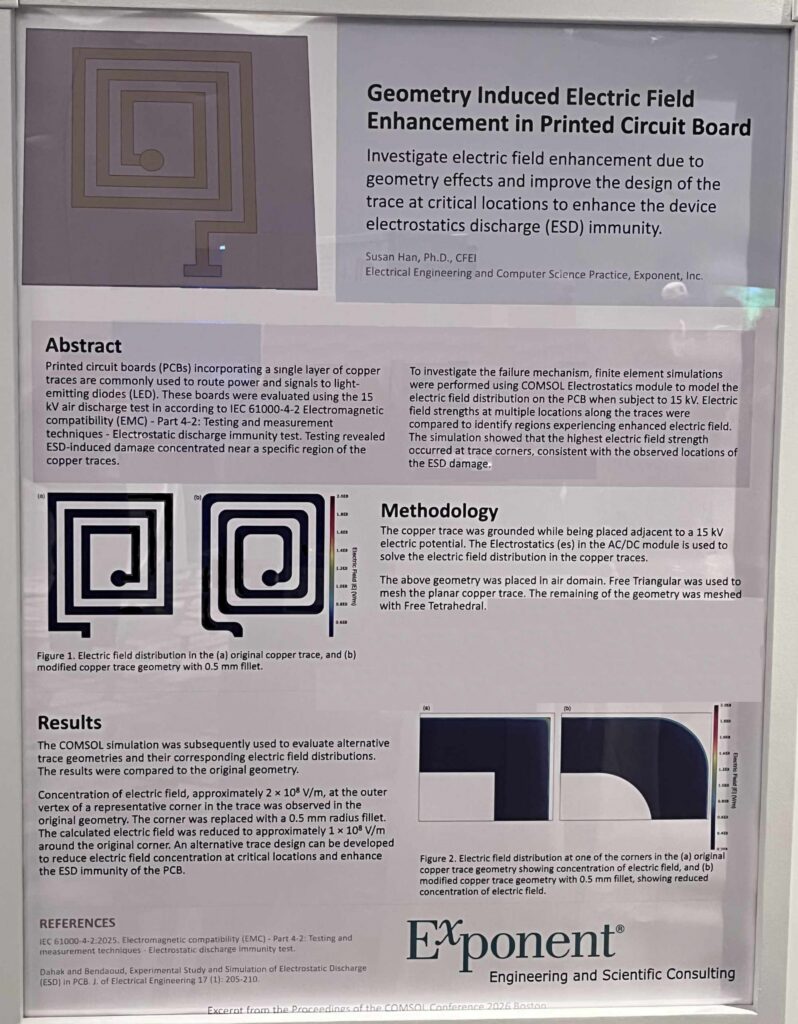
At the COMSOL conference, posters gave attendees a chance to see applications covering simulations across many facets of engineering and science. One poster explained how Susan Han of Exponent used COMSOL Multiphysics to simulate electric-field distributions in PCB traces and investigate electric-field enhancement caused by trace geometry.
“The purpose of the study was to investigate the trace geometry effect and demonstrate that the induced local electric field can be affected by trace geometry,” said Han. “The results help explain why ESD-related damage may occur at certain geometry features. It also provides a potential design consideration — modifying local geometry may reduce electric field concentration without making substantial changes to the PCB design or materials.”
The poster shown in Figure 4 compares the electric-field distributions around right-angle and rounded corners in PCB traces under conditions representing a 15-kV air-discharge ESD test according to IEC 61000-4-2. In the simulation, Han used COMSOL’s Electrostatics Module to calculate an electric-field concentration of approximately 2×10⁸ V/m at a sharp trace corner. Replacing the corner with a 0.5 mm radius fillet reduced the calculated electric field to approximately 1×10⁸ V/m.
In the simulation, Han placed a 15 kV charged thin plate adjacent to the PCB for the trace-induced electric field calculation instead of applying a waveform.
Keynote address: EV battery charging
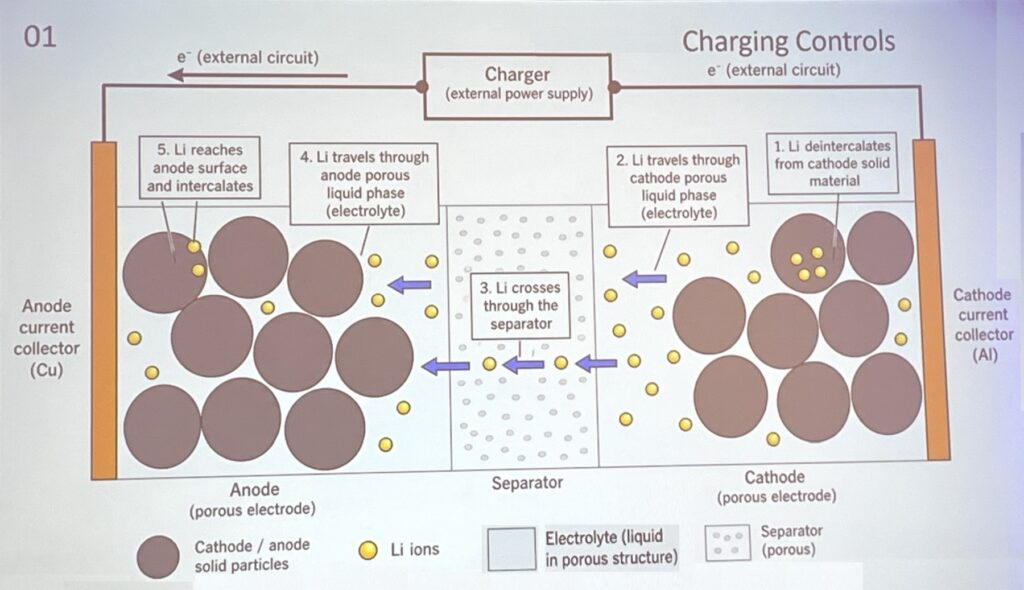
Two keynotes given on Wednesday, October 7 covered EVs and their batteries. In “From atoms to wheels,” GM’s Taylor Garrick explained the physics behind fast charging of EV batteries and how engineers are working to shorten charging time. He covered electrochemical models and how simulations monitor battery heat while charging.
The slide in Figure 5 shows what takes place inside the battery during charging. Lithium passes through the separator, but lithium plating is an issue based on temperature, which of course, varies widely. COMSOL calculates battery temperature and simulates charging under numerous temperature conditions. When cold, the batteries reach their electrochemical limits and charge slowly.
Keynote address: Electric race cars
When it comes to EVs, it’s all about the batteries. That includes Formula E electric race cars. At the conference, COMSOL announced that it had signed a contract making it the official multiphysics partner of ABB FIA Formula E World Championship, a series of races for Formula E cars.
I spoke with Dan Cherowbrier following his keynote address, where he discussed how using COMSOL has helped engineers develop batteries for the Gen 4 electric race car (Figure 6) that are smaller, lighter, and hold more charge than previous generations. “It’s about energy density,” said Cherowbrier.

While energy density is a challenge, there are other engineering challenges that go into electric race cars, such as cooling of the electronics. A Formula E car has ten cameras, nine of which provide different views for a TV audience. The tenth, a high-frame-rate camera, lets the crew see the driver’s face; it’s purely for safety use. Another camera shows a view of the instrument panel; the two are time-synchronized so crews can see both the driver’s face and instrument panel at the same time in case something goes wrong.
The cameras generate a lot of data that needs processing and transmitting to the crew and for streaming of a race. Data then travels over the internet for post-processing in the UK. The data-processing electronics need cooling, especially if a race takes place in a hot or humid climate such as Saudi Arabia or southern China.
Keeping the cameras and processing electronics cool also depends on whether the car is still or moving. When still, there’s insufficient airflow, so crew members blow air over the heat sinks. They’ve even used dry ice, but it can damage components on a circuit board, so cool air is channeled to pass over the heat sinks, not the electronics.
Engineers use COMSOL to simulate the antennas needed on a race course. That’s because they can’t install the antennas ahead of time. “The antennas collect the camera data from the car, which is harder than you might assume,” said Cherowbrier. “For one thing, the car is traveling at 200 miles an hour, and there are 24 of them in the race.”
“We have to place the antenna network in the course in about 48 hours. We have to build the antenna network, and we don’t get to test it until the cars go out on the track for real, so doing that installation is quite something.”
The 2027 Boston COMSOL conference will take place in the City of Boston’s Seaport. Attendees from outside the area will find it more exciting than at a suburban hotel.
Filed Under: EE World - EV ENGINEERING, FAQs, Featured, Technology News