EV Engineering & Infrastructure

  • News
  • Articles
    • Q&As
    • Tech Spotlight
  • Batteries
  • Charging
    • Wireless Charging
    • Vehicle-to-Grid (V2G)
  • Electrification
  • Testing and Safety
  • Learn
    • Learning Center
    • Tech Toolboxes
    • Webinars
  • Resources
    • Digital Editions
    • Diversity & Inclusion
    • Voices
  • Advertise
  • Subscribe

Resin film could reduce EV battery cell weight by 10%

By Michelle Froese | August 3, 2026

Toray Industries has developed a resin-film substrate designed to replace conventional copper foil in lithium-ion battery anode current collectors, with potential applications in electric vehicle batteries.

The film supports current collectors made with an ultrathin copper layer deposited on a resin substrate. According to Toray, the material provides the reduction resistance, copper adhesion, mechanical strength, and thermal stability required for use on the anode side of a lithium-ion cell.
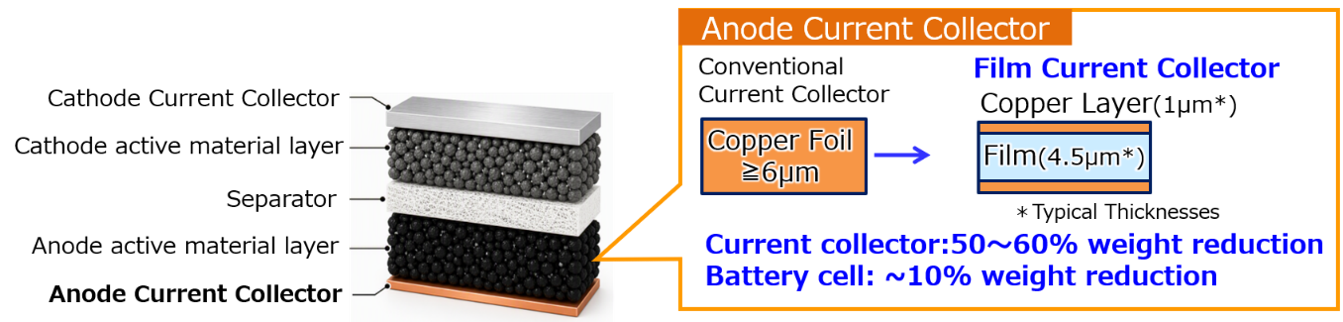
Comparison of conventional copper foil anode current collector and film current collector.

Polyethylene terephthalate films can be used in some cathode current collectors but can degrade in the strongly reducing environment of the anode. Toray developed the new substrate using its polymer alloy and film-forming technologies to improve chemical durability while maintaining structural and thermal performance.

In cell testing, current collectors made with the film delivered performance comparable to conventional copper-foil current collectors. Toray says the film also provides mechanical strength similar to copper foil and low thermal shrinkage.

The resulting current collector is 50% to 60% lighter than a conventional copper-foil design and could reduce total battery cell weight by approximately 10%. For EV battery designers, reducing inactive cell mass could improve gravimetric energy density or allow more active material to be added without increasing overall cell weight.
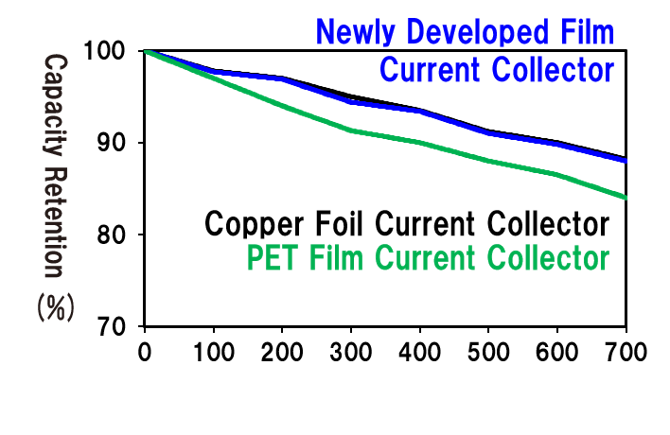
Toray assessment of capacity retention during battery cycling tests.

Toray estimates that using the saved weight to add more active material could extend EV driving range by up to 10% under certain conditions. Reducing copper content could also lower material use and limit exposure to fluctuations in copper supply and pricing.

Toray produced a 4.5-micron standard-grade film using mass-production equipment and has begun supplying samples to customers.

The company is initially targeting mobile devices, drones, and electric vertical take-off and landing aircraft while evaluating the material for larger batteries used in electric vehicles and energy storage systems.

You might also like


Filed Under: Batteries, Technology News
Tagged With: batteries, lithiumion, testing, toray
 

Next Article

← Previous Article
Next Article →


“ee
EXPAND YOUR KNOWLEDGE AND STAY CONNECTED
Get the latest info on technologies, tools and strategies for EV professionals.

Tech Spotlight

  • Why high-power EV charging is pushing control integration into one ECU
  • Designing safety into the cell: The case for system-level solid-state batteries
More Tech Spotlight

Featured Contributions

  • How do two-level and three-level inverter topologies compare in EVs?
  • Inside the development of the Megawatt Charging Standard
  • How does fault-tolerant control keep an EV operating after a sensor failure?
  • Q&A: How EV architectures are changing high-speed connectivity
  • How to catch EV faults before they become failures
More Featured Contributions

EV TECH TOOLBOX

“ee
Explore the EV Engineering Tech Toolboxes: a collection of high-impact articles that break down the latest EV design trends and technologies. Download to stay aligned with today’s evolving EV design challenges.

Learning Center

EE Learning Center

Sponsored Content

  • Converting custom materials for EV applications
  • Advantech Powers Versatile Electric Vehicle Charging Systems

EV Training Days

ev
Q&A
EV Engineering & Infrastructure
  • 5G Technology
  • Analog IC Tips
  • Battery Power Tips
  • Connector Tips
  • EDABoard Forums
  • Electro-Tech-Online Forums
  • Engineer’s Garage
  • Microcontroller Tips
  • Power Electronic Tips
  • Sensor Tips
  • Test and Measurement Tips
  • Contact Us

Copyright © 2026 Arrowfly LLC. All Rights Reserved. The material on this site may not be reproduced, distributed, transmitted, cached or otherwise used, except with the prior written permission of Arrowfly
Privacy Policy | Advertising | About Us

Search EV Engineering & Infrastructure

  • News
  • Articles
    • Q&As
    • Tech Spotlight
  • Batteries
  • Charging
    • Wireless Charging
    • Vehicle-to-Grid (V2G)
  • Electrification
  • Testing and Safety
  • Learn
    • Learning Center
    • Tech Toolboxes
    • Webinars
  • Resources
    • Digital Editions
    • Diversity & Inclusion
    • Voices
  • Advertise
  • Subscribe