Researchers at the University of Tennessee, Knoxville are developing a 150-kW integrated charger-inverter (ICI) system that would let electric vehicles (EVs) use their existing traction power electronics for battery charging.
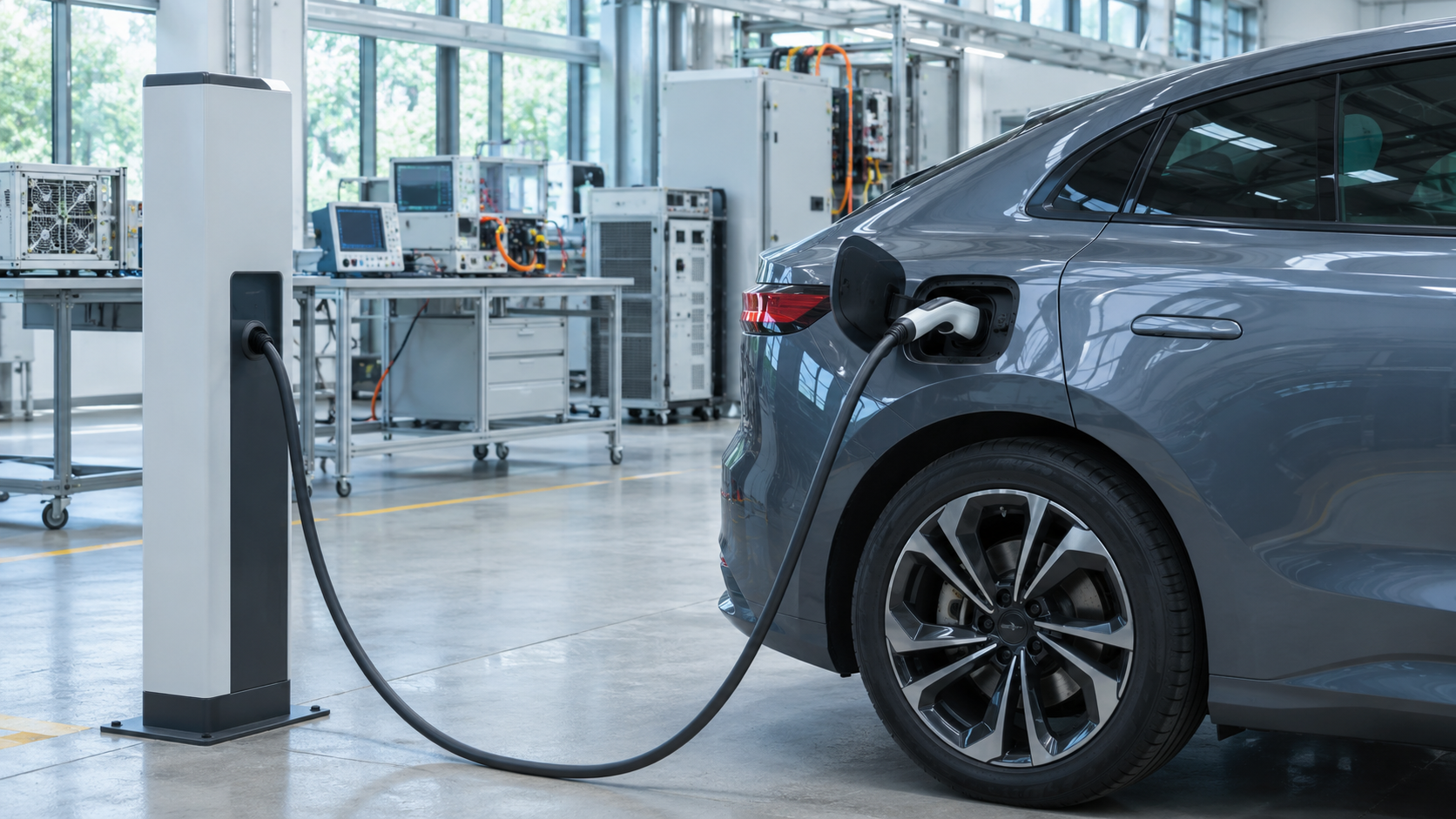 Most EVs use separate systems for charging and propulsion. An onboard charger converts incoming ac power into dc power for the battery, while the traction inverter converts battery dc power into ac power for the electric motor.
“The traditional on-board charger technologies in many existing EVs have very limited power management capability, resulting in very slow charging speed from common power sources,” said JiangBiao He, an associate professor in the Min H. Kao Department of Electrical Engineering and Computer Science at the University of Tennessee.
The proposed ICI architecture combines these functions, so traction inverter components handle charging and propulsion. The approach could reduce the size, weight, and cost of EV power electronics while accepting power from ac or dc sources. The design also includes vehicle-to-grid capability.
The research is part of a $3.17-million project funded by the US Department of Energy (DOE) in 2024 and led by Western Michigan University professor Sandun Kuruppu. Collaborators include Oak Ridge National Laboratory, the University of Kentucky, BorgWarner, and John Deere.
Western Michigan University led development of an initial 15-kW prototype. In summer 2026, He’s team at the University of Tennessee took over development of the full-scale 150-kW system, investigating hardware and control techniques that would allow efficient fast charging from almost any standard power source.
“Charging flexibility is one of the major advantages of our ICI concept,” said He. “For existing EVs on the market, drivers have to drive to one of very few fast charging stations, which is very inconvenient. They also have to plan their trips carefully around where fast charging stations are available. With the ICI, you would be able to charge the vehicle anywhere there is an ac or dc power source.”
References
- UT spearheads development of novel integrated EV charger-inverter, University of Tennessee, Knoxville
- $3.17 million grant will energize electric vehicle research at WMU, Western Michigan University
Filed Under: Charging, Technology News