Honda R&D Co., Ltd., Taisei Corporation, and Taisei Rotec Corporation have developed a magnetic-coupling wireless power transfer (WPT) road system designed to charge electric vehicles (EVs) while they are moving. Public-road demonstration testing is planned for Japan’s 2027 fiscal year.
The system combines Honda’s power receiver and transmitter technology with Taisei’s dc power supply system and Taisei Rotec’s technology for embedding charging equipment into road surfaces. Development is aimed at applications ranging from passenger EVs to large commercial electric vehicles.
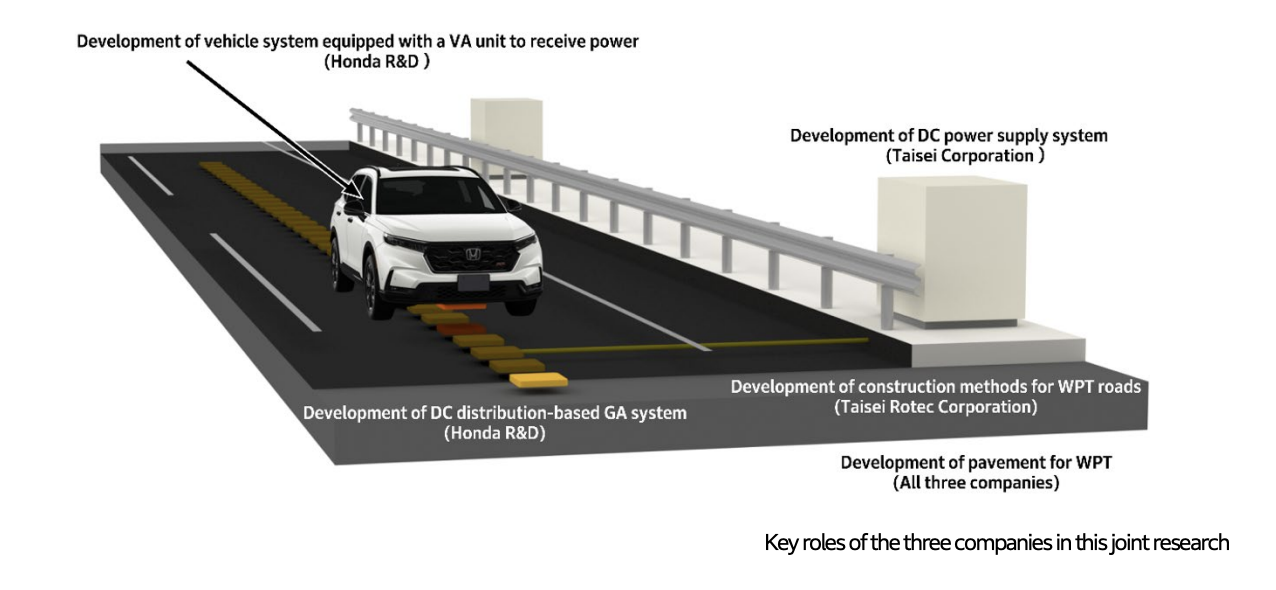 The companies began joint research in 2025 and have tested the technology at the Future Technology Field for Taisei Group/Satte. Testing has included the WPT system, pavement structures, and construction methods for commercial vehicles.
The dynamic wireless power transfer system uses a ground-based dc power supply, transmitter units embedded in the roadway, and a receiver installed on the vehicle. Each embedded unit integrates an inverter and coil, while the dc distribution architecture is intended to reduce roadway wiring and component requirements.
The roadway equipment and surrounding pavement are being designed to withstand vehicles with gross weights of approximately 20 tons. The system can also be installed in existing pavement using milling and embedding methods.
Further testing will include power levels of up to 150 kW for large commercial EVs, higher vehicle speeds, electromagnetic field leakage, and long-term pavement durability equivalent to one million wheel loads.
A new test roadway is planned for late 2026 at the Future Technology Field for Taisei Group/Tamura. Honda, Taisei, and Taisei Rotec also plan to participate in the Tateyama Project on the Tateyama Expressway in Chiba, Japan, with public-road testing scheduled to begin during fiscal 2027.
Filed Under: Technology News