One approach to testing battery management systems (BMS) for electric vehicles is to do so on the signal level. This method enables safe, early validation of key control and communication functions before high-voltage hardware is involved. The focus here is on testing the main functions of the BMS and its interaction with the vehicle network or any other environment. Plus, this is all done without using high voltages.
In this approach, the BMS main controller is the device under test. The battery cells and all of the cell supervision circuits or CSCs are simulated.
“To enable early testing, the cell controllers, or in other words the CSCs must be simulated,” explained Connor Foley, senior application engineer at dSPACE Inc., which provides advanced tools for simulation, testing, and validation. “For the corresponding test solution, this means that the registers, logics, and functions of the simulated CSC chips must be implemented in the test solution.”
In addition to the CSCs, their communication with the BMS must also be simulated in the context of this use case. In the real world, the CSCs communicate with the main BMS controller via a communication protocol.
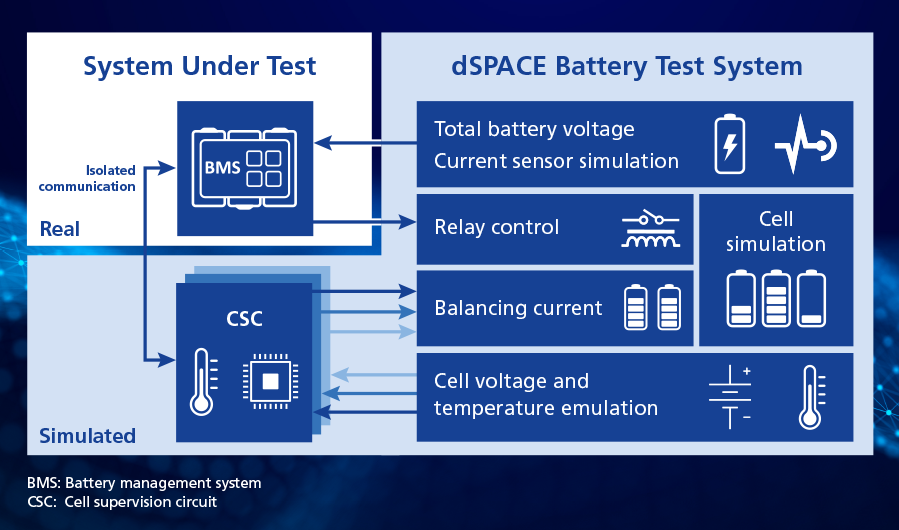
The dSPACE Cell Controller Virtualization (CCV) solution enables simulation of cell supervision circuits (CSCs) and their communication with the main battery management system (BMS) controller.
When testing the main BMS controller in an HIL environment with simulated CSCs, the test system must, therefore, support this protocol.
In the past, it was very common to use standard CAN communication for this.
“In this case, setting up the simulation environment was quite simple, as CAN had already been in use for decades,” said Foley. “However, today there’s a trend towards chip-supplier-specific, isolated protocols, such as isoSPI or Vertical Interface, with high bit rates of 1 MBaud or even higher. This requires a more sophisticated solution for the simulation.”
isoSPI (isolated serial peripheral interface) uses transformer-based galvanic isolation to transmit data between the BMS controller and the cell monitoring circuits, ensuring reliable, high-speed communication in high-voltage environments. Vertical Interface refers to a proprietary high-speed communication link used by some chip suppliers to connect CSCs to the main BMS controller with enhanced isolation and bandwidth.
Fortunately, there is a solution for testing the main BMS controller together with simulated CSCs.
“dSPACE offers what’s called Cell Controller Virtualization (CCV), which is ideal for BMS tests on the signal level,” he added. “Using CCV, developers and testers can simulate the entire environment of the BMS main controller, allowing earlier and safer system validation before physical components are available.”
For this purpose, CCV enables the simulation of:
- The cell controllers, also known as CSCs
- The communication between the cell controllers and the main BMS controller
“CCV solution allows for the simulation of CSCs and their communication with the main BMS controller,” said Foley. The complete hardware and software needed for the BMS tests is available from dSPACE.
Why choose the signal-level approach for BMS testing?
When compared to high-voltage BMS testing, the signal-level approach has two decisive advantages which are price efficiency and the compactness of the related test system. This is primarily because no real cell voltages are required for signal-level testing, resulting in a less complex test system with fewer safety installations.
“By using the CCV solution, developers can test and optimize their BMS functions early in the development process, even before real CSCs are available.”
This allows for continuous integration testing, where software can be verified and improved iteratively as new hardware designs evolve.
Of course, it’s also possible to mix the high-voltage and the signal-level test approaches. In this case, some of the CSCs are available and tested as real parts with actual cell voltages, while the remaining CSCs are simulated using dSPACE Cell Controller Virtualization.
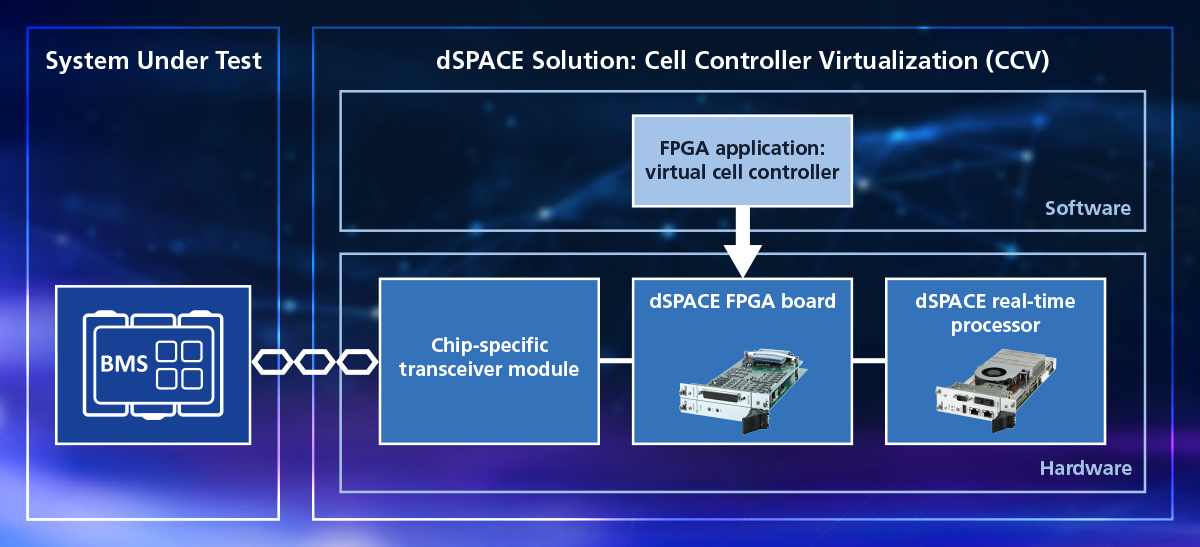
The dSPACE Cell Controller Virtualization (CCV) solution includes an FPGA application for the virtual cell controller, along with a dSPACE FPGA board, real-time processor, and chip-specific transceiver module.
To meet highest timing requirements, the chip-supplier-specific communication protocols and the relevant chip-specific registers and commands are implemented on a powerful dSPACE FPGA board. The single-ended communication is converted into the differential, isolated protocol by means of a chip-supplier-specific transceiver module.
“To simulate an overall realistic behavior of the simulated CSC, you can use ASM Battery, the dSPACE model for battery simulation,” shared Foley. Using this simulation model, you can simulate each individual cell of the battery. The model also enables cell balancing and the realistic simulation of temperatures.”
Together, CCV and ASM Battery form a scalable framework for developing and validating BMS software for electric vehicles and energy storage systems, accelerating time to market while reducing testing risk and cost.
Filed Under: BMS, FAQs, Featured, Featured Contributions, Software, Tech Spotlight