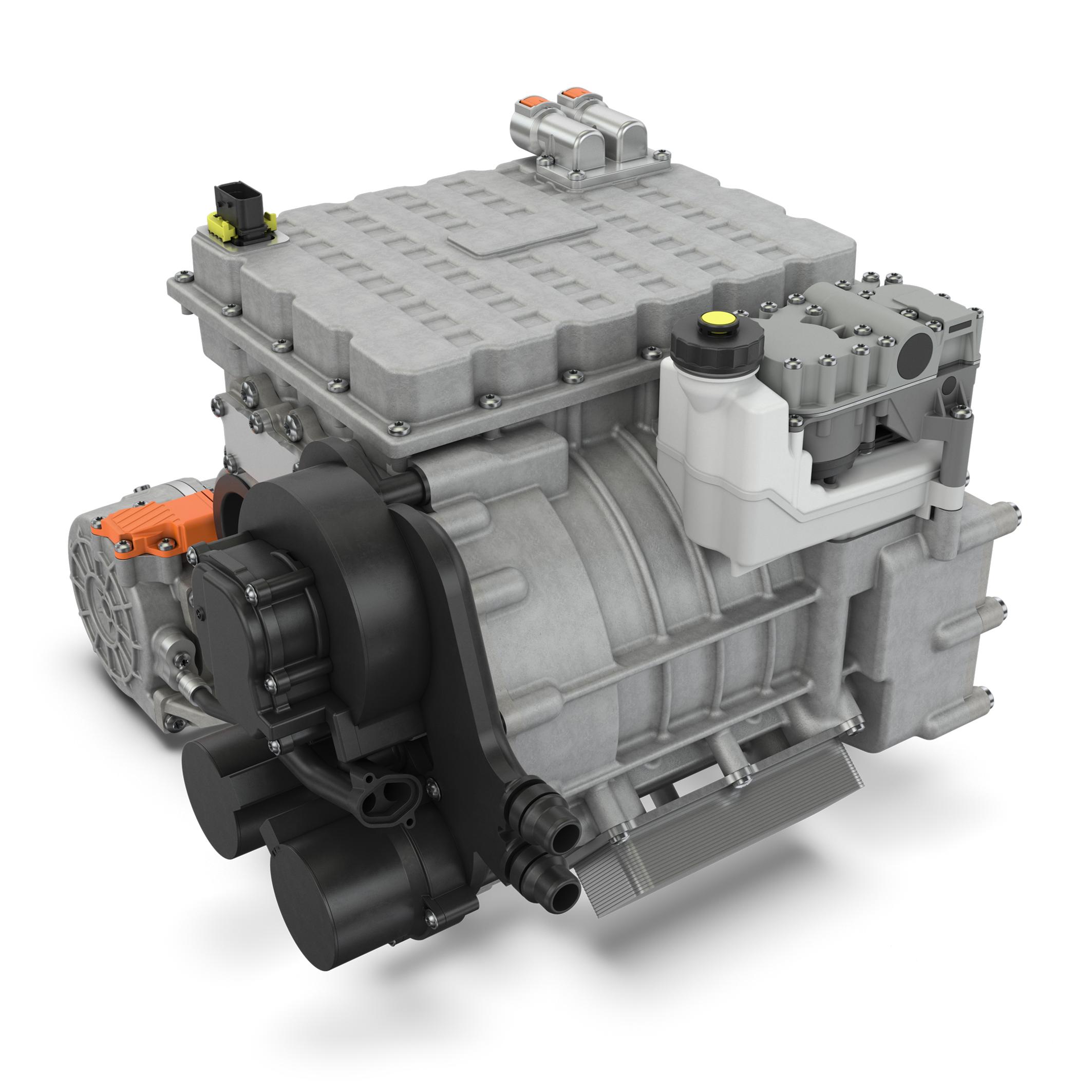
A compact e-axle can place drivetrain fluid close to the motor, increasing its role in cooling and electrical compatibility. (Image: Schaeffler)
Electric vehicle (EV) drive units keep getting smaller and more integrated, and that’s changed what the fluid inside them has to do. In a conventional gearbox, lubricant selection mostly comes down to protecting the gears while keeping friction losses in check.
An e-axle can put that same fluid right next to the electric motor, where heat and electrical compatibility become part of the design problem.
In many e-axle designs, the lubricant contacts motor components directly. It circulates through the gearbox and then carries heat away from the motor. SAE’s J3200 information report on fluids for electrified drivetrains covers this case, where the motor is immersed in the lubricant or exposed to it, and treats electrical properties and material compatibility as performance requirements that conventional transmission fluid specifications never had to address.
The fluid now has to protect the mechanical hardware without creating new problems on the electrical side.
Balancing lower viscosity with durability
Efficiency targets have pushed EV drivetrain fluids toward lower viscosity. A thinner fluid puts up less resistance as the gears rotate through it, reducing churning losses and drivetrain energy consumption. Lower viscosity also tends to improve heat transfer, and researchers have shown that reducing it can raise the heat transfer coefficient while lowering churning loss. So a single change improves cooling and efficiency at the same time.
The limit is mechanical protection. E-axles still carry heavily loaded gears and bearings, and those surfaces need a film thick enough to keep metal apart under high torque. The problem is sharpest at low speed and high torque, where a thinner fluid produces a thinner film between meshing teeth and gear friction goes up.
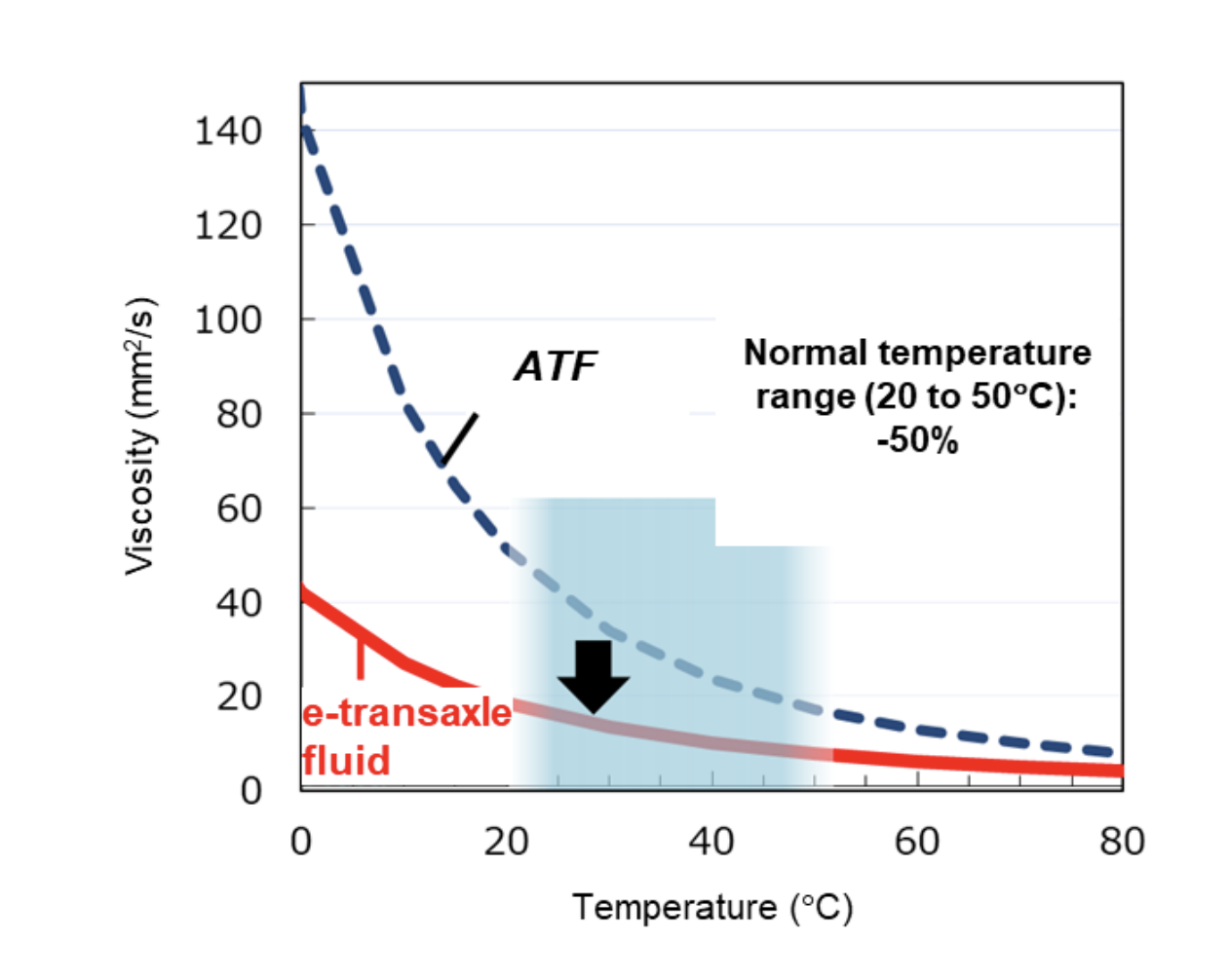
This graph shows how a dedicated e-transaxle fluid can reduce viscosity by about 50% compared with conventional ATF across a typical 20° to 50° C operating range. (Image: Toyota Motor Corporation)
Motor speed adds another complication. Transmission input speeds in current drive units often run past 15,000 rpm, putting gear and bearing contacts well outside the conditions conventional lubricant testing was built around.
Engineers are left trying to lower viscosity without giving up durability, and the base oil cannot solve that alone. Formulators have compensated by reworking antiwear and extreme pressure additives, while gear designers are looking at surface finishing to keep friction and wear under control as fluids move toward ultralow viscosity.
Recent tribology work pairing high-speed gear tests with thermal elastohydrodynamic simulation shows how closely the lubricant formulation and the gear surface have to be developed together.
Direct motor cooling brings in electrical requirements
When the fluid cools the motor directly, it can reach the windings and other electrically active areas. At that point, its conductivity becomes a design parameter.
The fluid’s electrical behavior also has to hold up as it ages. Excessive conductivity can create unwanted current paths, while low conductivity can allow electrostatic charge to accumulate and discharge. Lubricant developers have proposed upper and lower conductivity limits for this reason. Water contamination and metallic wear debris shift those properties over time, and corrosion or degradation byproducts can form conductive deposits on circuit surfaces.
That’s why EV drivetrain fluid development now includes dielectric and conductivity testing alongside conventional transmission fluid specifications. A fluid that behaves correctly at initial fill can look quite different after thousands of operating hours, once oxidation has changed its chemistry and wear particles have built up inside the drive unit. Engineers need electrical data across the expected service life rather than a single measurement on new oil.
Copper changes the additive chemistry
Conventional gear lubricants often rely on additives that react with metal surfaces to reduce wear. Some active sulfur compounds that work well on steel will attack copper at elevated temperatures. In one Lubrizol study, solution phase corrosion didn’t appear below about 110° C, but above 120° C each fluid tested became more corrosive as temperature climbed, though at different rates.
That matters inside an e-axle because motor windings and electrical connections expose copper to the lubricant and its vapors. The same research showed that corrosion can occur on copper located above the fluid level, where volatile species from an unsuitable lubricant reach hardware that never sees liquid oil. Motor failures initiated by copper corrosion have happened with fluids that passed the traditional copper strip test (ASTM D130), which pushed the industry to develop the wire corrosion test and the conductive deposit test. SAE J3200 now recommends them.
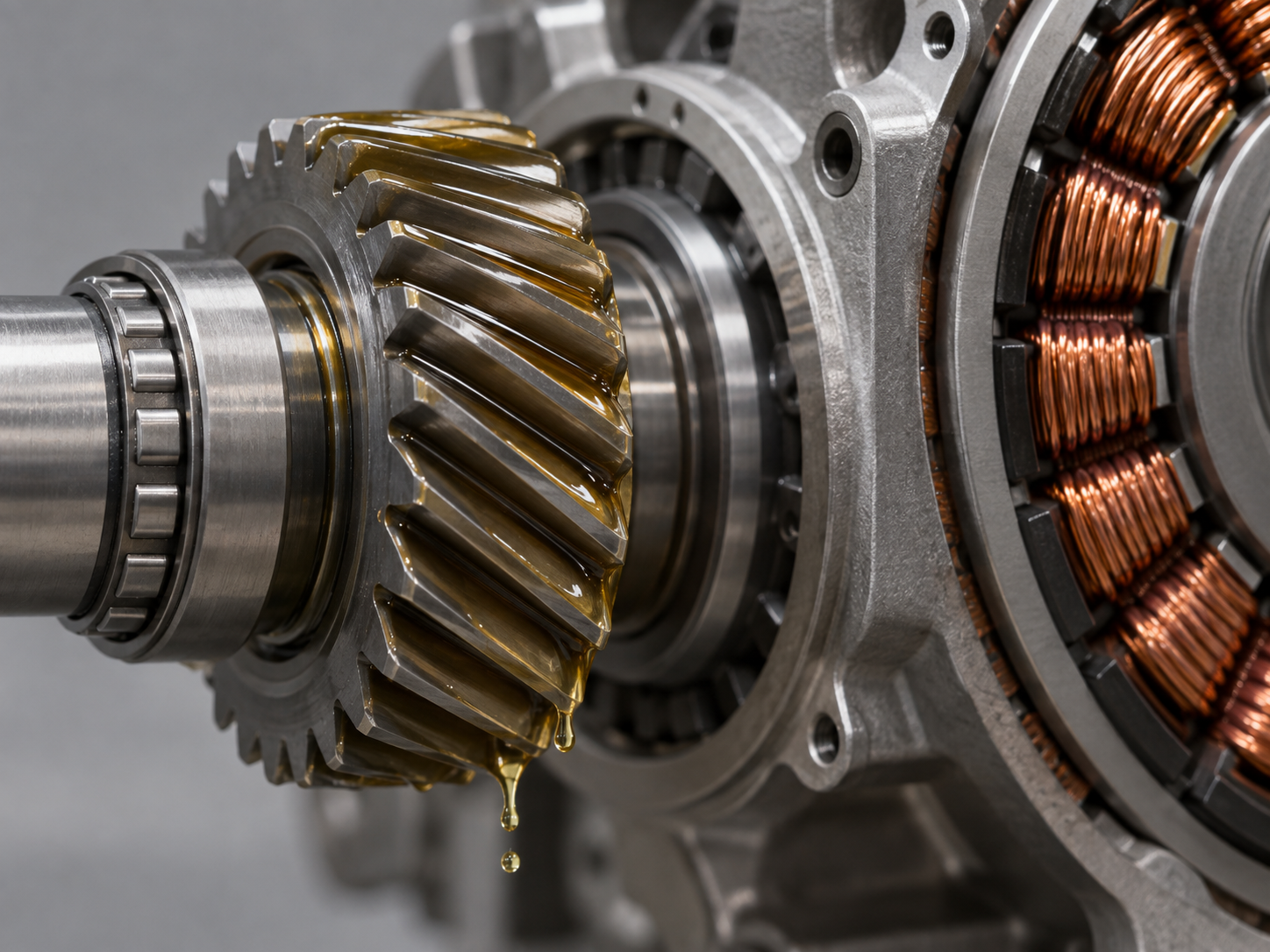
E-axle fluids have to protect heavily loaded gears while remaining compatible with nearby motor components. (Image: AI-generated)
The additive package has to protect the gears without damaging the motor. The motor also introduces polymer materials that must remain compatible with the fluid, from magnet wire insulation to the sheets and bindings that hold the windings in place, and hard plastics are replacing metal in parts such as bearing cages. A formulation that protects the gears well can still degrade insulation elsewhere in the unit, which turns fluid qualification from a gearbox test into a drive unit test.
Designing the fluid and e-axle together
No single e-axle fluid specification covers every architecture, because the fluid’s job depends on how the drive unit is built. A gearbox paired with a separately cooled motor asks far less of the lubricant than a design that sprays oil directly onto the windings. The more integrated the cooling strategy, the more the fluid acts as part of the thermal and electrical architecture (and the less it resembles a maintenance consumable).
That’s pushing original equipment manufacturers (OEMs) and lubricant suppliers toward co-development, as Toyota and ENEOS did with Toyota’s e-transaxle lubricant. Simulation can predict how viscosity affects flow and heat transfer before prototypes exist. Component testing then exposes candidate fluids to copper and insulation at realistic temperatures, with aging tests showing whether electrical properties stay stable as the lubricant oxidizes or picks up contamination.
The same process helps decide whether direct oil cooling is worth the extra fluid requirements. A 2026 SAE paper from General Motors engineers described an axial flux motor with direct oil cooling in the air gap that kept permanent magnet temperatures low while adding only 0.3 Nm of drag torque above 500 rpm. It’s a good example of fluid routing becoming part of motor thermal design instead of staying confined to the gearbox.
E-axle integration saves space and can reduce drivetrain losses, but it removes the boundary that used to keep lubrication and motor cooling separate. With one fluid now responsible for lubrication and motor cooling, its formulation becomes part of the drive unit design, with consequences for durability and electrical reliability over the vehicle’s life.
References
- SAE International, J3200 Fluid for Automotive Electrified Drivetrains, 2022. sae.org/standards/content/j3200_202210/
- Understanding Vapor and Solution Phase Corrosion of Lubricants Used in Electrified Transmissions, SAE Technical Paper 2020-01-0561, 2020. saemobilus.sae.org/papers/understanding-vapor-solution-phase-corrosion-lubricants-used-electrified-transmissions-2020-01-0561
- A Brief Review of the Rapid Transformation of Driveline Lubricants for Hybrid Electric and Electric Vehicles, Frontiers in Mechanical Engineering, 2023. frontiersin.org/journals/mechanical-engineering/articles/10.3389/fmech.2023.1139385/full
- Development of Transaxle Fluid for Electrification Vehicles, SAE Technical Paper 2022-01-1102, 2022. sae.org/publications/technical-papers/content/2022-01-1102/
- Axial Flux Motor Design Solutions for Loss Reduction, Cooling Enhancement, and Manufacturability Improvement, SAE Technical Paper 2026-01-5001, 2026. doi.org/10.4271/2026-01-5001
Images
- Schaeffler, “4in1 e-axle,” Schaeffler Media Library, 2026. schaeffler.com/en/media/media-library/?tab=mediathek-pic&uid=87941771
- Hitomi, M., Suzuki, K., Hirai, M., and Hayashi, T., “The Toyota bZ4X,” Toyota Technical Review, Vol. 68, 2023. global.toyota/pages/global_toyota/mobility/technology/toyota-technical-review/TTR_Vol68_E.pdf
Filed Under: Electric Motor, FAQs