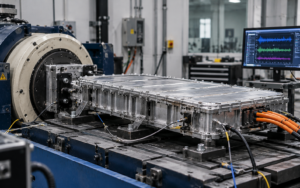
Modern electric vehicle (EV) battery engineering revolves around removing layers of structure so more active cell material fits into the same footprint. Increasingly, the battery also becomes part of the vehicle’s load-bearing architecture. Along … [Read more...]
Researchers rethink EV battery packs for safer repair and reuse
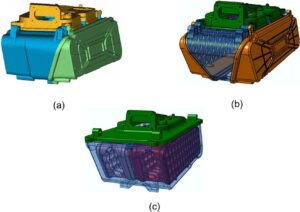
Researchers at Graz University of Technology (TU Graz) and the University of Graz have developed design guidelines intended to improve the safety, repairability, and recyclability of electric vehicle battery packs. The work, conducted through the … [Read more...]
How sensor placement and density impact thermal mapping in EV battery packs
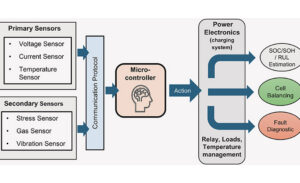
Temperature sensors in electric vehicle (EV) battery packs measure temperature only where they are mounted. Nevertheless, a battery management system (BMS) must use limited local readings to reconstruct the pack temperature field, detect developing … [Read more...]
Q&A: Bridging EV battery component design and production reality

Electric vehicle (EV) battery performance depends on more than cell chemistry. Material selection, component design, and manufacturing processes determine how systems hold up under thermal, mechanical, and environmental stress. Many challenges … [Read more...]
What are the gas sensors for thermal runaway detection in EV battery packs?

Thermal runaway is a safety issue in electric vehicle (EV) batteries, characterized by rising temperatures and the release of flammable gases. As conventional battery management systems (BMS) often fail to provide timely warnings, gas sensing … [Read more...]
Understanding reconfigurable EV battery packs

Reconfigurable battery packs dynamically adjust internal connections, voltage, current distribution, and power output. Unlike conventional fixed packs, they isolate faulty cells, balance power loads, and respond to dynamic energy demands. These … [Read more...]