EV Engineering & Infrastructure

  • News
  • Articles
    • Q&As
    • Tech Spotlight
  • Batteries
  • Charging
    • Wireless Charging
    • Vehicle-to-Grid (V2G)
  • Electrification
  • Testing and Safety
  • Learn
    • Learning Center
    • Tech Toolboxes
    • Webinars
  • Resources
    • Digital Editions
    • Diversity & Inclusion
    • Voices
  • Advertise
  • Subscribe

Semi-dry braking architecture reduces residual brake drag

By Michelle Froese | September 25, 2026

AUMOVIO has developed a semi-dry brake system that combines electromechanical braking with a conventional hydraulic front axle, using active brake-pad clearance to reduce residual drag in electric vehicles (EVs).
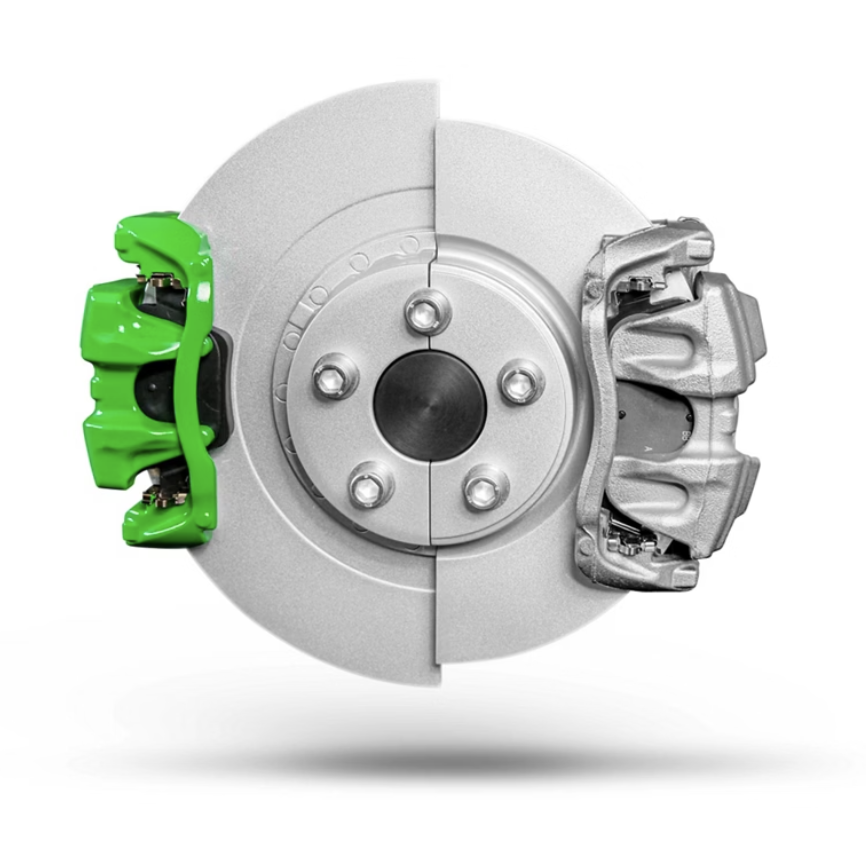
The system uses a near-production electromechanical brake on the rear axle. Instead of relying on hydraulic pressure, an electric motor actuates the rear brake caliper, eliminating the need for hydraulic lines and brake fluid at the rear wheels.

One of the main engineering advantages is active control of the air gap between the brake pad and disc. The electric actuator can reopen the caliper after braking and maintain a consistent clearance, reducing the residual braking torque that can occur when pads remain close to the disc.

The air gap can also be adjusted according to vehicle conditions. A larger clearance can reduce drag during normal driving, while the system can reduce the gap when faster brake response may be required.

At the front axle, AUMOVIO uses its MK C2 brake-by-wire system with modified hydraulic calipers designed to establish a larger air gap more quickly. The system electronically determines when friction braking is required and when braking demand can instead be handled through regenerative braking.

The semi-dry architecture also creates opportunities to reduce vehicle weight and simplify packaging by removing hydraulic hardware from part of the braking system. AUMOVIO says a fully dry configuration using electromechanical calipers at all four wheels could extend those benefits further.

The braking technology is being evaluated in Volkswagen’s Mission Efficiency EV, based on the ID. Polo, as a near-production demonstration of how lower brake drag can contribute to overall vehicle efficiency.

You might also like


Filed Under: Technology News
Tagged With: aumovio, braking, volkswagen
 

Next Article

← Previous Article
Next Article →


“ee
EXPAND YOUR KNOWLEDGE AND STAY CONNECTED
Get the latest info on technologies, tools and strategies for EV professionals.

Tech Spotlight

  • Why high-power EV charging is pushing control integration into one ECU
  • Designing safety into the cell: The case for system-level solid-state batteries
More Tech Spotlight

Featured Contributions

  • How do two-level and three-level inverter topologies compare in EVs?
  • Inside the development of the Megawatt Charging Standard
  • How does fault-tolerant control keep an EV operating after a sensor failure?
  • Q&A: How EV architectures are changing high-speed connectivity
  • How to catch EV faults before they become failures
More Featured Contributions

EV TECH TOOLBOX

“ee
Explore the EV Engineering Tech Toolboxes: a collection of high-impact articles that break down the latest EV design trends and technologies. Download to stay aligned with today’s evolving EV design challenges.

Learning Center

EE Learning Center

Sponsored Content

  • Converting custom materials for EV applications
  • Advantech Powers Versatile Electric Vehicle Charging Systems

EV Training Days

ev
Q&A
EV Engineering & Infrastructure
  • 5G Technology
  • Analog IC Tips
  • Battery Power Tips
  • Connector Tips
  • EDABoard Forums
  • Electro-Tech-Online Forums
  • Engineer’s Garage
  • Microcontroller Tips
  • Power Electronic Tips
  • Sensor Tips
  • Test and Measurement Tips
  • Contact Us

Copyright © 2026 Arrowfly LLC. All Rights Reserved. The material on this site may not be reproduced, distributed, transmitted, cached or otherwise used, except with the prior written permission of Arrowfly
Privacy Policy | Advertising | About Us

Search EV Engineering & Infrastructure

  • News
  • Articles
    • Q&As
    • Tech Spotlight
  • Batteries
  • Charging
    • Wireless Charging
    • Vehicle-to-Grid (V2G)
  • Electrification
  • Testing and Safety
  • Learn
    • Learning Center
    • Tech Toolboxes
    • Webinars
  • Resources
    • Digital Editions
    • Diversity & Inclusion
    • Voices
  • Advertise
  • Subscribe