Researchers patterned copper current collectors with nanoscale structures and an MXene coating to suppress lithium dendrite growth without adding excess lithium.
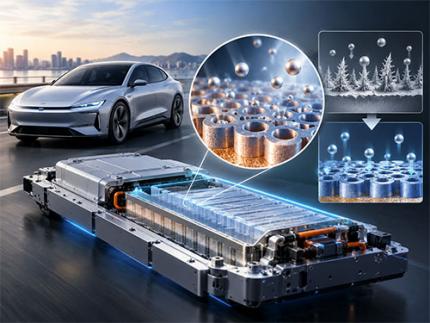
KAIST’s nanopatterned copper (bottom right) promotes more uniform lithium deposition than flat foil, which forms dendrites (top right). (Image: KAIST)
A research team at the Korea Advanced Institute of Science and Technology (KAIST) has developed a method for extending the cycle life of anode-free lithium metal batteries by applying ultrafine fabrication processes from semiconductor manufacturing to the copper current collector.
The work was led by Professors Jinwoo Lee and Hee-Tae Jung of KAIST’s Department of Chemical and Biomolecular Engineering, with researchers from Kyungpook National University and the National NanoFab Center.
Conventional lithium-ion batteries store lithium in an anode material such as graphite during charging. Anode-free designs deposit lithium directly onto a thin copper foil instead, removing the weight and volume the anode material would otherwise take up. That makes it possible to pack more energy into a cell of the same size.
The challenge is that repeated charging and discharging causes lithium to deposit unevenly on the copper foil, forming branch-like dendrites. The solid-electrolyte interphase (SEI) that forms over the lithium can also become unstable, causing performance to degrade quickly. This is one of the main obstacles to commercializing anode-free cells.
Earlier approaches have added excess lithium to compensate for losses or applied a thick protective coating to the electrode surface. These approaches add weight and thickness, cutting into the size and mass advantage that makes anode-free designs attractive in the first place.
The KAIST team focused instead on modifying the copper foil. Using secondary sputtering lithography, a process used for precise semiconductor micromachining, the researchers fabricated an array of tube-shaped structures roughly 300 nanometers in diameter and 150 nanometers tall on the copper surface. The structures increased the surface area available for lithium deposition to about four times that of flat copper foil, spreading deposition more evenly and reducing localized dendrite growth.
The team then coated the patterned foil with a layer of MXene, a two-dimensional material, about 10 nanometers thick. The MXene does not act as the protective layer on its own. Instead, in the lithium hexafluorophosphate (LiPF6)-based electrolyte used in the study, it promotes the formation of a robust SEI rich in lithium fluoride as the battery operates. This layer reduces unwanted reactions between the lithium and electrolyte and further suppresses dendrite growth.
To confirm the mechanism, the researchers examined electrode surfaces and cross sections while minimizing air exposure. Surface chemistry analysis using X-ray photoelectron spectroscopy and time-of-flight secondary ion mass spectrometry, along with transmission electron microscopy, showed that a nanoscale protective layer forms uniformly along the MXene.
In anode-free full-cell testing under lean-electrolyte conditions, the patterned and MXene-coated current collector retained 78.1 mAh/g after 125 cycles with 99.06% Coulombic efficiency. A comparable cell using bare copper retained 44.9 mAh/g with 95.01% efficiency.
“This study shows how ultrafine fabrication techniques used in semiconductor manufacturing can create both uniform sites for lithium deposition and a stable protective layer without changing the bulk electrolyte formulation or adding excess lithium,” said Professor Jinwoo Lee.
The team expects the approach could help move high-energy anode-free batteries toward commercialization by extending cycle life with minimal added weight or volume.
KAIST researchers Eunji Kim, Hyunju Jung, and Jinuk Kim are co-first authors of the study, which was published online in Advanced Functional Materials on September 1 under the title “Anion-Interactive Anode Interfaces for Stable Anode-Free Lithium Metal Batteries.” The research was supported by the National Research Foundation of Korea and the National NanoFab Center.
Filed Under: Batteries, Technology News