Researchers at the Fraunhofer Institute for Manufacturing Engineering and Automation (IPA) and the University of Stuttgart have developed and patented a cell and electrode technology designed to improve the stability of aluminum anodes in lithium-ion batteries.
The approach addresses material degradation during repeated charging and discharging, a longstanding obstacle to using aluminum as an alternative to conventional anode materials.
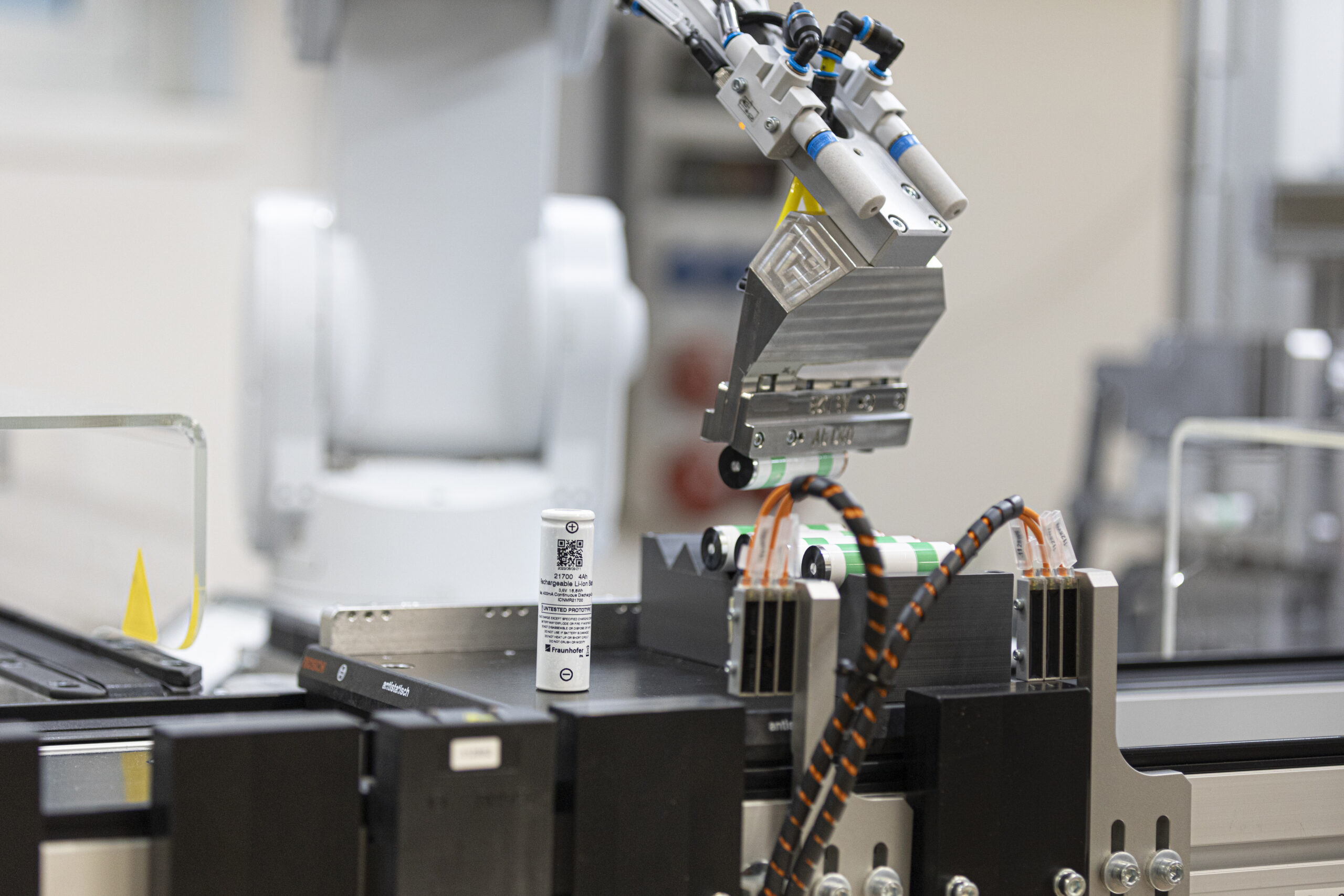
Batteries incorporating aluminum-anode technology developed by Fraunhofer IPA and the University of Stuttgart. (Image: Fraunhofer IPA/Rainer Bez)
Aluminum offers relatively high capacity and is widely available, but its volume changes during battery cycling can create mechanical stresses within the electrode. These stresses can lead to cracking, pore formation, and eventual pulverization of the active material, reducing capacity and limiting cell life.
The patented technology is designed to stabilize the electrode materials and maintain electrical contact over repeated charge-discharge cycles.
“We are making a battery technology that has long been known but difficult to control practically usable,” said Professor Kai Peter Birke, scientific director for battery and hydrogen systems and storage at Fraunhofer IPA. “Our approach combines high energy densities with a simple, robust cell chemistry designed for safety.”
According to the researchers, the approach eliminates the need for graphite or silicon in the anode, potentially reducing dependence on critical battery materials.
The design uses commercially available alloyed aluminum foil that serves as the active material and the current collector. This eliminates the copper foil typically used in conventional lithium-ion anodes, along with the separate coating process required to apply active material to the current collector. Fraunhofer IPA expects these changes to reduce manufacturing complexity, energy consumption, and production costs.
The researchers are also investigating the aluminum anode in combination with a fluorine-free lithium manganese oxide (LMO) cathode. This cell configuration could provide a phosphate-free alternative to lithium iron phosphate (LFP) batteries.
The aluminum anode can also be combined with alternative electrolyte solvents that have higher flash points. When paired with a fluorine-free LMO cathode and a suitable fluorine-free electrolyte, the resulting cell could eliminate fluorinated materials, including per- and polyfluoroalkyl substances (PFAS). According to Fraunhofer IPA, this would also avoid the formation of hydrogen fluoride associated with fluorine-containing battery materials during a fire.
The cell chemistry is designed for integration into existing battery production equipment without requiring an entirely new manufacturing infrastructure.
Researchers have produced several prototypes and are currently testing them at Fraunhofer IPA’s Center for Digitalized Battery Cell Production.
The institute identifies applications requiring compact and reliable energy storage, including air freight tracking and specialized medical devices, as potential early uses. Although the electrode technology addresses broader challenges in lithium-ion battery manufacturing, its suitability for electric vehicle (EV) traction batteries has not yet been established.
Fraunhofer IPA has not disclosed detailed cycle-life results or specific energy-density measurements in its announcement.
References
Aluminium-Anoden für anspruchsvolle Batterie-Anwendungen (Aluminum anodes for demanding battery applications), Fraunhofer IPA
Filed Under: Batteries, Technology News