Cambustion has introduced a Powertrain in the Loop (PiL) testing platform at its Hub Dyno facility in the UK. The system combines physical powertrain hardware with simulated vehicle subsystems to begin vehicle-level development before a complete prototype is available.
The platform uses Hardware in the Loop (HiL) capability to represent systems that are not yet available in physical form. Engineers can use the setup to assess system interactions and develop control strategies while other parts of the vehicle are still being developed.
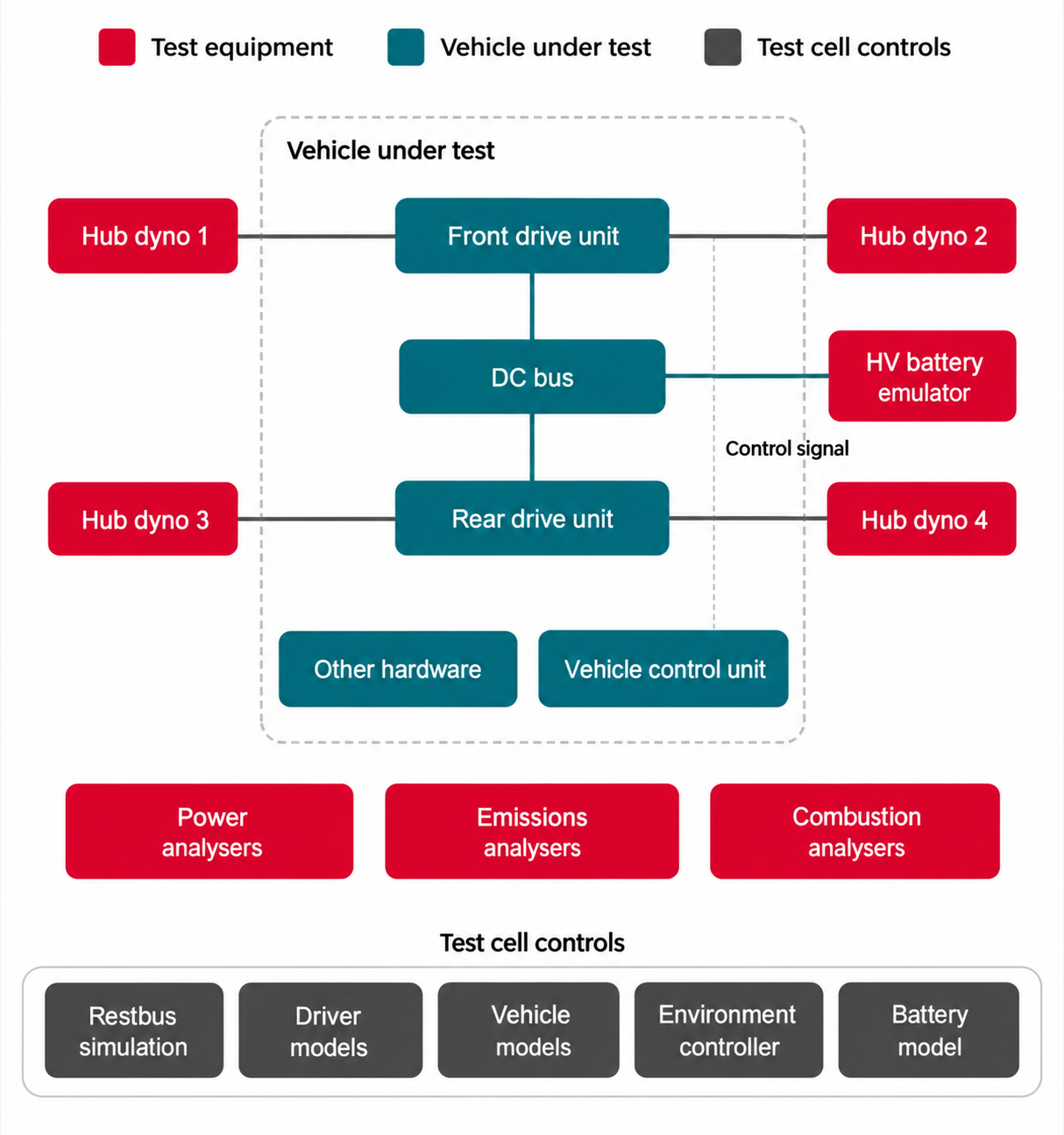
The PiL test architecture combines physical powertrain hardware with simulated vehicle systems, including battery emulation for high-voltage EV development.
For electrified powertrains, the platform can be used to evaluate high-voltage systems and electric drives. An 1,100-V, 500-kW battery simulator can replace the physical battery during development, allowing engineers to test the powertrain before the production battery is available.
Powertrains that have already been integrated into a vehicle chassis can also be connected directly to the wheel hubs. Dynamometers reproduce transient operating conditions for drive-cycle testing and vehicle dynamics functions such as torque vectoring.
The temperature-controlled test cell can operate at temperatures down to -15 °C, allowing powertrain performance and control strategies to be evaluated under different environmental conditions.
Cambustion developed the PiL capability during a 12-month test program for a hybrid electric supercar. Once a prototype vehicle becomes available, development can transition to the company’s 4WD chassis dynamometer or continue using PiL testing alongside vehicle-based validation.
Filed Under: Technology News, Testing and Safety