TotalEnergies Lubrifiants has developed the Coolant Keep Plate (CKP), a passive technology designed to improve thermal-runaway protection in immersion-cooled lithium-ion batteries for electric vehicles (EVs) and other applications.
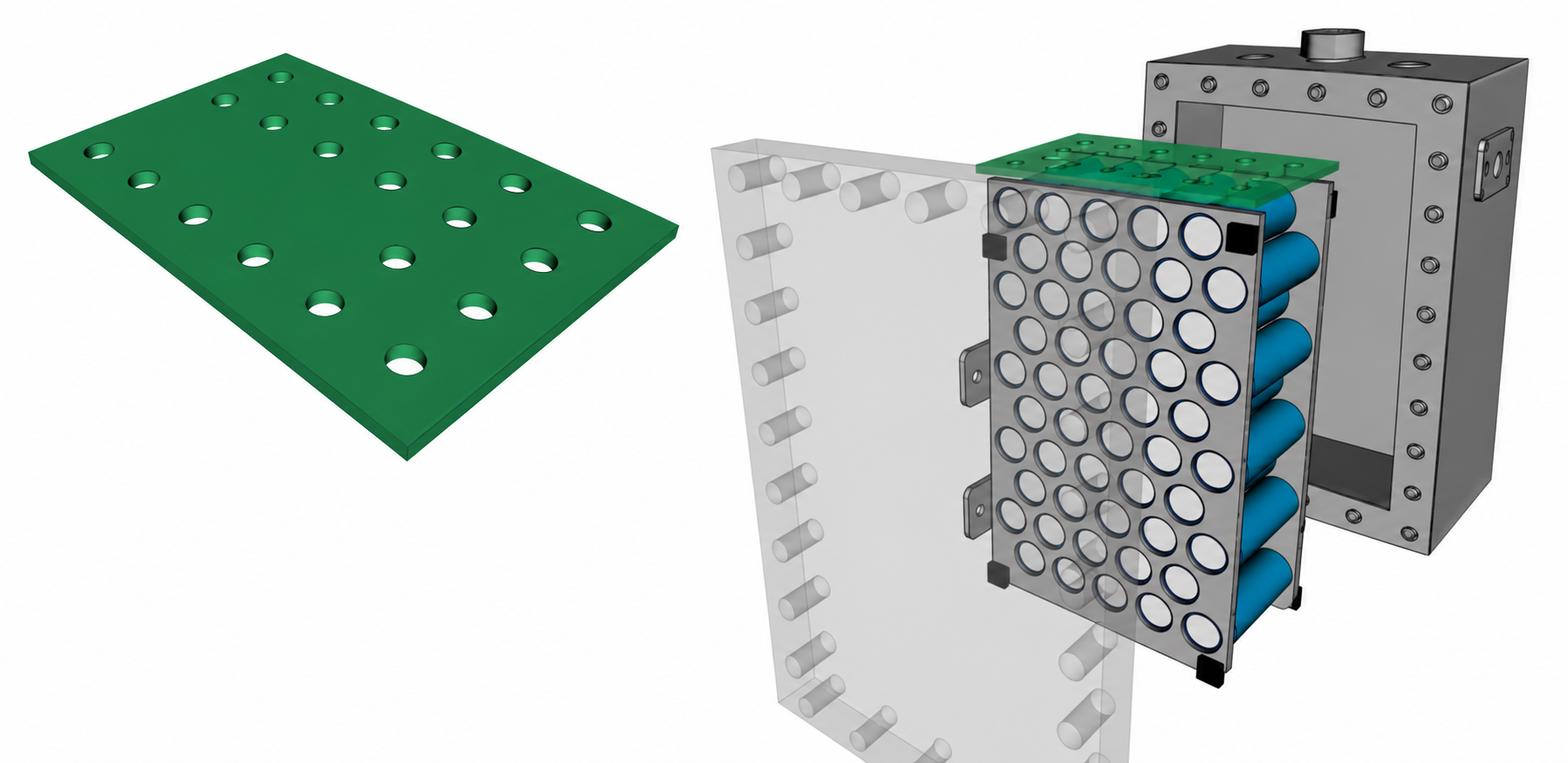
Illustration of the Coolant Keep Plate (CKP), a passive technology designed to retain dielectric cooling fluid around battery cells during venting to help prevent thermal-runaway propagation.
Direct immersion cooling uses dielectric fluid to manage battery temperatures by placing the cooling medium in direct contact with the cells. By eliminating several thermal interfaces between the cells and the cooling system, the approach can improve heat transfer and temperature uniformity, particularly under demanding conditions such as ultra-fast charging.
Although immersion cooling can help reduce the risk of thermal-runaway propagation, challenges remain when a battery cell vents. The resulting high-pressure gas jet can displace or expel dielectric cooling fluid, leaving nearby cells exposed and reducing the thermal protection needed to prevent propagation.
The CKP is designed to address this problem by retaining cooling fluid around the cells during venting. Positioned between the cell group and the venting interface, the plate separates the gas and liquid phases, allowing gases to escape while keeping dielectric fluid around the most exposed cells.
The technology operates passively, without sensors, electronic controls, or an external power supply.
According to TotalEnergies, testing across several battery configurations demonstrated no fire or thermal-runaway propagation when the CKP was installed, including scenarios where propagation occurred without it. The company did not provide detailed test conditions or numerical performance results in the announcement.
The CKP is designed to work with TotalEnergies’ dielectric cooling fluids and can be adapted to different cell formats and immersion-cooled battery architectures.
The company is developing the technology as part of a broader battery safety approach that considers several interacting factors, including:
- Dielectric fluid selection and module thermal capacity.
- Cooling fluid circulation and convection paths.
- Vent-gas cooling and depressurization.
- Cooling fluid retention during cell venting.
By maintaining fluid coverage following an initial venting event, the CKP is intended to help preserve thermal protection and limit the spread of thermal runaway to neighboring cells.
The technology is aimed at improving the safety of immersion-cooled battery systems, particularly in EV applications where high charging rates and thermal management requirements place additional demands on battery design.
Filed Under: Technology News, Thermal Management