Infineon Technologies has introduced a high-voltage battery management system (BMS) reference design that enables advanced battery models to run directly on the battery management unit (BMU). The system combines an AURIX TC4x microcontroller with a parallel processing unit (PPU) to support battery modeling, monitoring and control in electric vehicles (EVs).
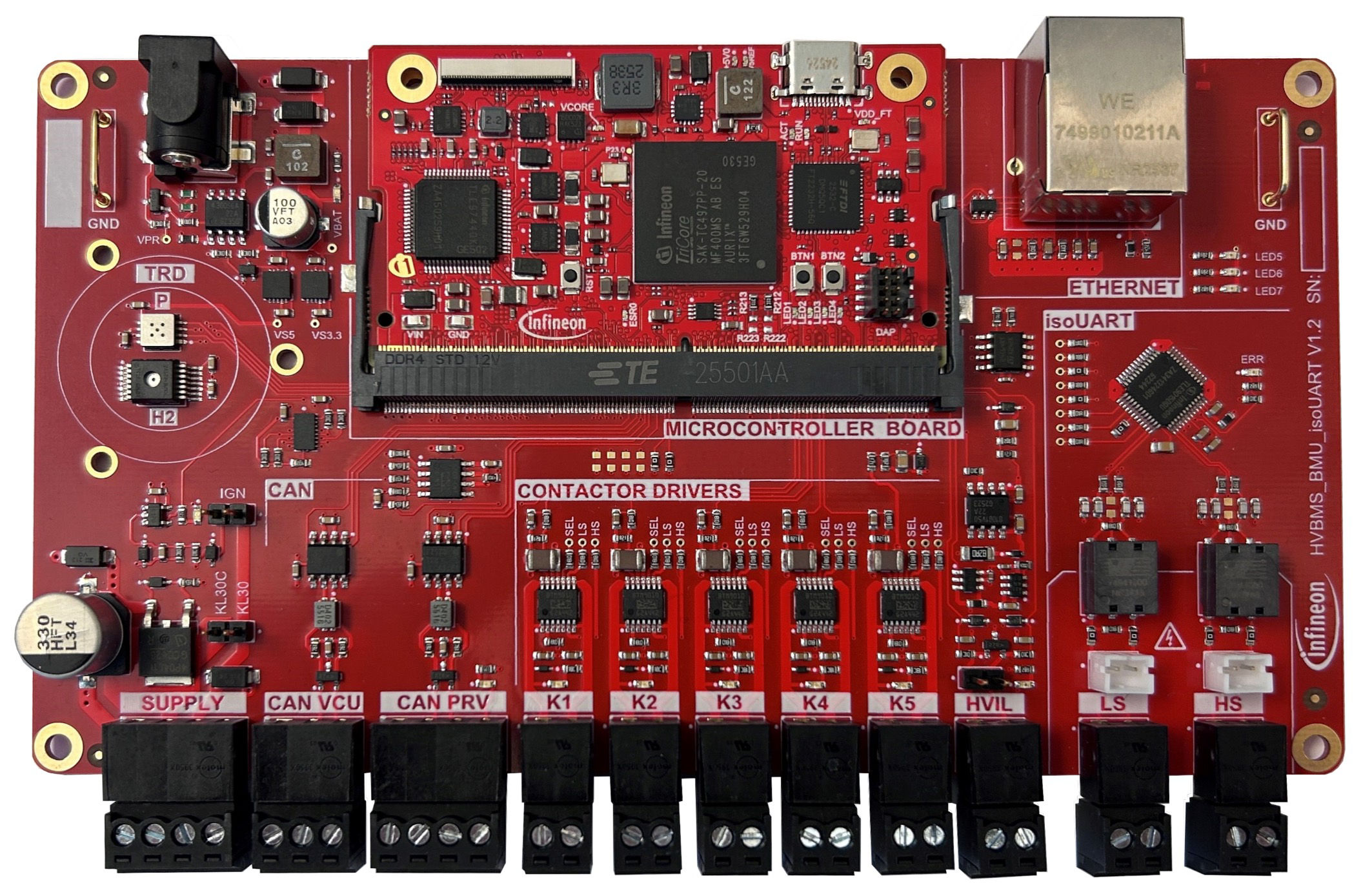 The reference design integrates a BMU, pack monitoring unit (PMU) and cell monitoring unit (CMU), along with supporting software. It provides a hardware and software platform for developing and evaluating high-voltage battery management systems.
The AURIX TC4x microcontroller’s PPU delivers up to 30 times higher processing performance for certain workloads compared with a standard central processing unit (CPU). This enables engineers to run computationally intensive models, including electrochemical models, digital twins, machine learning and artificial intelligence (AI)-based algorithms, directly within the vehicle.
According to Infineon, advanced battery modeling and optimized control strategies could provide several potential benefits, depending on the application:
- Up to 30% longer battery life through optimized load profiles.
- Up to 20% fewer battery cells for certain designs, or increased driving range with an unchanged battery configuration.
- Up to 20% shorter charging times through improved battery modeling and control.
The reference design supports several methods for estimating battery conditions, including electrochemical impedance spectroscopy, open-circuit voltage measurement, coulomb counting and Kalman filtering. These approaches can be used to estimate state of charge, state of health, internal cell temperature and available power, as well as identify conditions associated with lithium plating.
The BMU also incorporates Infineon’s XENSIV pressure and gas sensors to support early thermal-runaway detection. Combined with battery monitoring and modeling capabilities, these sensors can help identify potential safety concerns and enable protective measures.
For pack-level monitoring, the PMU uses Infineon’s PSOC 4 HVPA SPM 1.0, supporting current sensing, high-voltage monitoring up to 1,000 V and isolation-resistance measurement. The system is designed to meet Automotive Safety Integrity Level D (ASIL D) requirements.
The CMU incorporates Infineon’s TLE9018DQK, an 18-channel lithium-ion battery monitoring and balancing integrated circuit (IC). The device supports direct supply from three to 18 cells and can be cascaded to support larger battery configurations. It is designed to meet ISO 26262 functional safety requirements.
By running advanced battery models directly on the BMU, the system can reduce reliance on cloud-based processing and minimize data transfer requirements. The architecture also supports model development and validation across laboratory, cloud and vehicle environments, including over-the-air (OTA) software updates.
Infineon’s high-voltage BMS reference design is available to order and will be demonstrated at electronica 2026 in Munich, Germany, November 10–13.
Filed Under: Batteries, BMS, Technology News