Xeal has launched Laitent, an edge inference computing network designed to use available electrical capacity at EV charging sites when that capacity is not required for vehicle charging.
 Xeal operates more than 1,600 EV charging sites with over 200 MW of permitted and installed electrical infrastructure. The company says its charging sites typically operate below their maximum permitted load, allowing unused capacity to be directed to computing equipment without requiring a separate grid interconnection.
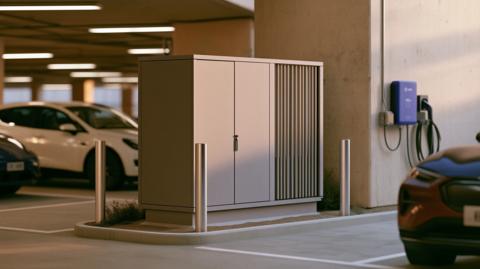
Laitent will use compact computing pods installed alongside existing EV charging infrastructure. Xeal plans to deploy more than 100,000 NVIDIA GPUs across the network, with the first Laitent Pod scheduled to come online with JVM Realty by the end of 2026.
Xeal’s dynamic power orchestration software manages how available site capacity is divided between EV charging and computing workloads. The system is designed to adjust computing demand as charging requirements change, allowing the existing electrical connection to serve both applications.
Each Laitent Pod occupies approximately one parking space and can accommodate up to 48 NVIDIA Hopper or Blackwell Ultra GPUs. The pods use self-contained cooling and do not require a water connection. Xeal says deployments in metropolitan areas can provide inference latency below 20 ms.
The company is working with Rafay Systems for AI infrastructure orchestration and Spectrum Business for fiber connectivity. Xeal has also secured an agreement with an inference provider for up to 5 MW of computing capacity.
Laitent Pod features
- Uses available electrical capacity at EV charging sites
- Supports up to 48 NVIDIA Hopper or Blackwell Ultra GPUs
- Self-contained cooling with no water hookup required
- Operates at less than 65 dB
- NEMA 4 outdoor enclosure
- Fits within approximately one parking space
- Designed for rapid installation at existing grid-connected sites
- Dynamically adjusts computing loads around EV charging demand
Xeal plans to expand the approach beyond its initial 200 MW of installed charging capacity and says its existing EV charging footprint could provide access to more than 1 GW of additional electrical headroom.
Filed Under: Charging, Technology News