EV Engineering & Infrastructure

  • News
  • Articles
    • Q&As
    • Tech Spotlight
  • Batteries
  • Charging
    • Wireless Charging
    • Vehicle-to-Grid (V2G)
  • Electrification
  • Testing and Safety
  • Learn
    • Learning Center
    • Tech Toolboxes
    • Webinars
  • Resources
    • Digital Editions
    • Diversity & Inclusion
    • Voices
  • Advertise
  • Subscribe

Collaboration to advance dual-inverter systems for hybrid and electric vehicles

By Michelle Froese | October 31, 2025

BorgWarner, a global manufacturer of electrified propulsion and powertrain systems, has expanded its collaboration with automaker Great Wall Motor in the field of electrified propulsion. Building on two previously announced dual-inverter programs, the company has secured two additional projects with mass production scheduled for 2026.
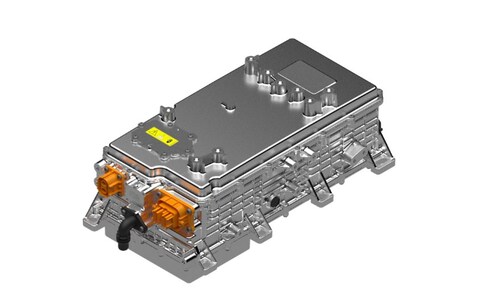
The dual-inverter system developed by BorgWarner is designed to control and drive two electric motors simultaneously through a single controller.

This integrated design improves packaging flexibility, reduces overall system weight, and simplifies installation within hybrid and electric vehicle platforms.

The power module incorporates a double-sided cooling design that lowers thermal resistance by up to 50% compared to conventional single-sided cooling systems. This improvement enhances power density and thermal performance, which are critical factors in meeting modern efficiency and durability standards, such as China’s light-duty vehicle test cycle (CLTC).

The inverter architecture allows for different semiconductor die configurations within the same package size, providing flexibility for various vehicle voltage levels and performance requirements. Adaptive battery voltage regulation further extends the motor’s constant power and high-efficiency operating range, improving overall system efficiency.

The platform-based design also supports multiple hybrid vehicle configurations. In the newly awarded projects, the hybrid electric vehicle (HEV) version integrates a dc/dc converter and includes an optional voltage boost module, while the plug-in hybrid (PHEV) version omits both modules for a more compact layout.

This modular approach enables faster adaptation to different vehicle architectures and reduces development complexity.

By consolidating inverter and power conversion functions, BorgWarner’s dual inverter system supports the growing demand for compact, efficient, and flexible power electronics across a range of hybrid and electric vehicle applications.

You might also like


Filed Under: Electrification, Inverter, Technology News
Tagged With: borgwarner, Great Wall Motor, Inverter
 

Next Article

← Previous Article
Next Article →


“ee
EXPAND YOUR KNOWLEDGE AND STAY CONNECTED
Get the latest info on technologies, tools and strategies for EV professionals.

Tech Spotlight

  • Why high-power EV charging is pushing control integration into one ECU
  • Designing safety into the cell: The case for system-level solid-state batteries
More Tech Spotlight

Featured Contributions

  • What causes bearing currents in EV motors and how engineers prevent them
  • Q&A: What the shift to chrome-free coatings means for EV design
  • How do two-level and three-level inverter topologies compare in EVs?
  • Inside the development of the Megawatt Charging Standard
  • How does fault-tolerant control keep an EV operating after a sensor failure?
More Featured Contributions

EV TECH TOOLBOX

“ee
Explore the EV Engineering Tech Toolboxes: a collection of high-impact articles that break down the latest EV design trends and technologies. Download to stay aligned with today’s evolving EV design challenges.

Learning Center

EE Learning Center

Sponsored Content

  • Converting custom materials for EV applications
  • Advantech Powers Versatile Electric Vehicle Charging Systems

EV Training Days

ev
Q&A
EV Engineering & Infrastructure
  • 5G Technology
  • Analog IC Tips
  • Battery Power Tips
  • Connector Tips
  • EDABoard Forums
  • Electro-Tech-Online Forums
  • Engineer’s Garage
  • Microcontroller Tips
  • Power Electronic Tips
  • Sensor Tips
  • Test and Measurement Tips
  • Contact Us

Copyright © 2026 Arrowfly LLC. All Rights Reserved. The material on this site may not be reproduced, distributed, transmitted, cached or otherwise used, except with the prior written permission of Arrowfly
Privacy Policy | Advertising | About Us

Search EV Engineering & Infrastructure

  • News
  • Articles
    • Q&As
    • Tech Spotlight
  • Batteries
  • Charging
    • Wireless Charging
    • Vehicle-to-Grid (V2G)
  • Electrification
  • Testing and Safety
  • Learn
    • Learning Center
    • Tech Toolboxes
    • Webinars
  • Resources
    • Digital Editions
    • Diversity & Inclusion
    • Voices
  • Advertise
  • Subscribe