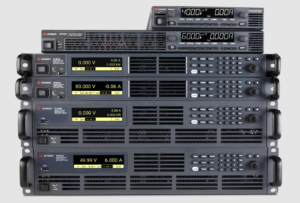
Keysight Technologies has expanded its high-power automated test equipment (ATE) portfolio with additional voltage and current options for testing electric vehicle (EV) batteries, charging systems and power conversion equipment. The expansion … [Read more...]
Compact HD thermal camera enables detailed EV battery analysis
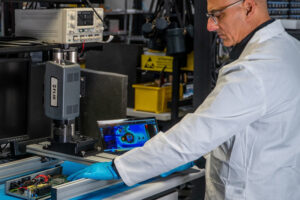
Teledyne FLIR has introduced the A8481, a compact high-definition mid-wave infrared (MWIR) science camera suitable for thermal research and testing of electric vehicle (EV) batteries. The camera enables researchers to analyze temperature distribution … [Read more...]
How does impedance spectroscopy detect early EV battery degradation?
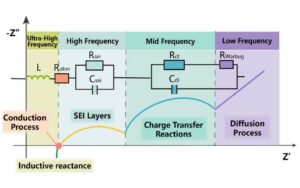
A battery management system (BMS) normally judges cell health from terminal voltage, current, and temperature. From these readings, capacity fade is usually estimated with a model rather than any actual measurement. However, impedance spectroscopy … [Read more...]
New battery monitoring IC integrates EIS diagnostics for EVs
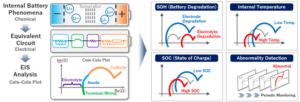
Nuvoton Technology Corporation Japan has introduced the KA85010UA, a sixth-generation battery monitoring IC that integrates electrochemical impedance spectroscopy (EIS) for electric vehicle (EV) battery diagnostics. The IC monitors up to 26 battery … [Read more...]
Mercedes-Benz to test ProLogium Gen4 solid-state cells for future EVs

Mercedes-Benz and ProLogium have signed a joint testing agreement covering ProLogium’s latest Gen4 solid-state battery cells, with the automaker evaluating the technology for potential use in future electric vehicles (EVs). Testing will include … [Read more...]
X-ray CT system expands non-destructive inspection for EV components
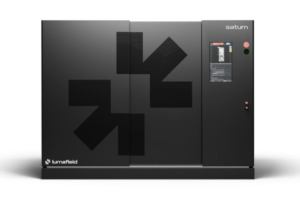
Lumafield has introduced Saturn, a large-format industrial X-ray computed tomography (CT) scanner designed to inspect dense components and complex assemblies without destructive testing. The system is intended for applications including large … [Read more...]
Part II: What CT can reveal about EV component design

X-ray computed tomography (CT) can reveal the internal structure of electric vehicle (EV) components without requiring disassembly. The technology gives engineers a way to examine how a component is built while preserving the relationships between … [Read more...]
Part I: How x-ray CT can improve EV component inspection and validation
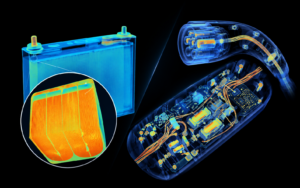
X-ray computed tomography (CT) gives engineers a way to inspect the inside of an electric vehicle (EV) component without taking it apart. The technology creates a three-dimensional view of an assembled part so internal features can be examined while … [Read more...]
Where force and torque measurement matters in vehicle validation

Simulation gives automotive engineers a way to evaluate vehicle designs before physical prototypes are built. The value of those models depends on how closely they match what happens in the real world. Live testing provides the measured data … [Read more...]
Split-core current sensors simplify in-vehicle EV testing
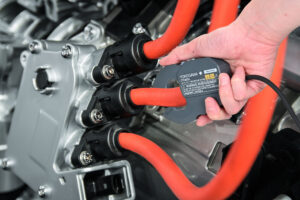
Yokogawa Test & Measurement has introduced the CT500SA and CT200SA ac/dc split-core current sensors for high-accuracy current measurement in space-constrained applications, including in-vehicle EV testing. The sensors cover 500 and 200 A ranges … [Read more...]
DEKRA gains GM approval for EMC testing
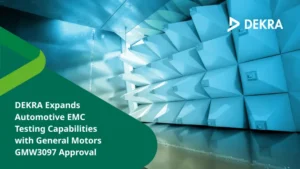
DEKRA’s Automotive Test Center of Excellence in Plymouth, Michigan, has received approval to perform testing to General Motors’ (GM) GMW3097 electromagnetic compatibility specification. The approval expands DEKRA’s OEM-recognized testing … [Read more...]
High-current switches simplify automated EV validation

Pickering Interfaces has introduced the 60-191 LXI high-current and sense switching family for automated electric vehicle (EV) battery and automotive electronics testing. The switches can handle signals up to 80 A and 300 V, allowing engineers to … [Read more...]
Particle analyzer for EV battery materials research and quality control

HORIBA has launched Partica, a laser diffraction and dynamic image analysis particle size and shape analyzer designed to support research, development and quality control for advanced battery materials, including those used in electric vehicles … [Read more...]
How do engineers correlate dynamometer testing with real-world EV range?
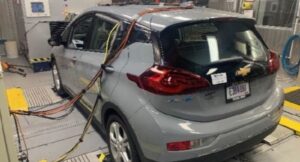
When testing electric vehicles (EVs) for range in laboratories using a dynamometer, engineers often do not see the same EV's range on the road. So the first step is isolating each of the variables and studying how they impact EV range … [Read more...]
Why testing future EV batteries often begins with coin cells
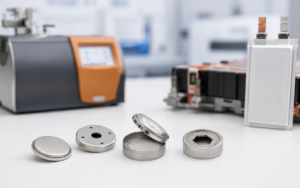
When most people think about electric vehicle (EV) battery development, they picture large battery packs, cooling systems, and high-voltage cells destined for production vehicles. In reality, many EV battery technologies begin life in a laboratory … [Read more...]
New 18-A current transducer for battery test equipment

Danisense has introduced the DP12IP current transducer for isolated dc and ac current measurement in PCB-mounted power electronics systems. For electric vehicle (EV) battery development, the device is suited to battery test benches and battery … [Read more...]